-
by sayum
24 August 2026 3:22 PM







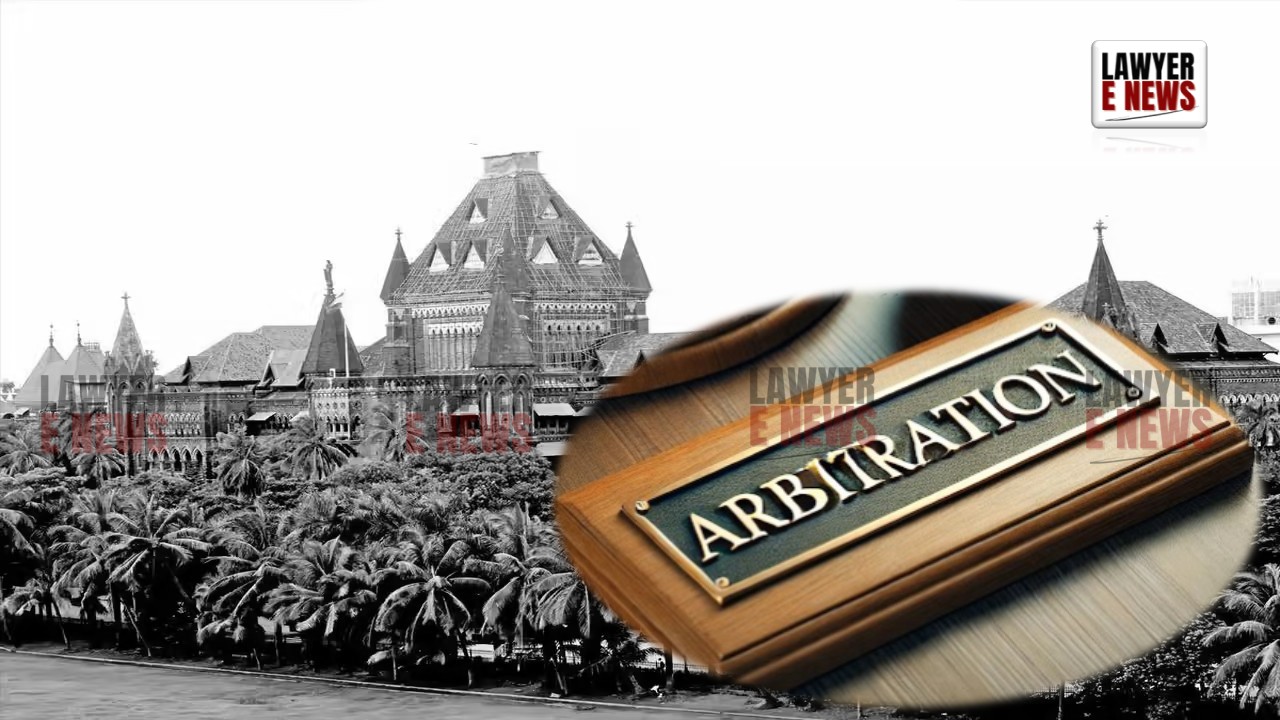
“Party Autonomy Means Freedom to Arbitrate — and Freedom Not to Arbitrate Certain Claims” — In a significant ruling interpreting the scope of arbitration agreements and party autonomy, the Bombay High Court held that courts have no jurisdiction under Section 11 of the Arbitration and Conciliation Act, 1996 to appoint an arbitrator when the very arbitration clause excludes arbitrability of claims exceeding a specified threshold.
Commercial arbitration application under Section 11(6) of the Arbitration Act was dismissed by Justice Sandeep V. Marne, after the Court found that the contract between the parties only allowed arbitration for claims up to 20% of the contract value, and explicitly excluded arbitration for any higher-value claims.
“There Is No Arbitration Agreement for Rs.3 Crore Claim When Contractual Arbitration Cap Is Rs.16.9 Lakhs”
The case revolved around a dispute arising out of a contract dated 7 May 2018, under which the applicant, M/s. Sowil Limited, was awarded work by the Central Railways for a contract value of ₹84.52 lakhs. After termination of the contract, the applicant sought arbitration for an estimated claim of ₹3 crores, nearly 400% of the contract value.
However, Clause 39 of the contract specifically provided: “The provisions of Clauses 63 and 64 of the GCC will be applicable only for settlement of claims or disputes between the parties for values less than or equal to 20% of the value of the contract... arbitration will not be a remedy for settlement of such disputes [exceeding that limit].”
Justice Marne held:
“The parties have expressly agreed that only claims up to 20% of the contract value would be adjudicated through arbitration. The applicant’s claim being 400% of the contract value, there exists no arbitration agreement in respect of the claim sought to be referred.”
“Party Autonomy Does Not Mean Every Dispute Must Be Arbitrated”
Rejecting the applicant’s argument that the restrictive clause was arbitrary and violative of Article 14, the Court ruled: “Party autonomy is the foundation of arbitration. If parties agree to resolve only a subset of disputes through arbitration, courts cannot compel them to arbitrate beyond what is agreed.”
The Court clarified that arbitration is a contractual remedy, not a constitutional right:
“If there was no arbitration clause at all, could the applicant have insisted on arbitration? The answer is obviously no. The same logic applies when the clause restricts arbitrability to claims of a certain value.”
The judgment noted that Section 7 of the Arbitration Act requires a valid arbitration agreement, and the jurisdiction of the Court under Section 11 is limited to enforcing that agreement, not expanding it.
“No Violation of Article 14 — Clause Applies Equally to Both Parties”
The applicant argued that the clause was discriminatory as it limited the contractor’s right to arbitrate but not the Railways’. The Court found this contention “misplaced and speculative”, observing:
“Clause 39 applies to disputes ‘between the parties’ — not just the contractor. Whether Railways will raise counterclaims exceeding 20% is speculative. At Section 11 stage, the Court only looks at the applicant’s claim.”
Justice Marne further held: “The clause does not bar legal remedies — it merely directs higher-value claims to the civil court. There is no embargo on the contractor’s right to sue.”
“No Arbitrator Can Be Appointed Where Arbitration Agreement Does Not Cover the Dispute”
The applicant urged the Court to appoint an arbitrator and leave the issue of arbitrability to the tribunal under Section 16 (Kompetenz-Kompetenz doctrine). The Court flatly rejected this:
“Section 16 assumes an existing arbitration agreement. Where the agreement itself excludes certain disputes, the Court under Section 11 must decide jurisdiction. This is not a question the arbitrator can rule upon.”
The Court cited its own earlier ruling in Railtech Infraventure Pvt. Ltd. v. Union of India, which had upheld the same 20% ceiling for arbitrability under similar clauses.
“Clause Not Arbitrary Like Pre-Deposit Clauses in ICOMM Tele Case”
The applicant relied heavily on the Supreme Court’s landmark ruling in ICOMM Tele Ltd. v. Punjab State Water Supply Board, where a clause requiring 10% pre-deposit was held arbitrary and unconstitutional under Article 14.
Justice Marne, however, distinguished ICOMM, observing:
“In ICOMM, a claimant was barred from arbitration unless it deposited 10% of claim value — with risk of forfeiture. In contrast, here the contractor is not barred from enforcing claims exceeding 20%; he is only required to go to civil court.”
“Unlike ICOMM, this clause does not deter, penalize, or restrict legal enforcement — it only limits the forum of adjudication.”
“Courts Cannot Rewrite Arbitration Agreements”
Rejecting arguments based on Shin Satellite Public Co. Ltd. v. Jain Studios Ltd., where the Supreme Court upheld severability of contractual clauses, the Court said:
“Doctrine of severability applies only where part of the agreement is invalid. Here, the 20% cap is neither invalid nor unconstitutional. Hence, there is no question of severance.”
“Contractual Limitations on Arbitration Are Valid — Precedents Affirm This”
The Court relied on multiple precedents — Deepak Kumar Bansal (SC), Seth Mohanlal Hiralal Construction (MP HC), Railtech Infraventure (Bom HC), and State of A.P. v. Obulu Reddy (SC) — all of which recognised the validity of arbitration clauses restricting claims by monetary threshold.
In Deepak Kumar Bansal, the Supreme Court did not invalidate the 20% ceiling; instead, it held that additional work orders must be counted to determine total contract value — a factual point not applicable in the present case.
“Railways Cannot Be Forced to Arbitrate Where It Has Not Agreed To”
In a resounding affirmation of contractual freedom, Justice Marne concluded:“When the parties have agreed to arbitrate only claims up to a defined value, the Court cannot compel arbitration of higher-value disputes. Such intervention would overstep judicial jurisdiction under Section 11.”
The Court also clarified: “Encouraging arbitration does not mean enforcing it beyond its agreed limits. Courts must respect contractual boundaries — party autonomy includes freedom not to arbitrate certain disputes.”
Accordingly, the Section 11 application was dismissed, with the Court holding that no arbitration agreement existed in respect of the ₹3 crore claim, and therefore no arbitrator could be appointed.
Date of Decision: 28 January 2026