-
by sayum
27 August 2026 3:32 PM







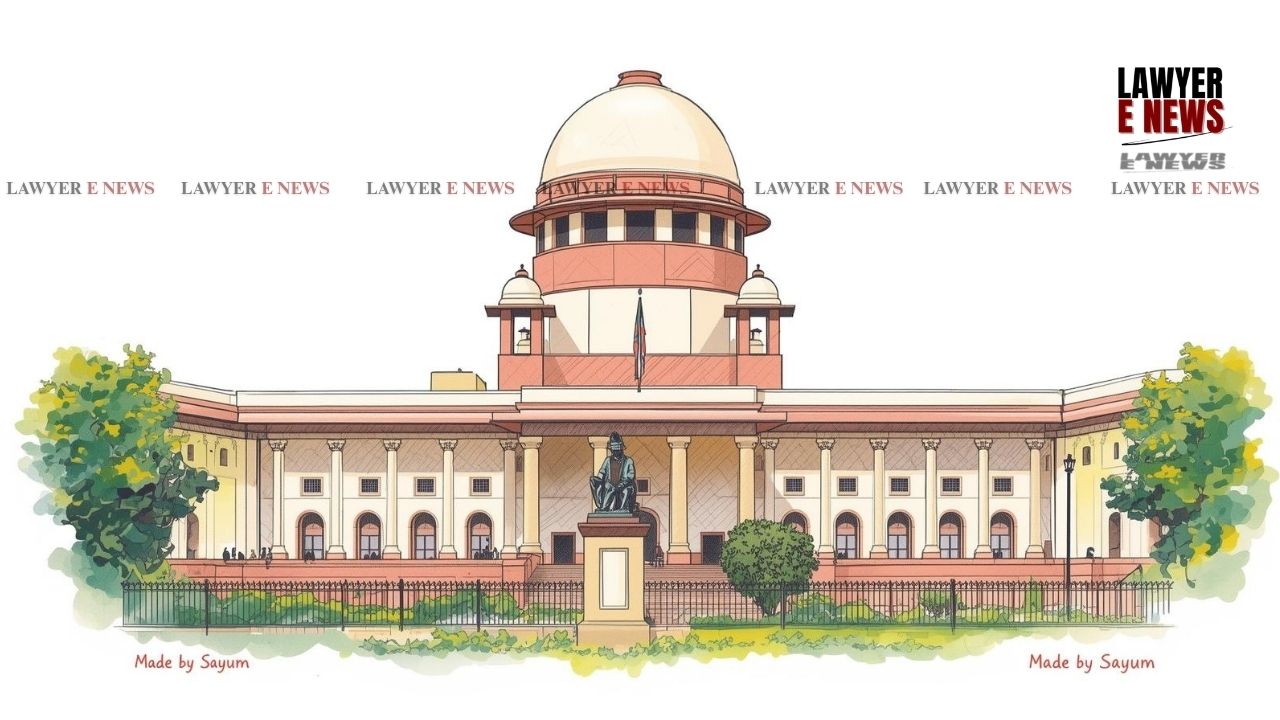
“Justice Must Not Only Be Done, But Must Also Appear To Be Done”, In a scathing judgment Supreme Court of India set aside the minutes of the fourth Search-cum-Selection Committee (SCSC) that had rejected the petitioner’s candidature for the post of Member (Accountant) of the Income Tax Appellate Tribunal (ITAT), citing institutional bias, mala fide departmental action, and gross violation of natural justice.
Invoking its extraordinary jurisdiction under Article 32 of the Constitution, the Bench of Justice Vikram Nath and Justice Sandeep Mehta declared the selection process to be “vitiated” owing to the participation of a senior officer — referred to throughout the proceedings as “the Officer” — who had previously been arraigned in contempt proceedings initiated by the petitioner.
The Court directed the Department of Personnel and Training (DoPT) to reconvene the SCSC within four weeks, excluding the said officer, and further imposed ₹5 lakh in costs on the Union of India for “deliberate procrastination and harassment” of the petitioner.
“The conduct of respondents bordered on vendetta”: Supreme Court condemns departmental obstruction
Delivering the opening lines of the judgment, Justice Sandeep Mehta observed:
“The present case discloses a sordid tale of targeted departmental vendetta, full of mala fide actions and protracted persecution...”
The petitioner, a decorated ex-Army officer who transitioned into the Indian Revenue Service (IRS) after sustaining a disability in Army operations, was ranked All India Rank One by the first SCSC in 2014. However, for over a decade, his appointment was systematically obstructed through adverse Intelligence Bureau inputs allegedly stemming from matrimonial disputes, repeated vigilance inquiries, arbitrary disciplinary proceedings, and a controversial compulsory retirement under FR 56(j) — all of which were eventually quashed by judicial orders.
Despite being twice recommended by prior SCSCs and backed by Tribunal, High Court, and Supreme Court orders, the appointment process was never concluded. Instead, the petitioner was subjected to departmental inquiries, withheld vigilance clearance, and finally prematurely retired just months before his superannuation.
In its judgment, the Court drew extensively from its earlier ruling in Civil Appeal No. 6161 of 2022 (dated March 3, 2023), where it had already quashed the petitioner’s compulsory retirement as “punitive in nature” and held it was undertaken “to short-circuit the disciplinary proceedings and ensure his immediate removal.”
“Actual proof not required – reasonable apprehension suffices”
The central issue in the present writ petition was the composition of the fourth SCSC, convened on September 1, 2024, where the petitioner appeared again. To his shock, the panel included “the Officer” who had previously been summoned in Contempt Petition (C) No. 210 of 2024, initiated by the petitioner himself for wilful disobedience of earlier judicial directions.
Despite an earlier apology tendered by the Officer in contempt proceedings, his inclusion in the evaluation committee led the petitioner to assert a reasonable apprehension of bias, thereby challenging the integrity of the selection process.
The Court ruled unequivocally:
“Though there may not be a case of actual bias... where the circumstances are such so as to create a reasonable apprehension... the same is sufficient to invoke the doctrine of bias.”
Quoting State of Gujarat v. R.A. Mehta (2013) 3 SCC 1, the Court reaffirmed:
“Justice must not only be done, but must appear to be done... even the presence of one member with a likelihood of bias vitiates the entire proceedings.”
It held that the Officer’s continued participation despite prior involvement in contempt proceedings not only raised a genuine perception of bias, but also violated the principles of natural justice, rendering the selection process coram non judice.
High-Handedness and Mala Fides: A Consistent Pattern
In sharp language, the Court condemned the persistent pattern of obstruction and procedural misconduct:
“At every stage of proceedings, the respondents have deliberately created hurdles... by either putting up cooked-up charges or failing to ensure compliance.”
The respondents’ failure to file a counter affidavit despite repeated opportunities further convinced the Bench of their “rank procrastination” and “intentional derailment” of the petitioner’s candidature.
The Court highlighted how the inclusion of the Officer, who had earlier been implicated for contempt, should have resulted in recusal, and his failure to do so “fortifies the aspersion of bias.”
Fresh SCSC Directed – ₹5 Lakh Cost Imposed on Government
Setting aside the minutes of the fourth SCSC dated September 1, 2024, insofar as they relate to the petitioner, the Supreme Court issued a binding direction:
“Respondent No.1 – DoPT shall ensure that a fresh meeting of the SCSC is convened within four weeks from today to consider the candidature of the petitioner... ensuring exclusion of ‘the Officer’ from the said proceedings.”
Further, noting the persistent and wilful attempts to frustrate lawful compliance, the Court imposed ₹5 lakh in costs on the respondents:
“In view of the rank procrastination... and deliberate obstacles created... bordering on vendetta... we impose cost quantified at ₹5 lakhs on the respondents.”
This ruling reinforces the foundational principle that justice must be visibly fair, and any semblance of bias — even in appearance — is enough to annul a selection process, especially in public appointments involving adjudicatory roles.
By reiterating that “even a single tainted member compromises the fairness of collective decisions”, the Supreme Court has not only protected the petitioner’s individual rights but also set a decisive precedent safeguarding the transparency of quasi-judicial appointments.
Date of Decision: January 30, 2026