Motor Accident Claim Maintainable Despite Compensation Under Workmen’s Compensation Act – Insurer Liable Despite Fake Licence Allegation: Gujarat High Court Review Is Not a Second Round of Litigation: Orissa High Court Dismisses Plea Seeking Reconsideration of Dropped Contempt in MCL Appointment Case Fresh Ex Parte Relief Cannot Bypass Order 39 Rule 3 – Restoration of Electricity Refused for Tenant Running Cold Storage: Punjab & Haryana High Court Section 498A IPC | Telling Her To Indulge In Prostitution For Dowry Is Most Obnoxious Form Of Harassment: Jharkhand High Court Search Can’t Stretch Time: Gujarat High Court Quashes Income Tax Reopening Beyond 10-Year Limit in Search-Based Reassessment 138 NI Act | Mere Claim of ‘Security Cheque’ No Defence Against Statutory Presumption : Calcutta High Court Rigour of Section 37 NDPS Act Cannot Be Diluted by Bail Pleas Citing Delay or Procedural Defects: Punjab & Haryana High Court Denies Bail in Heroin Recovery Case If Arbitration Clause Itself Bars Larger Claims, Court Cannot Appoint Arbitrator: Bombay High Court Dismisses Section 11 Application Once Arbitration Clause Exists and Proceedings Are Ongoing, Civil Court Must Step Back: Andhra Pradesh High Court Dismisses Suit for Injunction in Partnership Dispute Autonomy of Private Schools Can't Be Crushed in the Name of Fee Regulation: J&K High Court Strikes Down FFRC Chairperson Clause, Upholds Fee Control Law with Caveats Demand and Acceptance of Bribe Must Be Proved as a Fact – Mere Possession of Money Not Enough: Kerala High Court Recovery Alone Can't Prove Bribery Where Legal Fee Is Established Through Official Records: Punjab & Haryana High Court Acquits Patwari Exoneration on Technical Grounds Can’t Quash Criminal Prosecution for Tax Evasion: Kerala High Court Denies Relief to Doctor Accused of Concealment Answer To A Leading Question Cannot Be Sole Basis For Conviction In Serious Offences Like Rape: Bombay High Court NDPS | Mere Absence of Contraband No Ground for Bail When Recovery from Co-Accused Points to Coordinated Drug Network: Punjab & Haryana High Court Allahabad High Court Quashes Ceiling Surplus Land Order Passed Without Spot Inspection, Ignores Rights Acquired Through Adverse Possession Civil Death Cannot Be the Price of Past Mistakes: Orissa High Court Strikes Down Blanket Tender Ban on Previously Blacklisted Bidders Once Supreme Court Cancels Bail for Violation, Subordinate Courts Cannot Reconsider: Karnataka High Court Non-joinder Is a Curable Defect, Not a Death Blow to Appeal: Madhya Pradesh High Court Restores Mutation Appeal Stale Allegations and Closed FIRs Cannot Justify Preventive Detention: J&K High Court Quashes PSA Detention Order for Lack of Proximate Link Employment-Related Separation Cannot Be Labelled as Desertion: Jharkhand High Court Dismisses Husband’s Divorce Appeal “Fair Pre-Estimate” of Damages Valid Even Without Proof of Loss: Delhi High Court Partly Sets Aside Arbitral Award in Carlsberg Dispute Or 39 CPC | Unregistered Will With Single Attesting Witness Cannot Confer Absolute Title: Delhi High Court Grants Injunction Failure To Comply With Mandatory Rent Deposit Directions Under WBPTA Will Invite Striking Off of Tenant’s Defence, Even For Single Default: Calcutta High Court Insistence on Impossible Term Reflects Absence of Readiness: Bombay High Court Denies Specific Performance for Delay and Inflexibility Medical Negligence | Stem Cell Therapy for Autism Is Not Valid Medical Practice: Supreme Court Declares Commercial Use as Medical Negligence Stem Cells Are ‘Drugs’ Under Law, Not Medical Procedures”: Supreme Court Brings Stem Cell Therapy Back Under Drugs Act NGT Can Impose Compensation Without Statutory Formula, Guided By Polluter Pays Principle: Supreme Court Upholds Environmental Penalties On Builders Environmental Compensation Must Not Be Illusory: Supreme Court Upholds NGT’s ₹5 Crore Penalty On Builder For Violating Environmental Laws Section 34 Court Has Limited Power to Modify Arbitral Award — But It Exists: Supreme Court Endorses Judicial Calibration of Damages in Arbitration Delay in Public Utility Projects Is Per Se a Loss: Supreme Court Upholds ₹27 Crore Damages Against Solar Developer Article 21 | Menstrual Health is an Integral Facet of Right to Life & Dignity: Supreme Court RTE Act | Free Sanitary Pads, Vending Machines & Separate Toilets Mandatory for All Schools: Supreme Court Issues Continuing Mandamus No Waiver of Fundamental Rights by Signing a Job Contract: Supreme Court Declares Contractual Clauses Barring Regularization Unenforceable When the State is the Lion, the Employee Cannot Be the Lamb Forever: Supreme Court Slams Jharkhand for Exploiting Contractual Engineers for a Decade Bail Once Granted Should Not Be Cancelled Lightly: Supreme Court Refuses to Revoke Bail of Accused in Daylight Murder Case A Decade of Targeted Persecution Cannot Be Cloaked as Procedure: Supreme Court Slams Department for Systematic Denial of ITAT Appointment Even Presence Of A Single Biased Member Vitiates  Selection Process: Supreme Court Nullifies ITAT Appointment Panel Over Bias Concerns Court Can Prevent Institutional Vacuum Despite Invalid Appointment: Supreme Court Invokes Article 142 to Protect Tenure of Vice-Chancellor in Exceptional Circumstances State Cannot Override Higher Education Standards Set by Parliament: Supreme Court Declares Puducherry VC Appointment Illegal, Upholds Primacy of UGC Regulations

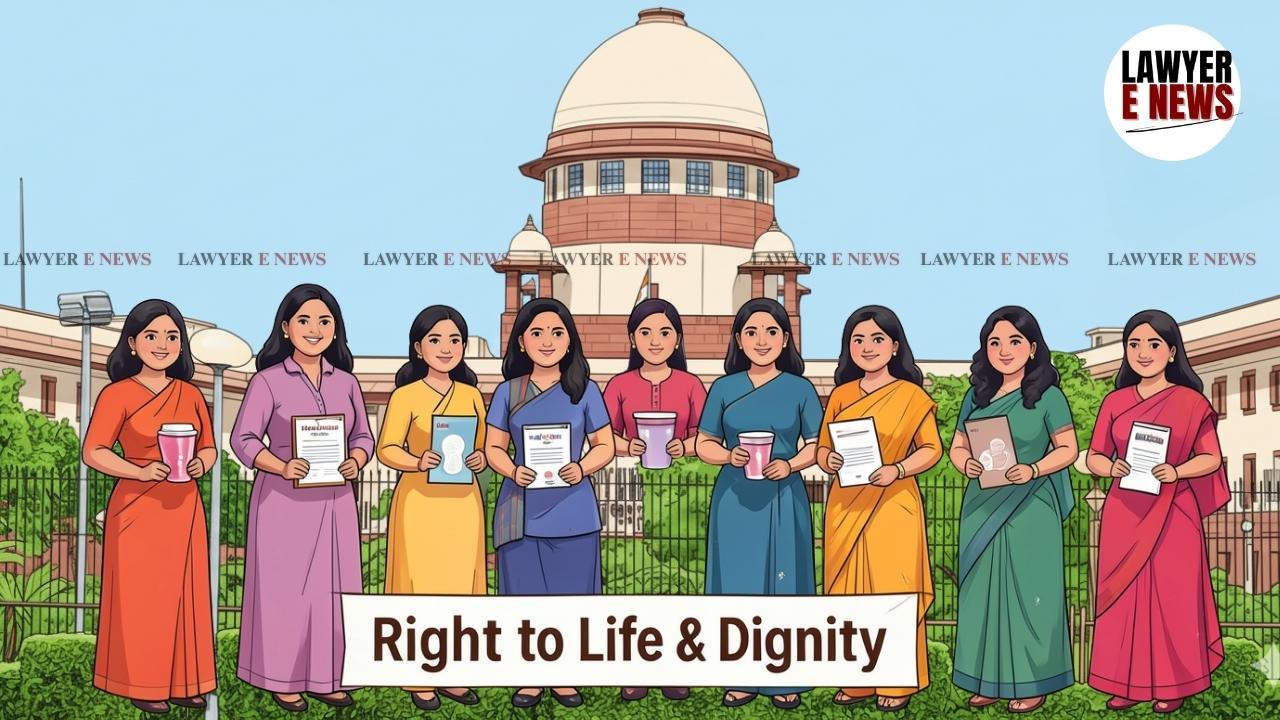
Article 21 | Menstrual Health is an Integral Facet of Right to Life & Dignity: Supreme Court

31 January 2026 2:04 PM

By: sayum


“A period should end a sentence – not a girl’s education.”— In a seminal ruling, the Supreme Court of India, comprising Justice J.B. Pardiwala and Justice R. Mahadevan, has declared that the right to menstrual hygiene is intrinsic to the Right to Life under Article 21 and the Right to Education under Article 21A, holding that the State’s failure to provide menstrual hygiene management (MHM) measures amounts to a violation of substantive equality.

Substantive Equality Over Formal Equality

In Dr. Jaya Thakur v. Government of India & Ors., the Court moved beyond the traditional concept of formal equality. The Bench observed that treating unequal individuals equally perpetuates injustice. To place a menstruating girl child on an equal footing with her male counterparts, the State must adopt affirmative measures. The Court held that the lack of MHM measures—such as sanitary pads and functional toilets—creates a structural barrier that disproportionately affects female students, converting a biological reality into a source of exclusion.

“In order to place a menstruating girl child on an equal footing with others, mere equal treatment would not suffice.”

Dignity, Privacy, and Autonomy

Drawing heavily from the landmark Puttaswamy (Privacy) judgment, the Court ruled that dignity is not an abstract ideal but must find expression in reality. The Bench articulated that forcing a girl to manage menstruation without privacy, water, or absorbents subjects her to humiliation and violates her decisional autonomy. The judgment establishes that menstrual health is a component of the "Right to Health" under Article 21, and the State has a positive obligation to ensure access to safe and affordable MHM products.

The Intersection of Gender and Disability

The judgment paid special attention to intersectionality, noting that a girl child with disabilities faces a "coalesced vulnerability." The Court emphasized that "barrier-free access" under the Rights of Persons with Disabilities Act is not limited to ramps but extends to accessible toilets and menstrual support. The denial of these facilities to a disabled girl child was termed a violation of her freedom and dignity.


“The lack of access to MHM measures acts as a significant barrier to girls’ participation in school.”

Education as a Multiplier Right

The Court termed education a "multiplier right" that enables the realization of all other human rights. It observed that absenteeism caused by "period poverty" or lack of toilets leads to dropouts, which in turn forecloses future economic and social opportunities for women. The Bench concluded that the constitutional promise of Article 21A (Right to Education) is rendered meaningless if the State fails to provide the basic enabling conditions for a girl to attend school with dignity.

Date of Decision: 30th January, 2026

Latest Legal News