-
by sayum
24 August 2026 3:22 PM








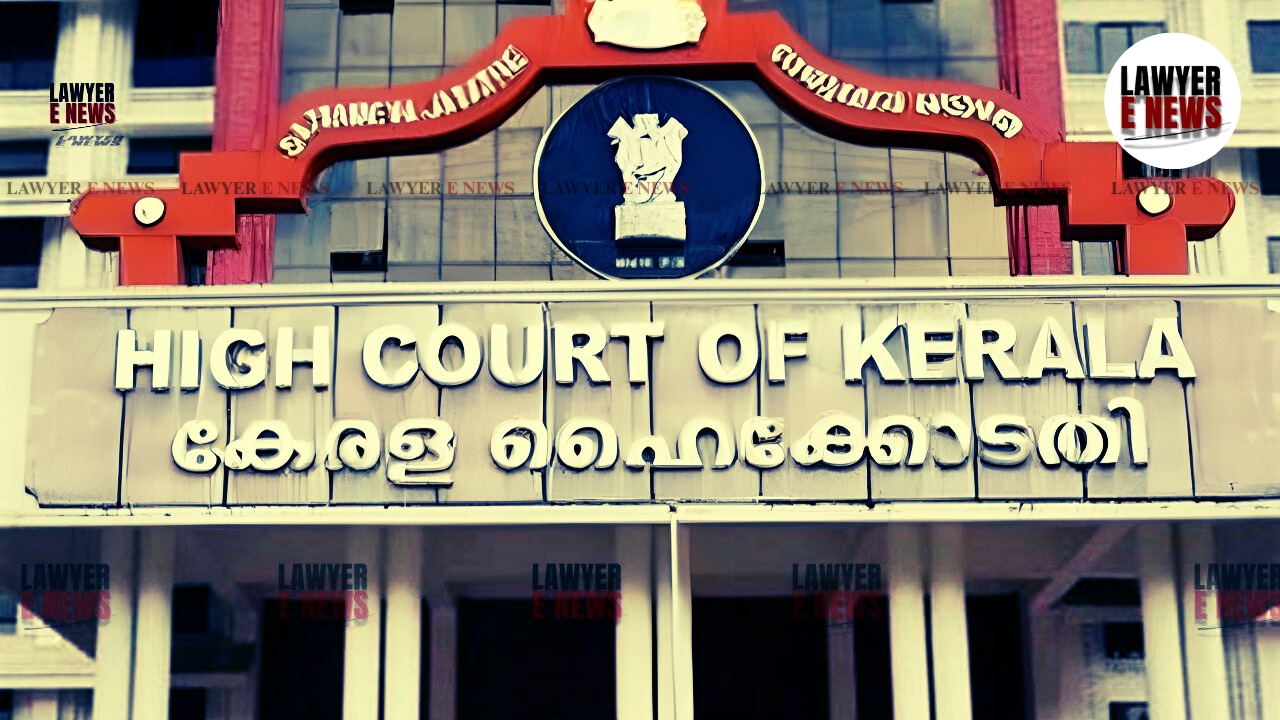
“Once the court finds a witness to be of sterling quality, their version alone can sustain a conviction”, In a significant decision Kerala High Court affirmed the conviction of the appellant under Section 302 IPC for the murder of one Vasu, resting its reasoning squarely on the ocular testimony of the deceased's daughter, which it held to be of “sterling witness” quality. The Division Bench comprising Dr. Justice A.K. Jayasankaran Nambiar and Justice Jobin Sebastian dismissed Criminal Appeal, upholding the trial court’s verdict in Sessions Case No. 451/2011 from the Additional Sessions Judge-II, Thalassery.
Calling the testimony of PW2, Bincy, the daughter of the deceased, “credible, consistent and unimpeachable,” the Court held that corroboration was not a legal necessity when such ocular evidence is found to be wholly reliable. The Bench further held that the dying declaration of the deceased, along with statements admissible under Section 6 of the Indian Evidence Act (res gestae), added further evidentiary value, and scientific discrepancies concerning blood group did not affect the core of the prosecution’s case.
Dying Declaration and Spontaneous Statements Enhance Ocular Testimony
“The deceased told his daughter it was the accused who attacked him—this is admissible as a dying declaration”: High Court
The Court noted that PW2 had witnessed her father being hacked with a billhook by the appellant and had rushed to cradle his injured body, during which he made a clear dying declaration identifying the attacker. The Court observed:
“The said statement coupled with other contemporaneous utterances—such as the accused shouting he had ‘finished her father’—qualify under Section 32 as a dying declaration and under Section 6 as res gestae.”
These statements, made immediately before and after the fatal attack, were seen by the Court as integral to the transaction of murder and hence admissible, rejecting the defence's argument that they were hearsay or fabricated.
Eyewitness Identified as ‘Sterling Witness’: Conviction Can Rest Solely on Her Testimony
“When a witness withstands cross-examination and her version matches medical and material evidence, her word alone is sufficient for conviction.”
The Bench extensively cited the Supreme Court’s dictum in Rai Sandeep v. State (NCT of Delhi), (2012) 8 SCC 21, to assess the quality of PW2’s evidence:
“The witness should be in a position to withstand cross-examination of any length...and under no circumstance should give room for any doubt...Such a witness can be called a ‘sterling witness’ whose version can be accepted by the court without any corroboration.”
Finding PW2’s testimony consistent from beginning to end, corroborated by medical evidence, postmortem findings, and the testimony of other prosecution witnesses (PW3 Anitha, PW6 Ratheeshan), the Court held that the trial court rightly relied on her evidence to convict.
Scientific Evidence Discrepancy on Blood Group Not Fatal
“Blood group mismatch due to bacterial contamination is scientifically explained—ocular evidence prevails”
The appellant attempted to cast doubt by pointing to a discrepancy in the blood group of the deceased: While postmortem records (Ext. P10) recorded the group as O+ve, the chemical examiner’s report (Ext. P24) mentioned B group blood on the deceased’s clothing.
However, the High Court accepted the forensic explanation given by PW16, Dr. S. Gopalakrishna Pillai, who clarified that blood samples not dried properly before packaging could undergo bacterial contamination, producing false antigenic results. Supporting this, the doctor relied on authoritative forensic texts, including Guharaj & Chandran’s Forensic Medicine and Methods of Forensic Science by Frank Lundquist.
The Court observed: “This being a case where conviction is based primarily on direct eyewitness testimony and corroborative medical evidence, the minor discrepancy in blood group is not fatal to the prosecution’s case.”
Private Defence Plea Rejected: No Injuries on Accused, No Aggression by Deceased
“Right of private defence cannot be claimed where no imminent threat is proved and no injuries are sustained by the accused”
The appellant argued that he acted in private defence, asserting that the deceased was the aggressor in a property dispute. However, the Court decisively rejected this plea:
“There is absolutely no evidence to suggest that the deceased was the aggressor. No injuries were found on the accused. No medical certificate or wound certificate was produced. The property in question was an open garden—no urgent threat was shown to exist.”
Further, even as per the accused's own statement under Section 313 CrPC, his narrative of self-defence lacked corroboration and failed to meet the legal threshold under Section 96–100 IPC. The Court held:
“This was not a case where the accused was defending himself against any acts of aggression. His plea of self-defence is wholly unsubstantiated.”
Court Reaffirms Scope of Interference in Criminal Appeals
“Where the trial court’s findings are based on cogent evidence and law, appellate courts should not interfere”
Upholding the concurrent findings of the trial court, the High Court reiterated the settled principle that unless there is perversity, manifest illegality, or miscarriage of justice, an appellate court will not interfere with findings of fact, especially when supported by “credible and consistent” direct evidence.
“We see no reason to interfere with the well-considered judgment of the trial court...The appeal is devoid of any merit.”
Conviction Under Section 302 IPC Upheld, Appeal Dismissed
The Kerala High Court dismissed Criminal Appeal No. 553 of 2019, affirming the appellant’s conviction for murder under Section 302 IPC, along with the sentence of life imprisonment and a fine of ₹50,000, to be paid to PW2, the deceased's daughter, under Section 357(1)(b) CrPC. The set-off under Section 428 CrPC was also upheld.
This judgment fortifies the legal principle that a single, credible eyewitness, particularly when supported by dying declaration and medical evidence, can legally sustain a conviction for murder—even when minor scientific discrepancies exist or a plea of private defence is raised without evidentiary backing.
Date of Decision: 29 January 2026