-
by sayum
24 August 2026 3:22 PM








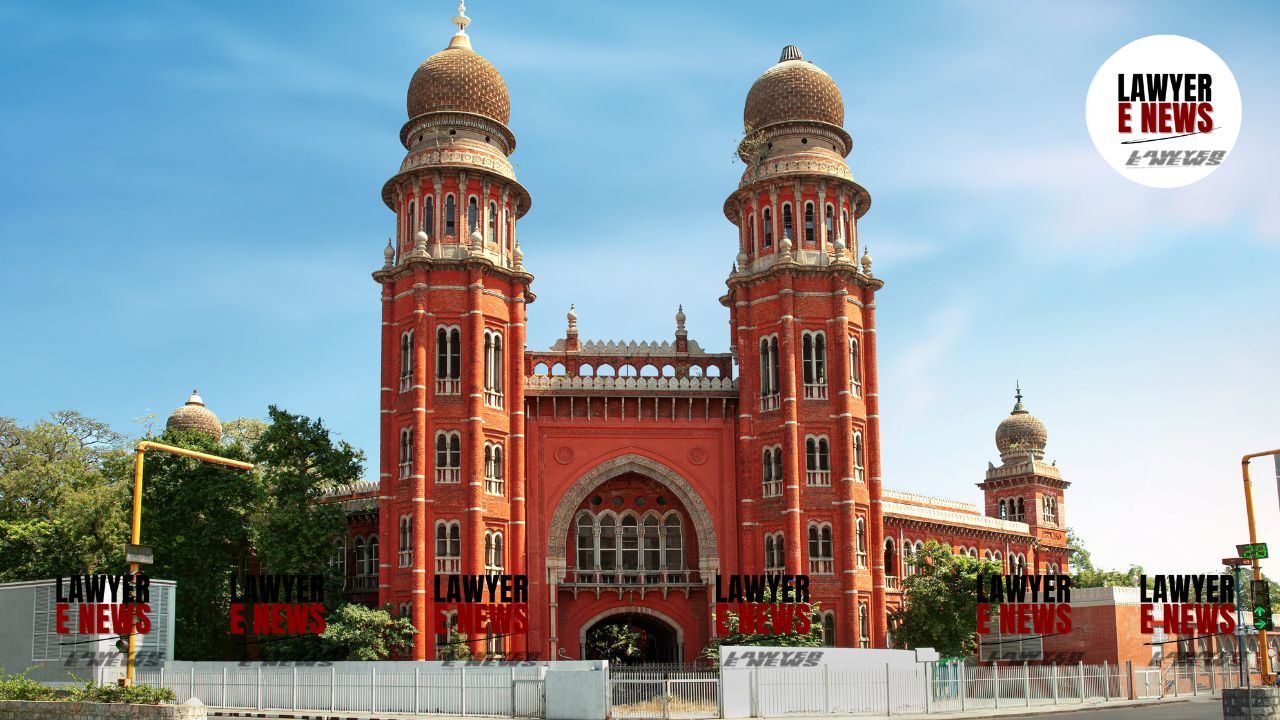
“Wetting the Fiber is Not Enough”, Madras High Court upheld the rejection of a divisional patent application for a fiber reinforced thermoplastic composition filed by Steer Engineering Private Limited, emphasizing that the claimed invention lacked inventive step and was obvious in light of existing prior art.
Dismissing CMA (PT) No. 54 of 2024, filed under Section 117A of the Patents Act, 1970, Justice N. Senthilkumar affirmed the findings of the Joint Controller of Patents and Designs, who had denied the patent on multiple legal grounds, including Section 2(1)(ja) (lack of inventive step), Section 59(1) (impermissible amendment), and Section 16(2) (impermissible divisional application).
“No Demonstrable Technical Advancement Over Prior Art”: Court Rejects Claim of Inventiveness Based on ‘Wetted Fiber’ Addition
The central subject of the divisional application involved a fiber reinforced thermoplastic composition combining unplasticised PVC (uPVC) and acrylonitrile-butadiene-styrene (ABS) polymers, with wetted continuous fibers to reduce fiber breakage and improve strength. The applicant contended that incorporation of wetted fibers and a specific extrusion process involving a twin-screw processor with “wave elements” constituted an inventive advancement.
However, the Controller found, and the Court affirmed, that each of the features—uPVC-ABS blends, extrusion, and wetting of fibers—were already disclosed in prior art documents D1–D7. The Court noted:
“The applicant has not provided any support or evidence regarding an improved effect achieved by the said feature compared to the prior arts... The amended claims do not meet the requirements under Section 2(1)(ja), 59(1), and 16(2) of the Patents Act.”
“Obviousness Analysis Was Sound, No Hindsight Bias Involved”: High Court Rejects Appellant’s Arguments Against Controller’s Methodology
The appellant argued that the Controller had used hindsight in reconstructing the claimed invention using prior art documents, violating the anti-hindsight principle affirmed in Dura-Line India Pvt. Ltd. v. Jain Irrigation Systems Ltd., 2025 SCC OnLine Del 3467. However, Justice Senthilkumar held that the Controller correctly applied the Windsurfing–Pozzoli test and the five-step test from Hoffmann-La Roche, ruling:
“The Controller applied correct test by comparing prior art, identifying differences and assessing obviousness without hindsight... Mere rearrangement or combination of known features is insufficient to constitute an inventive step.”
Amendments Cannot Be Used to Overcome Obviousness: Section 59(1) Invoked
A key ground raised by the appellant was that the claims had been validly narrowed through amendment by incorporating features such as “wetted fibers” as disclosed in the specification. Relying on Nippon A & L Inc. v. Controller of Patents, 2022 SCC OnLine Del 1909, it was argued that so long as the invention is comprehended within the disclosure, such amendments are valid.
Rejecting this, the Court held:
“Amendment cannot be used to overcome lack of inventive step when the core subject matter remains obvious... The amended claims are fully covered by the parent application which itself was not granted.”
Thus, the Court affirmed the Controller’s refusal under Section 59(1), emphasizing that the amendments merely restated known processes without adding any novel inventive concept.
Divisional Application Impermissible Without Distinct Invention: Section 16(2) Attracted
Another important ground on which the appeal failed was the rejection of the divisional application under Section 16(2). The Court held that the divisional application did not disclose any invention distinct from the parent, which had also been refused registration. The Madras High Court affirmed:
“Where no distinct invention emerges and the amended claims are completely overlapped by those of the parent application, divisional application becomes impermissible.”
The Controller had meticulously compared the parent and divisional claims and found no new inventive step in the latter. The High Court found this conclusion well-reasoned and free from legal infirmity.
Patent Law Demands More Than Aggregation: Composition Was Technically Predictable
While the appellant pointed to improved flexural strength and modulus through comparative data, the Court found that such results were not surprising or non-obvious. The combination of PVC and ABS with fiber reinforcement and wetting techniques would be expected to yield such improvements in light of prior art D1 through D7.
The Court reiterated that innovation must go beyond predictable outcomes, stating:
“The claimed invention does not display a technical advance or economic significance over prior art. The improvements shown are within the range that a skilled person would expect from known processes.”
Judicial Deference to Technical Expertise of Patent Office
Reinforcing the limited scope of judicial review under Section 117A, the Court concluded that the Patent Controller had exercised technical discretion with reasoned application of law, and the High Court would not substitute its view in such matters:
“The High Court will not interfere where the Controller has undertaken detailed comparison of claims and prior art and applied settled legal principles. The impugned order is free from legal infirmity.”
Accordingly, the Civil Miscellaneous Appeal was dismissed, with the Madras High Court upholding the refusal order dated 31.07.2024 passed by the Joint Controller of Patents and Designs, Patent Office, Chennai.
No costs were imposed.
Date of Decision: 05.01.2026