-
by sayum
24 August 2026 3:22 PM







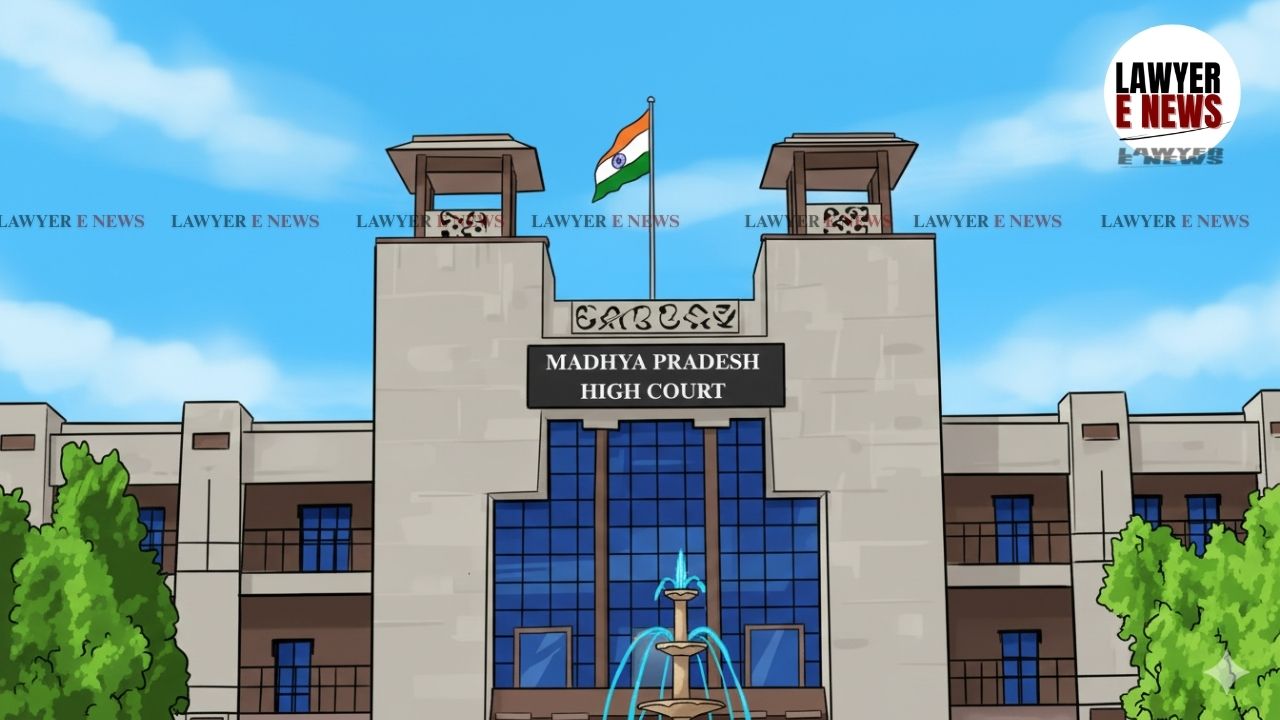
“Denying independent professional identity to a spouse is arbitrary – Sanction must show due application of mind to all material”, In a landmark judgment that reiterates the sacrosanct requirement of application of mind before sanctioning prosecution under the Prevention of Corruption Act, the Madhya Pradesh High Court quashed a prosecution sanction order issued against a senior Excise Department officer in a disproportionate assets case, holding that the sanctioning authority acted mechanically and in complete disregard of verified professional and agricultural income of the officer’s spouse.
Division Bench comprising Justice Vivek Kumar Singh and Justice Ajay Kumar Nirankari held that the impugned sanction dated 04.04.2025 was “vitiated due to non-application of mind” and “cannot withstand judicial scrutiny in view of the material facts that were either ignored or arbitrarily rejected.”
The Court observed:
“Sanction is not an idle formality or an acrimonious exercise but a solemn and sacrosanct act which affords protection to government servants against frivolous prosecutions… The validity of the sanction would depend upon the material placed before the sanctioning authority and the fact that all relevant facts, material and evidence have been considered.” [Para 16–17]
Ignoring Spouse’s Verified Income Was Unjustified – “Known Sources of Income” Includes Disclosed and Taxed Income
The petition was filed by Meenakshi Khare, an independent legal professional, and her husband, an Excise Officer against whom sanction for prosecution was granted on charges under Sections 13(1)(b), 13(2) of the PC Act and Section 120-B of the IPC, based on allegations that his assets were 88.20% disproportionate to his known income.
However, the High Court found that both the investigating agency and the sanctioning authority arbitrarily excluded the substantial legal and agricultural income of Petitioner No.1 (wife) despite such income being duly disclosed in income tax returns and verified during investigation.
The Bench categorically held:
“Income that has been formally intimated to the department under the applicable service rules and substantiated through statutory tax filings constitutes ‘known’ and legitimate income in the eyes of law.” [Para 18]
Citing the Supreme Court's decisions in Nirankar Nath Pandey v. State of U.P. and Robert Lalchungnunga Chongthu v. State of Bihar, the Court reinforced that income tax returns are conclusive proof of income unless shown to be fabricated.
“When a public servant is submitting his income tax returns, they should be presumed to be true and correct.” [Nirankar Nath Pandey, Para 9]
Agricultural Income Duly Verified But Arbitrarily Discarded – Discrepancy Below 10% Not Prosecutable
Notably, the petitioners produced detailed records of agricultural income, including mandi receipts, production data, and equipment seized during raids – all of which were verified by the authorities but still excluded from computation of total income.
The Court found that once this income was added, the discrepancy in assets fell well below 10%—a negligible margin that does not warrant criminal prosecution under settled legal principles.
“If the professional and subsequent agricultural income of petitioner No.1 is taken into account, the sanctioning authority ought not to have granted sanction and nipped the matter in the bud itself.” [Para 17]
Further, the Court relied on Bhajan Lal’s principles to hold that prosecution based on such flawed computation amounted to an abuse of process and deserved to be quashed at the threshold.
“Sanction Must Reflect Independent Satisfaction, Not Blind Endorsement” – Disagreement With Departmental Report Requires Reasoning
One of the most critical findings of the Court was that the Excise Commissioner had explicitly recommended against granting sanction, citing detailed calculations and verification of the spouse’s income. However, the sanctioning authority neither gave reasons for disagreeing with the departmental report nor disclosed the basis for its contrary view.
“Although the sanctioning authority purports to disagree with the detailed and reasoned recommendation of the Excise Commissioner, no reason whatsoever has been recorded for such disagreement.” [Para 6]
“The mind of the sanctioning authority should not be under pressure from any quarter… If it is shown that the sanctioning authority was unable to apply its independent mind, the order will be bad.” [Robert Lalchungnunga Chongthu, Para 19]
The Court was scathing in its finding that the sanction was issued in a mechanical fashion, treating Petitioner No.1 merely as the spouse of a government servant, thereby ignoring her independent professional standing.
Validity of Sanction Can Be Challenged at Pre-Trial Stage Under Article 226
The State and Lokayukt had opposed the petition on the ground that the validity of sanction could not be examined at the writ stage and ought to be raised during trial.
Rejecting this argument, the Court referred to authoritative Supreme Court precedents in Nanjappa v. State of Karnataka and State of Karnataka v. S. Subbegowda to affirm:
“The question regarding validity of such sanction can be raised at any stage of the proceedings… and more appropriately, it should be raised at an earlier stage of proceeding as has been done in the instant case.” [Paras 13–15]
Sanction and All Consequential Proceedings Quashed
Holding that the entire process leading to grant of sanction suffered from arbitrariness and non-consideration of material evidence, the Court allowed the writ petition and quashed the impugned sanction order dated 04.04.2025 as well as all proceedings arising therefrom.
“The impugned sanction order dated 04.04.2025 is set aside and the consequent proceedings emanating from the sanction order are quashed.” [Para 21]
The decision is likely to have far-reaching implications in disproportionate assets cases, especially in instances where investigating agencies mechanically discount income of spouses or misinterpret statutory disclosure obligations.
Date of Decision: 28 January 2026