-
by sayum
26 August 2026 4:44 AM







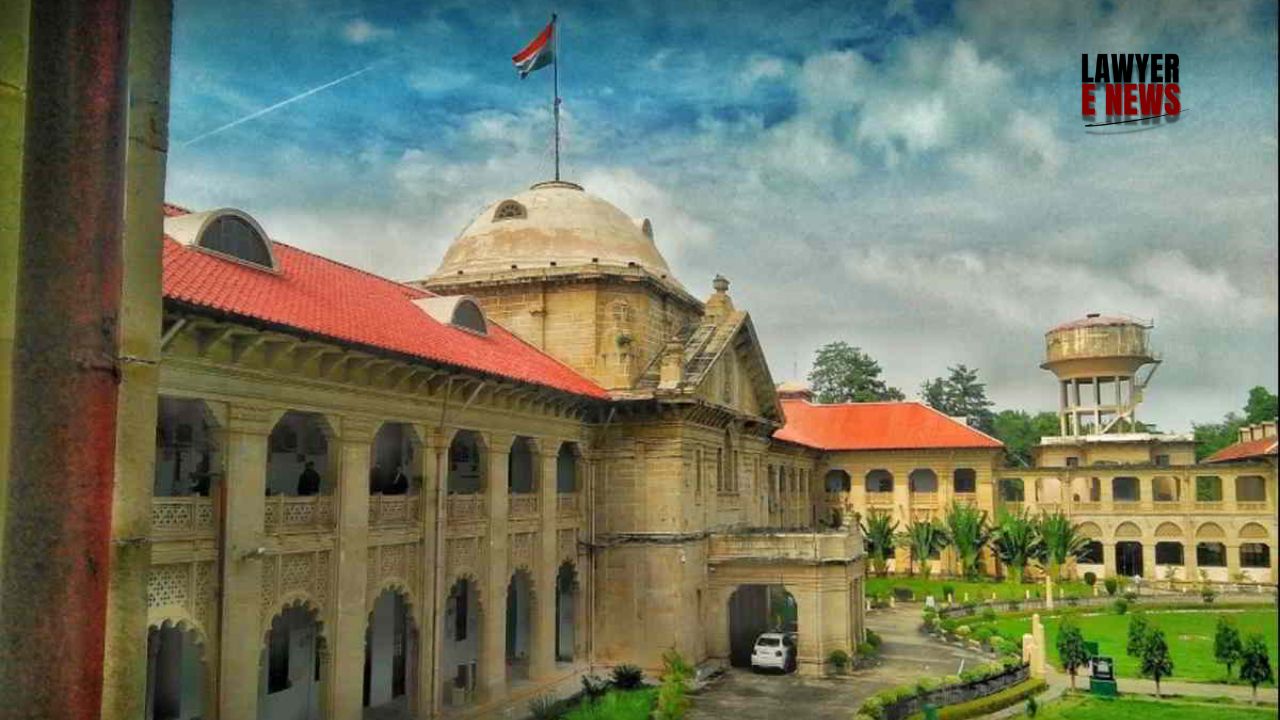
A Disguised Punishment Cannot Escape Judicial Scrutiny – In a significant ruling Allahabad High Court (Lucknow Bench) quashed the discharge of multiple judicial probationers, holding that the orders were punitive in nature and violated Article 14 of the Constitution. The Court ruled that an order labeled as “discharge simpliciter” but based on allegations of misconduct must be preceded by an inquiry.
Deciding a bunch of petitions led by Writ A No. 2001502 of 2014 – Sudhir Mishra v. State of U.P., a Full Bench comprising Justice Manish Mathur, Justice Jaspreet Singh, and Justice Subhash Vidyarthi observed, "A termination order, even if worded as a discharge simpliciter, cannot camouflage a punitive intent. If the foundation of discharge is misconduct, the principles of natural justice mandate a fair inquiry."
The Court struck down the discharge orders issued under Rule 24(4) of the U.P. Judicial Service Rules, 2001, ruling that the petitioners were entitled to due process before being removed from service.
"Drunken Altercation at Training Institute Becomes Basis for Mass Dismissal of Judges"
The case arose from an incident on September 7, 2014, when 15 judicial officers undergoing training at the Institute of Judicial Training and Research, Lucknow, went for a dinner at Charan Club and Resort on Faizabad Road. During the outing, an altercation broke out between two groups of probationers, allegedly involving consumption of alcohol.
The Registrar General of the High Court received telephonic information about the incident on September 8, 2014, following which an inquiry was ordered by the Chief Justice. The Senior Registrar (Judicial) submitted an inquiry report on September 12, 2014, confirming that a scuffle had taken place and that liquor had been consumed by the officers.
Based on this report, the Full Court of the Allahabad High Court, in its meeting on September 15, 2014, recommended the discharge of 11 probationary judges, including Sudhir Mishra, under Rule 24(4) of the Judicial Service Rules, 2001. A second inquiry on January 27, 2015, led to the discharge of four more probationers on June 15, 2015.
The petitioners challenged these orders, arguing that their termination was based on allegations of misconduct, which required a formal inquiry and an opportunity to be heard under Article 311(2) of the Constitution.
"If Termination is Based on Misconduct, It is Punitive – Courts Must Lift the Veil of ‘Discharge Simpliciter’"
The Allahabad High Court carefully examined whether the discharge orders were truly "simpliciter" or whether they were punitive in nature. Analyzing the Full Court's resolution, inquiry reports, and the service rules, the Court held:
"A termination order, even if framed as a discharge simpliciter, cannot evade judicial scrutiny if the real reason for removal is misconduct. Courts have a duty to lift the veil and examine whether the employer's action was in reality a punitive measure without due process."
Referring to Parshotam Lal Dhingra v. Union of India (AIR 1958 SC 36) and Shamsher Singh v. State of Punjab (AIR 1974 SC 2192), the Court reiterated the settled principle:
"If an employee is dismissed or removed for misconduct, then Article 311(2) is attracted, and the officer must be given an opportunity to be heard. A probationer has no vested right to continue, but their termination must not be a disguised punishment."
The Court found that the discharge of the petitioners was based entirely on the September 12, 2014, inquiry report, which focused only on the altercation and allegations of misconduct, without assessing their judicial work or overall suitability.
It was observed, "The Full Court resolution does not indicate any independent assessment of the probationers’ performance apart from this one incident. When misconduct forms the sole basis for removal, it is punitive and not a mere discharge simpliciter."
"Discharge Without Inquiry Violates Article 14 and Principles of Natural Justice"
The High Court ruled that the probationers’ fundamental right to fair treatment under Article 14 was violated, as they were discharged without being given a chance to defend themselves.
"Even a probationer is entitled to procedural fairness. The rule of audi alteram partem applies even to those in probationary service when removal is based on specific allegations. The petitioners were condemned without being heard, violating basic principles of natural justice."
The Court held that since the petitioners were not even informed about the inquiry proceedings and had no opportunity to present their defense, the discharge orders could not be sustained.
"Judicial Officers Must Maintain High Standards, But Summary Punishment is Unjust"
While emphasizing the importance of discipline and integrity in the judiciary, the Court rejected the argument that probationary judicial officers could be summarily removed without due process.
"Judicial service is not an ordinary government job; it demands the highest ethical standards. However, the power to remove a judicial officer must be exercised with fairness. The discharge of judicial probationers cannot be arbitrary or based on a single incident without any inquiry."
The Court relied on Dipti Prakash Banerjee v. Satyendra Nath Bose National Centre for Basic Sciences (1999) 3 SCC 60, where the Supreme Court held that:
"If findings are made against an employee behind their back, without a proper inquiry, the termination order is punitive and must be struck down."
Applying this principle, the High Court ruled that the probationers’ discharge orders carried an inherent stigma and could not be upheld without an inquiry.
"Orders Quashed – Probationers Entitled to Reinstatement or Fresh Consideration"
Setting aside the impugned discharge orders, the Allahabad High Court directed the State of Uttar Pradesh and the High Court administration to reconsider the petitioners’ cases in accordance with law.
"The orders of discharge simpliciter are hereby quashed. The petitioners are entitled to be reconsidered for continuation in judicial service. Any adverse decision must be preceded by a proper inquiry with due opportunity of hearing."
The ruling ensures that judicial probationers cannot be arbitrarily removed based on allegations of misconduct without due process, reinforcing the principle that even probationers are entitled to procedural fairness and justice.
Date of decision: 10/03/2025