-
by sayum
13 August 2026 1:48 PM







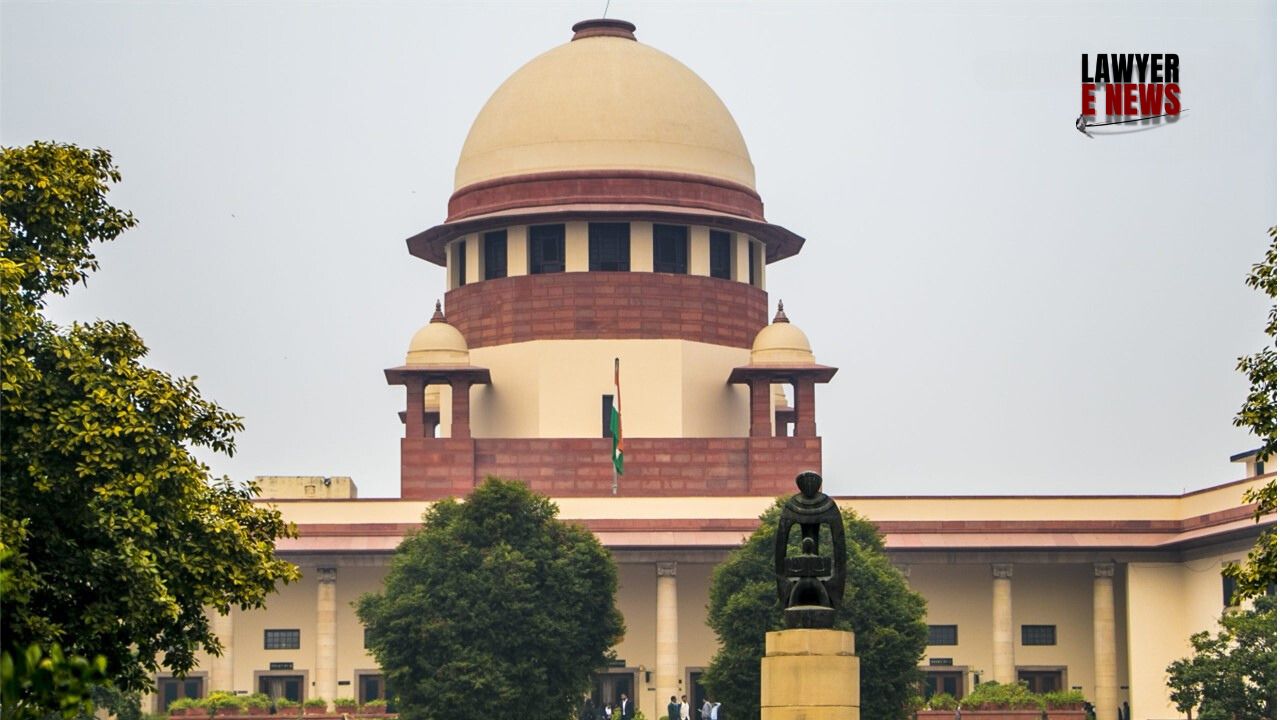
Supreme Court Upholds Meghalaya Government’s Decision to Dissolve CMJ University. Supreme Court of India, on February 13, 2025, delivered a significant ruling in the case of CMJ Foundation & Others v. State of Meghalaya & Others, upholding the dissolution of CMJ University by the State Government of Meghalaya. The Court categorically rejected the argument of "deemed approval" for the Chancellor’s appointment and ruled that a university cannot function without a legally appointed Chancellor.
"There is no concept of ‘deemed approval’ under the CMJ University Act, 2009. The appointment of a Chancellor, as per law, requires express approval from the Visitor (Governor of Meghalaya). The absence of such approval renders the appointment non-est in law," the Court held.
A bench comprising Justice Pamidighantam Sri Narasimha and Justice Sandeep Mehta dismissed CMJ Foundation’s appeal challenging the dissolution of the university and allowed the State’s appeal against the High Court’s remand order. The Court ruled that the dissolution of the university was conducted strictly in accordance with Section 48 of the CMJ University Act, 2009, and there was no need for further reconsideration by the High Court.
"When the validity of the dissolution order is upheld, remanding the matter for reconsideration serves no legal purpose. The High Court’s remand was unwarranted and unjustified," the Supreme Court observed.
"Appointment of Chancellor Without Visitor’s Approval is Invalid—A University Cannot Operate Without a Duly Appointed Head"
One of the key legal questions before the Supreme Court was whether the appointment of the Chancellor of CMJ University was made in compliance with the CMJ University Act, 2009. The appellants argued that since the State Government did not explicitly reject the appointment, it should be deemed approved.
Rejecting this contention, the Supreme Court clearly stated that the legislative intent behind Section 14(1) of the Act requires the Chancellor’s appointment to be expressly approved by the Visitor.
"Approval is not a mere formality—it is a substantive requirement under the law. The appointment of the Chancellor without the Visitor’s approval is legally non-existent. The concept of ‘deemed approval’ has no place in the statutory scheme of the Act," the Court observed.
Citing K.R.C.S. Balakrishna Chetty & Sons v. State of Madras and V. Balasubramaniam v. T.N. Housing Board, the Court reiterated that: "The phrase ‘subject to approval’ means ‘conditional upon’—it does not imply automatic or deemed approval. Any assumption of deemed approval is legally untenable."
The Court further clarified that if the legislature intended to introduce a deemed approval provision, it would have explicitly stated so. Courts cannot create legal fictions where none exist in the statute.
"A university without a legally appointed Chancellor cannot confer degrees, conduct examinations, or function as a statutory body. CMJ University operated outside the legal framework, rendering all its actions void ab initio," the Court concluded.
"Dissolution of CMJ University Was Legally Justified—State Followed Due Process"
The Supreme Court also examined whether the dissolution of CMJ University was carried out in compliance with Section 48 of the CMJ University Act, 2009. The appellants argued that the State Government had arbitrarily dissolved the university without following the prescribed procedure.
The Court, however, found that the State had issued show-cause notices, considered replies, and found overwhelming evidence of statutory violations and mismanagement.
"The State did not act arbitrarily. It followed the due process outlined under Section 48 of the Act. The university was given multiple opportunities to rectify its irregularities, which it failed to do," the Court noted.
The Supreme Court found that CMJ University had violated multiple statutory provisions, including:
Admitting students and awarding degrees despite the Chancellor’s appointment being legally non-existent.
Awarding Ph.D. degrees without the necessary faculty, violating UGC regulations.
Operating unauthorized off-campus centers outside Meghalaya.
Offering B.Ed. programs without necessary approvals.
Failing to submit annual reports and financial statements to the Visitor, as required by law.
Citing its own previous order in SLP (C) No. 19617 of 2013, where it had directed the State Government to pass a speaking order after issuing a show cause notice, the Court noted that the State fully complied with this directive.
"The decision to dissolve CMJ University was not arbitrary but necessary. The State acted in the interest of maintaining academic integrity and upholding the law," the Court ruled.
"Remanding the Case for Reconsideration Was Unjustified—High Court’s Order Set Aside"
A significant aspect of the case was the High Court’s decision to remand the matter to the Single Judge for reconsideration, despite upholding the validity of the dissolution order. The Supreme Court found this unnecessary and legally flawed.
"Once the Division Bench of the High Court upheld the dissolution order as valid, there was no live issue left for reconsideration. The remand was an empty formality," the Supreme Court held.
The Court cited Nadekerappa v. Pillamma (2022 SCC OnLine SC 387), stating that: "An order of remand cannot be passed as a matter of course. Where both sides have presented evidence and the appellate court has examined the case on merits, remand serves no purpose."
Applying the Wednesbury principles of judicial review, the Court reiterated: "Courts cannot substitute their views for that of the executive. Once the State Government’s procedure was found to be lawful, judicial intervention beyond that point is unwarranted."
Referring to Gohil Vishvaraj Hanubhai v. State of Gujarat (2023 SCC OnLine SC 892), the Court reaffirmed that judicial review is meant to examine the legality of decisions, not to re-decide them.
"The High Court’s remand was legally flawed. Once the dissolution was upheld, no further reconsideration was required," the Supreme Court concluded.
Conclusion
The Supreme Court’s decision in CMJ Foundation v. State of Meghalaya reinforces fundamental principles of education law and statutory compliance:
A Chancellor’s appointment without the Visitor’s approval is invalid—no university can function without a legally appointed head.
There is no concept of "deemed approval" in law. Express approval is mandatory under the CMJ University Act, 2009.
The State Government followed due process in dissolving CMJ University, adhering to the procedural safeguards under Section 48 of the Act.
Once the dissolution order was upheld as valid, remanding the case for reconsideration was unnecessary and legally untenable.
By dismissing CMJ Foundation’s appeal and allowing the State’s appeal, the Supreme Court’s ruling sets a strong precedent for strict adherence to statutory mandates in private universities.
"Academic institutions must function within the boundaries of law. Any deviation from statutory requirements threatens the integrity of higher education and cannot be condoned," the Court observed.
With this judgment, the Supreme Court has sent a clear message that regulatory compliance is non-negotiable in the education sector and that legal shortcuts, such as the doctrine of "deemed approval," have no place in academic governance.
Date of decision: 13/02/2025