-
by sayum
13 August 2026 1:48 PM







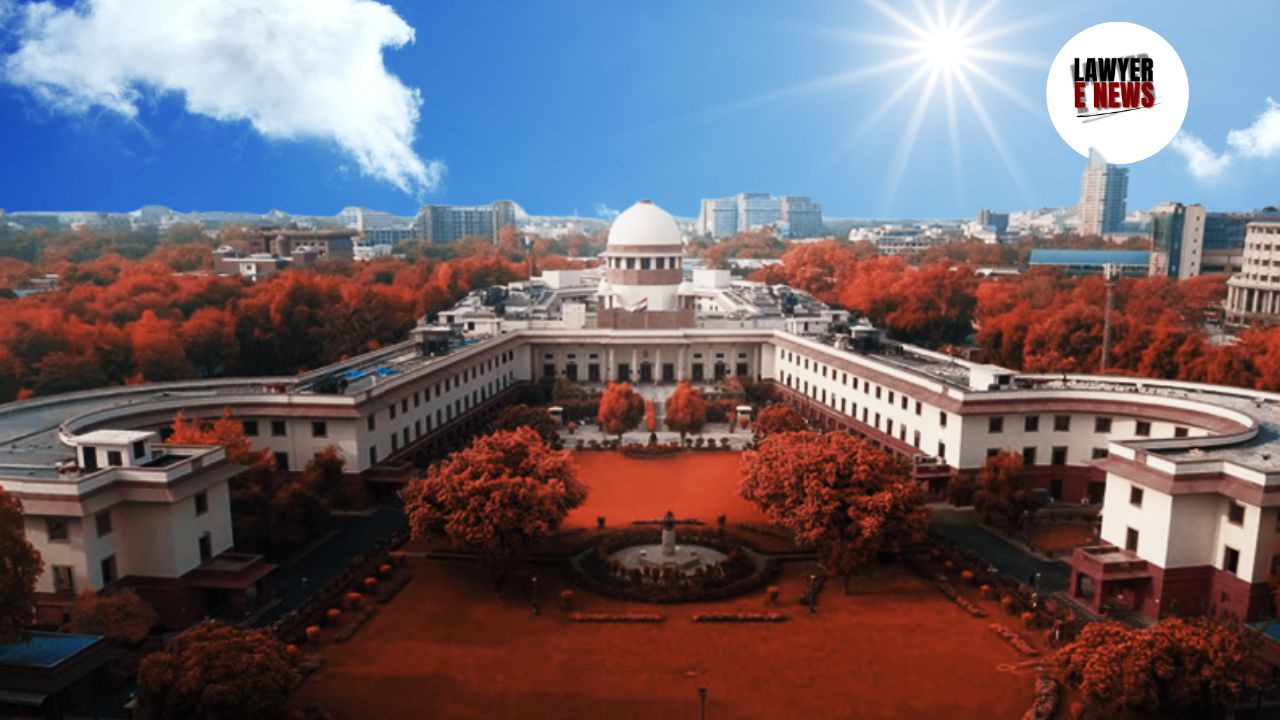
"Legitimate Expectation Cannot Be Shattered by Executive Fiat" – Supreme Court Protects Tax Exemptions Granted Under Industrial Incentive Schemes. In a landmark decision that reaffirms the sanctity of vested rights, the Supreme Court of India, in State of Maharashtra & Ors. v. Prism Cement Ltd. & Anr , ruled that a state government cannot retrospectively withdraw tax exemptions granted under an industrial incentive scheme merely because of subsequent legislative amendments. The Court, while delivering its verdict on February 12, 2025, held that once a substantive right has been conferred under a legally valid policy, it cannot be arbitrarily revoked without due process.
The dispute arose when the Maharashtra government sought to nullify tax exemptions granted under the Package Scheme of Incentives (PSI) 1993 after amendments were made to Section 8(5) of the Central Sales Tax Act, 1956 in 2002. Prism Cement Ltd., which had been awarded an Eligibility Certificate (EC) and Entitlement Certificate (ENC) in 1998, was entitled to sales tax exemptions until 2012 or up to ₹273.54 crores, whichever was earlier. However, after the 2002 amendment introduced new procedural requirements, the Maharashtra government issued notices demanding tax payments on inter-state sales, alleging non-compliance with the amended law. The Bombay High Court ruled in favor of Prism Cement, leading to an appeal before the Supreme Court.
The Supreme Court categorically rejected the state's attempt to revoke an already granted exemption, holding that “a substantive right, once accrued to an entity under a government policy, cannot be nullified by subsequent changes in law unless the statute expressly provides for such revocation.” The Court further observed that tax incentives under industrial policies are granted to encourage investment and economic growth, and such benefits, once conferred, cannot be whimsically withdrawn by the state.
The judgment addressed two pivotal questions: whether a state government can retrospectively withdraw tax exemptions once granted, and whether the amendment to Section 8(5) of the CST Act in 2002 had any bearing on previously conferred exemptions. The Court held that the 2002 amendment was prospective in nature and did not impact transactions where exemptions had already been granted. “Legislation must be interpreted in a manner that upholds certainty in economic transactions,” the Court asserted. “Governments cannot backtrack on their commitments by citing subsequent policy shifts.”
The Court also applied the doctrine of legitimate expectation, holding that businesses make long-term investment decisions based on assurances provided by government policies. “A state cannot promise an exemption, induce investment, and then unilaterally alter the terms of the contract through administrative orders,” the bench observed. “Such arbitrary actions strike at the root of economic stability and legal predictability.”
On the question of functus officio, the state argued that it retained the authority to modify or withdraw tax benefits even after issuing the original exemption order. The Court disagreed, holding that once the government had granted a tax exemption through a duly issued entitlement certificate, it had exhausted its powers. “Once an administrative decision has conferred rights on an individual or an entity, the state loses the power to unilaterally amend or revoke it, unless the governing statute expressly permits such intervention,” the Court held.
The judgment also emphasized the importance of natural justice and the right to be heard before adverse action is taken. The Maharashtra government had issued notices demanding tax payments without affording Prism Cement an opportunity to present its case. The Court condemned this approach, holding that “an executive order that imposes financial liabilities without prior notice violates the fundamental tenets of fairness and due process.”
Relying on its previous rulings, including MRF Ltd. v. Asst. Commissioner (2006) 8 SCC 702 and Southern Petrochemical Industries v. Electricity Inspector (2007) 5 SCC 447, the Supreme Court reiterated that tax benefits granted for a specified period create a vested right, and their premature withdrawal is impermissible. The Court observed that “industrial incentives are meant to foster growth, and their retrospective revocation not only disrupts legitimate business expectations but also erodes trust in government policies.”
Dismissing the appeal, the Supreme Court upheld the Bombay High Court’s ruling and quashed the Maharashtra government’s attempt to revoke the tax exemption. It held that Prism Cement’s exemption under the PSI 1993 scheme remained valid until the expiry of the eligibility period or the exhaustion of the specified exemption limit. The Court further ruled that the state's demand for retrospective tax recovery was illegal, and any attempt to cancel previously granted exemptions was ultra vires.
With this judgment, the Supreme Court has reaffirmed a fundamental principle of tax law—that retrospective application of amendments cannot override substantive rights unless expressly provided for. The ruling serves as a stern warning to governments against arbitrarily altering industrial policies and jeopardizing legitimate business expectations. By upholding the principles of non-arbitrariness, legitimate expectation, and natural justice, the Court has ensured that economic governance remains predictable, stable, and fair.
Date of Decision: February 12, 2025