-
by sayum
25 August 2026 6:19 AM







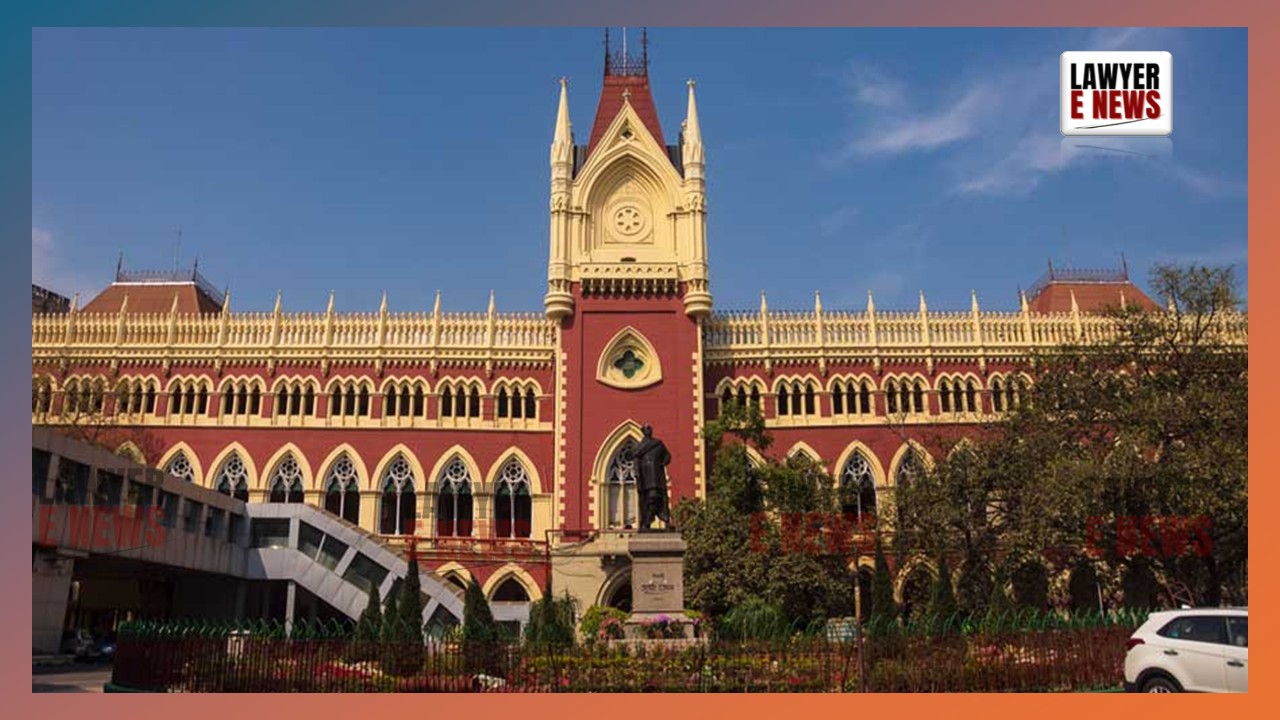
“The complainant is not empowered to make the petitioner represent the accused company... A resigned director cannot be compelled to appear on behalf of a juristic person”: In a decisive ruling Calcutta High Court firmly drew a line between corporate criminal liability and procedural representation in trials under the Prevention of Money Laundering Act, 2002 (PMLA). Allowing CRR 3146 of 2023 filed by Suman Chattopadhyay, Justice Dr. Ajoy Kumar Mukherjee set aside a Special CBI Court order which had required the petitioner—a former director of M/s Disha Production & Media Pvt. Ltd. (accused no. 23)—to represent the company during trial, despite having resigned in 2013.
The High Court held that representation of a company in a criminal proceeding is a matter of procedural law, governed by Section 305 of the Criminal Procedure Code, and not subject to prosecutorial preference. As the Court noted, “It is the corporation within the meaning of Section 305 Cr.P.C., and as such, the said company alone can appoint a representative for facing the prosecution.”
“Representation and Liability Are Not Interchangeable” – Resignation Shields Procedural Role, Not Criminal Charges
The Enforcement Directorate had argued that the petitioner, though separately prosecuted as accused no. 22, must also represent the company as accused no. 23, citing his role as director at the time of the alleged money laundering (2010–2011). But the Court made an important clarification: a former director can be held criminally liable for acts committed during his tenure, but cannot be forced to appear as the company’s procedural representative once his association has ended.
Rejecting the ED's interpretation of Section 70 of the PMLA, the Court held, “Section 70 is no way in conflict with Section 305 of Cr.P.C. or Section 141 of the N.I. Act... The petitioner herein had severed all ties with the accused company. The petitioner cannot be compelled to plead on behalf of the accused company under Section 246(2) of Cr.P.C.”
The Court emphasised that criminal liability under PMLA and procedural representation under Cr.P.C. are distinct legal domains and must not be conflated. “Representation of a company during inquiry or trial must not be confused with liability of a company in case the offence is committed by the company.”
“The Company Must Speak for Itself” – Summons Must Be Served at Registered Address, Not to Individuals
The High Court was also critical of the procedural irregularity whereby the summons to the company were not served at its registered address, but instead sent to the personal address of the petitioner. The Court directed strict compliance with procedural safeguards, observing: “Petitioner’s specific case is that no summon has been issued or served at the registered office of the company... Section 65 of PMLA clearly stipulates that Cr.P.C. shall apply where not inconsistent.”
The Court held that the CBI Court’s failure to resolve the representation issue before proceeding further was unlawful, stating that “the case cannot be proceeded at any stage without due representation of the accused company.”
Referring to settled law from Supreme Court and multiple High Courts including Bombay, Madras, and Calcutta itself, the Court reiterated, “Neither the prosecution nor the Court can insist that a particular person has to represent the company... It is for the company, a juristic entity, to nominate a person to represent it in the prosecution.”
“Compulsion Has No Place Where Legal Representation Must Be Voluntary”: High Court Directs Fresh Summons and Nomination Process
Setting aside the CBI Court's order dated 3rd November 2022 in ML Case No. 1 of 2013, the High Court directed the trial court to serve fresh summons at the company’s registered office, and give it an opportunity to nominate a representative as per Section 63 Cr.P.C.. If no one is appointed, proceedings must continue under Section 305(4) without forcing any individual to step in.
“The complainant/ED is not empowered to insist that the petitioner represent the company. Such insistence, when the petitioner has resigned years ago and has no current authority, is impermissible under law,” observed the Court.
Reiterating the autonomy of juristic entities, the Court reminded, “A company registered under the Companies Act is a legal person, separate, and distinct from its individual members.” Citing RC Cooper v. Union of India, the Court underscored that representation must come from the entity itself, not from a person chosen by the complainant or court.
No Legal Fiction Can Override Procedural Fairness
In a nuanced exposition on corporate accountability under PMLA, the High Court affirmed that criminal responsibility under Section 70 PMLA does not empower prosecuting agencies to bypass procedural due process. The judgment asserts that the independent status of a company, and its right to appoint its own representative, cannot be overridden by mere association with alleged offences.
The petitioner, already arrayed as an individual accused, was rightly allowed to contest the attempt to impose a dual procedural role—one that was unsupported by law and violative of settled principles of corporate jurisprudence.
As the Court concluded: “In such view of the matter, CRR 3146 of 2023 is allowed... The petitioner cannot be compelled to represent the company which he no longer directs or controls.”
Date of Decision: 01.12.2025