-
by sayum
25 August 2026 12:32 PM







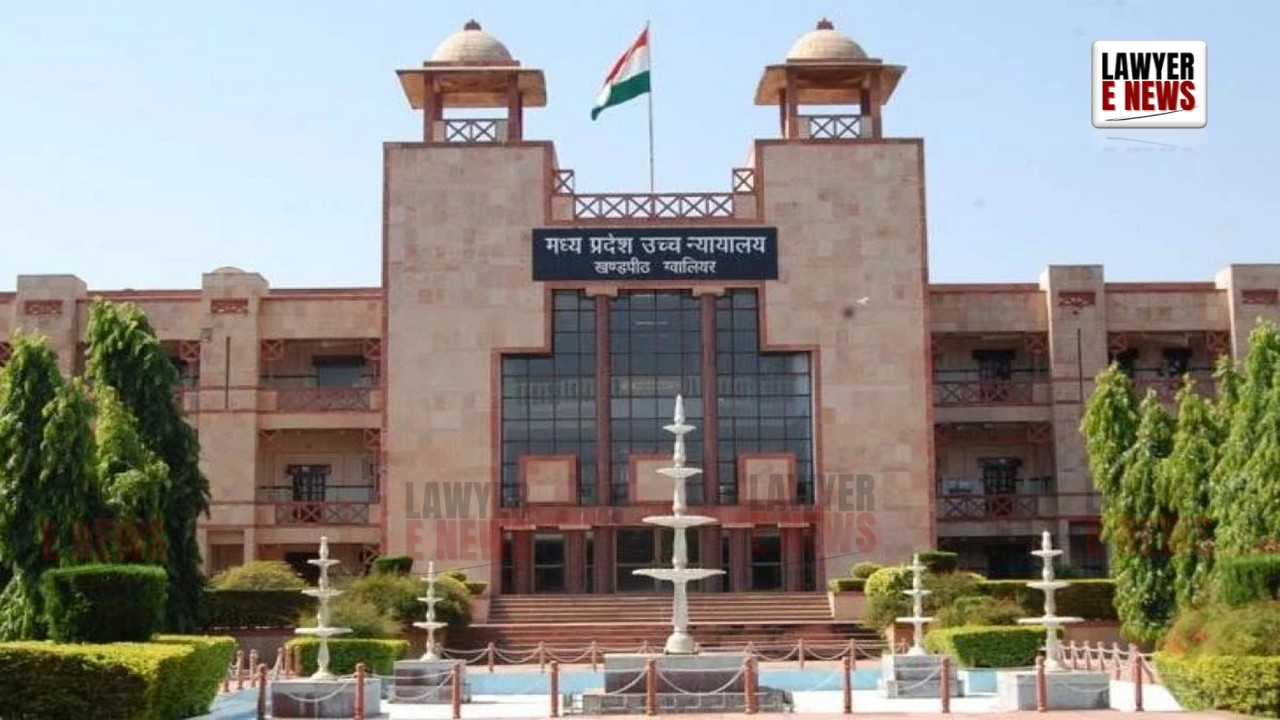
The Madhya Pradesh High Court, Indore Bench, has dismissed a Public Interest Litigation (PIL) challenging the implementation of the "Mukhyamantri Ladli Behna Yojana, 2023." In a significant ruling delivered on February 10, 2026, a Division Bench comprising Hon'ble Justice Vijay Kumar Shukla and Hon'ble Justice Alok Awasthi affirmed that the fixation of eligibility criteria and the operational timelines of a welfare scheme fall squarely within the executive domain of the State. The Court emphasized that judicial review over policy decisions is restricted to examining legality and constitutionality rather than the wisdom or administrative pragmatism behind such schemes.
Judicial Deference to Executive Policy: High Court Upholds Ladli Behna Yojana Criteria
The legal challenge was initiated by petitioner Paras Saklecha through a PIL under Article 226 of the Constitution of India. The petitioner contended that the state’s decision to halt fresh registrations for the scheme effective August 20, 2023, was illegal, arbitrary, and discriminatory. The Mukhyamantri Ladli Behna Yojana, introduced in March 2023, aims to promote women’s empowerment and economic independence by providing monthly financial assistance to domiciled women within the age group of 21 to 60 years. The petitioner argued that by closing the registration window, the State was effectively denying benefits to newly eligible women, thereby creating a class of "hostile discrimination" in violation of Article 14 of the Constitution. Furthermore, the petitioner sought a judicial direction to amend the age criteria and ensure the continued registration of beneficiaries during the subsistence of the policy.
The State, represented by the Deputy Advocate General, countered that the scheme is a pure policy decision. It was argued that the petitioner lacked the standing to challenge the nuances of the scheme as he was not an aspirant or a direct beneficiary. The State relied upon settled precedents to assert that the Court should not substitute its own opinion for that of the executive in economic or welfare matters. The Bench carefully analyzed the limits of judicial review, referencing landmark Supreme Court decisions including Balco Employees Union v. Union of India and Narmada Bachao Andolan v. Union of India. The Court noted that interference is only warranted if a policy is demonstrably unconstitutional, dehors the provisions of a statute, or marked by gross malafides.
Regarding the closure of the registration window, the Court found no merit in the petitioner’s claim of arbitrariness. The Bench observed that the State possesses the inherent power to decide the temporal scope of its welfare programs.
In a policy decision, it is for the State to decide the date of implementation and its continuation. The fixation of the date for commencement and its closure is within the domain of the State.
The Court further addressed the challenge to the age bracket of 21 to 60 years. The petitioner had argued that the minimum and maximum age limits were unreasonable. However, the Court maintained that the executive is best positioned to determine the specific demographic targets for welfare assistance based on available resources and social objectives.
The fixation of the age of entitlement of policy prescribing minimum and maximum is also absolutely within the domain of the State Government. Considering the nature of the scheme and the prescription of minimum and maximum age, we do not find any arbitrariness.
The petitioner also raised a grievance regarding the alleged failure of the State to further enhance the monthly payout as previously promised. The Court declined to entertain this aspect, noting that such a plea could not be considered at the instance of a petitioner who is not a beneficiary of the scheme. The Bench reiterated that a PIL cannot be used to dictate the financial scale of a state policy when the affected parties have not approached the court themselves.
In its final analysis, the Court held that the Ladli Behna Yojana is an executive policy and does not suffer from any constitutional infirmity that would necessitate judicial intervention. The Ratio Decidendi of the judgment reinforces the principle that while the executive must act within the bounds of Article 14, the specific mechanics of a welfare scheme—such as registration deadlines and age-based eligibility—are matters of administrative policy. Unless such criteria are proven to be patently irrational or unconstitutional, the High Court will not issue a writ of mandamus to alter the State’s legislative or executive judgment. Consequently, the petition was dismissed without any order as to costs.
Case Title: Paras Saklecha v. State of Madhya Pradesh & Others
Date of Order: February 10, 2026