-
by sayum
25 August 2026 12:32 PM







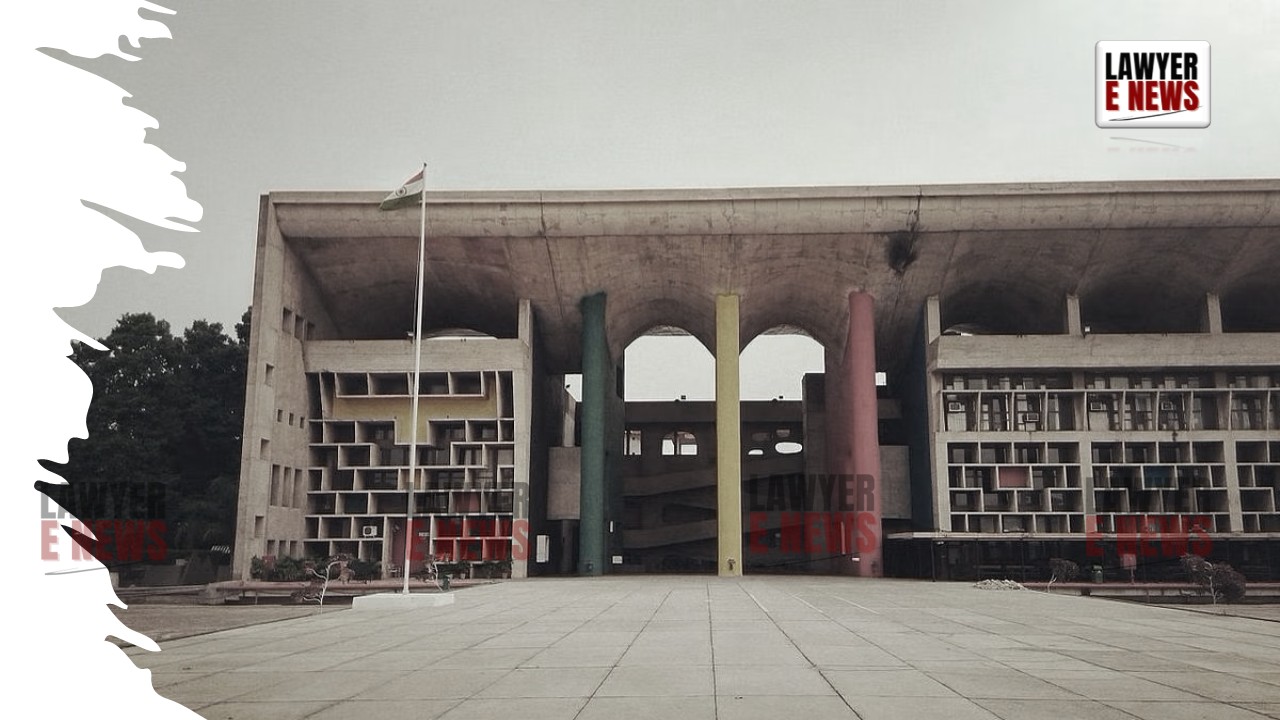
“Ratification Relates Back and Cures Want of Prior Authority”, In a significant ruling on agency, ratification, stamping defects, and the scope of second appeal jurisdiction, the Punjab and Haryana High Court upheld a decree for specific performance of an agreement to sell executed through the plaintiff’s father, despite the absence of prior power of attorney on the date of execution.
Justice Amarinder Singh Grewal dismissed the Regular Second Appeal filed by the defendant and affirmed the judgment of the First Appellate Court, holding that subsequent ratification of the father’s act validated the agreement from the original date of execution and that defects in stamping were curable.
The Court also reiterated that under Section 41 of the Punjab Courts Act, 1918, framing of substantial questions of law is not mandatory for second appeals before the Punjab and Haryana High Court.
Agreement Executed by Father While Plaintiff Was Abroad
The dispute arose from an agreement to sell dated 11.03.1985 concerning land measuring 28 kanals 13 marlas in village Sasoli, Tehsil and District Hoshiarpur. The total sale consideration was ₹57,500/-, out of which ₹10,000/- was paid as earnest money.
The plaintiff, who was residing abroad at the time, had the agreement executed through his father, Rattan Singh. The date fixed for execution and registration of the sale deed was 15.06.1985.
According to the plaintiff, notices dated 09.05.1985 and 21.05.1985 were issued to the defendant calling upon him to execute the sale deed. As 15.06.1985 was a holiday, the plaintiff’s attorney appeared before the Sub-Registrar on 14.06.1985 and again on 17.06.1985, but the defendant failed to turn up.
The defendant denied execution, alleged fraud, claimed that only ₹1,000/- was paid, and contended that the agreement was vague and unenforceable. A crucial objection was that the father had no authority on 11.03.1985, as the power of attorney was executed later on 04.06.1985.
The trial court dismissed the suit. However, the First Appellate Court reversed the decision and decreed specific performance. The defendant then approached the High Court in second appeal.
Ratification Validates the Earlier Act
Addressing the principal objection regarding lack of authority, the Court observed that a power of attorney merely creates an agency relationship. The plaintiff was abroad and this fact was within the knowledge of the defendant.
Crucially, the target date for execution of sale deed was 15.06.1985, and the power of attorney (Ex.P1) was executed on 04.06.1985, prior to that date. Additionally, a subsequent power of attorney dated 08.06.1987 (Ex.C1) ratified the earlier authority.
The Court invoked the doctrine of relation back and noted:
“The principle of ratification is fundamentally based on the doctrine of relation back, established by the maxim omnis ratihabitio retrorahitur et mandato priori aequiparatur, which signifies that when a principal ratifies an unauthorized act, the act is deemed valid from the date it was originally performed and not from the date of ratification.”
Thus, the agreement dated 11.03.1985 was not void merely because prior written authority was absent.
The Court also observed that if fraud had indeed been committed, the defendant could have initiated criminal proceedings, especially after receiving two notices for execution of sale deed.
Stamp Act Objection Rejected: “Inadmissibility Is Not Voidness”
The appellant contended that the power of attorney was neither properly stamped nor authenticated and hence inadmissible.
Relying upon the Seven-Judge Bench decision of the Supreme Court in Re: Interplay Between Arbitration Agreements and the Indian Stamp Act, 1899, (2024) 6 SCC 1, the High Court drew a clear distinction between inadmissibility and voidness.
The Supreme Court had clarified:
“The admissibility of an instrument in evidence is distinct from its validity or enforceability in law.”
And further:
“The effect of not paying duty or paying an inadequate amount renders an instrument inadmissible and not void. Non-stamping or improper stamping does not result in the instrument becoming invalid.”
The High Court emphasized that the Indian Stamp Act is a fiscal statute intended to secure revenue and “is not enacted to arm a litigant with a weapon of technicality.”
In the present case, the subsequent power of attorney (Ex.C1) was duly embossed and stamped by the Commissioner, Jullunder. The Court held that the defect in the earlier instrument stood cured.
Additional Evidence Under Order XLI Rule 27 CPC
The appellant argued that permitting additional evidence (subsequent power of attorney) amounted to filling lacunae.
However, the Court noted that no specific objection was raised before the First Appellate Court regarding production of a photocopy. Therefore, the appellant was barred from raising such objection at the second appellate stage.
The Court found that the additional evidence clarified authority and ratification rather than filling gaps in the plaintiff’s case.
Readiness and Willingness Proved
On the issue of readiness and willingness under the Special Relief Act, the Court relied heavily on the testimony of PW-4, a Bank Officer from State Bank of India, who proved preparation of a draft dated 10.06.1985 for ₹69,160/-.
The Court noted that the plaintiff had: “Issued notices dated 09.05.1985 and 21.05.1985,” “Appeared before the Sub-Registrar,”
“Prepared a bank draft for the balance consideration.”
These facts established continuous readiness and willingness, while the defendant failed to perform his part.
Agreement Not Vague Despite Absence of Khasra Numbers
The defendant contended that absence of specific khasra numbers rendered the agreement vague.
The Court rejected this argument, observing that the land was described as approximately 28 kanals with a clause for proportionate adjustment. It was noted that jamabandi was not available with the defendant himself.
The execution was proved by the scribe and attesting witnesses. Hence, the agreement was enforceable and not vague.
Scope of Second Appeal Under Section 41 Punjab Courts Act
Finally, the Court reiterated the legal position laid down in Pankajakshi, Randhir Kaur, and Gurbachan Singh, that framing of substantial questions of law is not mandatory in second appeals before the Punjab and Haryana High Court.
The jurisdiction under Section 41 of the Punjab Courts Act is distinct from Section 100 CPC.
Finding no perversity or illegality in the First Appellate Court’s findings, the High Court declined interference.
Appeal Dismissed, Specific Performance Affirmed
The High Court concluded that there was no perversity, illegality, or infirmity in the First Appellate Court’s judgment decreeing specific performance.
The Regular Second Appeal was dismissed, and the decree for possession by way of specific performance was upheld. All pending applications were also disposed of.
The ruling is a strong reaffirmation that technical objections regarding stamping or initial lack of authority cannot defeat substantive rights once ratification and compliance cure procedural defects. It also reinforces the principle that ratification relates back and validates prior unauthorized acts.
Date of Decision: 04 February 2026