-
by sayum
10 August 2026 10:09 AM







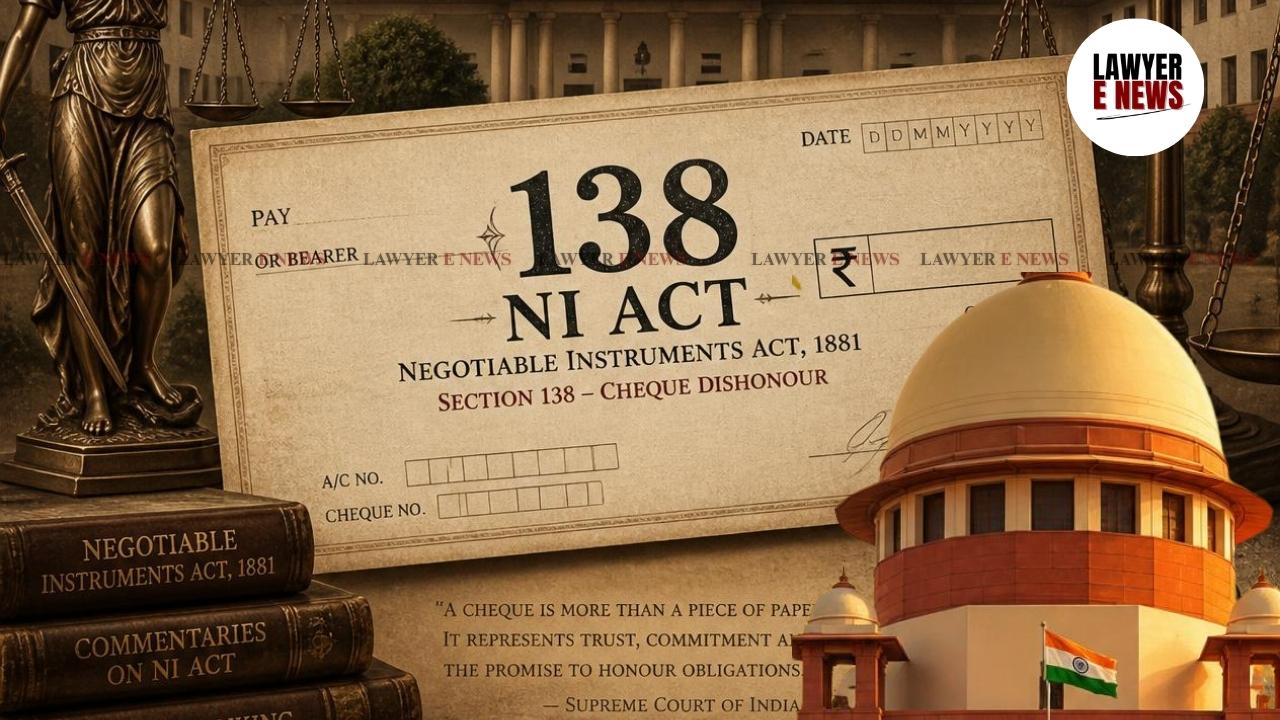
"Neither Section 269SS nor Section 271D of the Income Tax Act, states that any transaction in breach thereof will be illegal, invalid or statutorily void. Therefore, any violation of Section 269SS would not render the transaction unenforceable under Section 138 of the N.I. Act." Supreme Court, in a judgment, held that a cash loan transaction exceeding twenty thousand rupees in technical breach of Section 269SS of the Income Tax Act does not render the underlying debt illegal or unenforceable under Section 138 of the Negotiable Instruments Act.
A bench of Justices Manoj Misra and Vijay Bishnoi observed that any contravention of Section 269SS merely invites a penalty under Section 271D of the IT Act and does not invalidate the civil debt or displace statutory presumptions.
The appellant was prosecuted under Section 138 of the NI Act following the dishonor of two cheques issued for Rs. 8,00,000 and Rs. 50,000 respectively. The Trial Court acquitted the accused on the ground that the complainant failed to prove a legally enforceable debt, noting that cash loans exceeding Rs. 20,000 violate Section 269SS of the Income Tax Act. Upon appeal, the Karnataka High Court set aside the acquittal and remanded the matter back for fresh consideration, prompting the appellant to approach the Supreme Court.
The primary question before the court was whether a cash loan transaction exceeding twenty thousand rupees in violation of Section 269SS of the Income Tax Act renders a debt legally unenforceable under the Negotiable Instruments Act. The court was also called upon to determine whether the High Court erred in remanding the matter for fresh trial regarding the rebuttal of statutory presumptions.
Statutory Presumption Under Section 139 NI Act
The court underscored that once the execution of a cheque is admitted, strong statutory presumptions operate in favor of the holder. The bench noted that Section 118(a) presumes the instrument was drawn for consideration, while Section 139 presumes the cheque was received in discharge of a legally enforceable debt.
"Once the execution of the cheque is admitted, the presumption under Section 118(a) of the NI Act, that the cheque in question was drawn for consideration, and the presumption under Section 139, that the holder of the cheque received the said cheque in discharge of a legally enforceable debt or liability, arise against the accused."
Income Tax Act Violations Do Not Vitiate NI Act Proceedings
Addressing the Trial Court's reliance on Section 269SS of the Income Tax Act, the Supreme Court clarified that tax code penalties do not automatically translate into civil or criminal un-enforceability. The bench observed that penal consequences under Section 271D are self-contained and do not invalidate the underlying transaction.
"Consequently, the view that any transaction in cash above Rs. 20,000 is illegal and void and therefore does not fall within the definition of legally enforceable debt cannot be countenanced."
Rebuttal Requires More Than Mere Denial
The court reiterated that while the presumption under Section 139 is rebuttable, a casual or bald denial by the accused is legally insufficient. The drawer must affirmatively explain the circumstances in which the cheque landed in the hands of the payee.
"No doubt, the presumption under Section 139 of the N.I. Act is rebuttable but mere denial is not sufficient to rebut the presumption. To rebut such presumption the accused, inter alia, would have to explain the circumstances in which the cheque in question came to be issued."
Upholding The Order Of Remand
Noting that the Trial Court failed to properly evaluate the complainant's evidence regarding financial capacity and incorrectly placed an unwarranted burden of proof regarding Income Tax compliance, the apex court found no infirmity in the High Court's decision. The Supreme Court dismissed the appeal, directing the Trial Court to dispose of the 2006-vintage complaint expeditiously.
The Supreme Court dismissed the criminal appeal, affirming the High Court's order of remand for a fresh decision by the Trial Court on merits. The ruling reinforces the sanctity of statutory presumptions under the Negotiable Instruments Act against attempts to derail cheque bounce prosecutions using collateral tax technicalities.
Date of Decision: 16 July 2026