-
by sayum
10 August 2026 8:42 AM








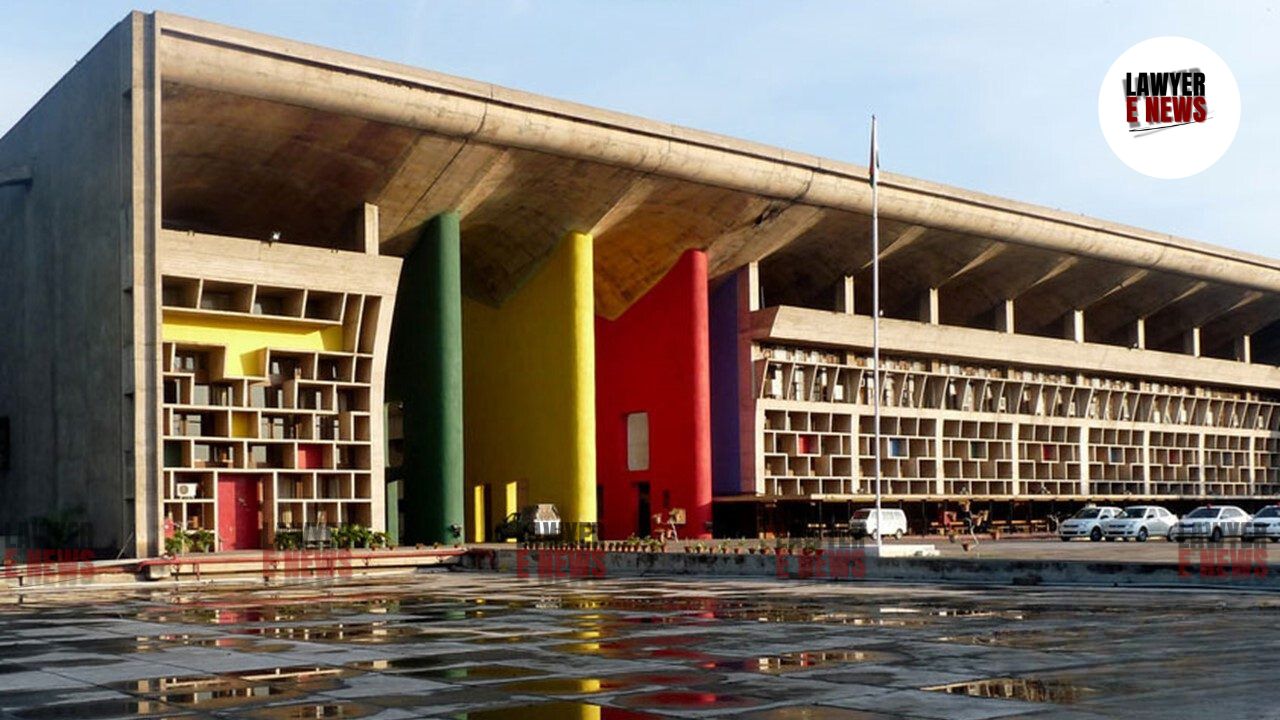
"Strangely, it is nowhere mentioned as to which essential document, statutorily or legally required to be appended along with the nomination form, was missing. Similarly, even the learned Election Tribunal failed to mention for want of which essential document, legally required to be appended along with the nomination form, the same was found incomplete." Punjab and Haryana High Court, in a significant ruling, held that a Returning Officer cannot reject a nomination paper on a vague and unreasoned ground like "incomplete form/papers" without specifying which mandatory statutory document was missing.
A bench of Justice Harkesh Manuja observed that the statutory scrutiny process is intended to be curative and enabling rather than an instrument for automatic disqualification based on unrecorded deficiencies.
The dispute arose from the elections for the post of Panch SC (Women) for Ward No. 1 in village Dalam, District Amritsar. The appellant, who was fully eligible to contest, filed her nomination papers within the stipulated window. However, the Returning Officer rejected her nomination on October 5, 2024, citing the cryptic reason of "incomplete form/papers" without pointing out any specific defect.
Aggrieved by the rejection, the appellant approached the Sub-Divisional Magistrate-cum-Election Tribunal by filing an election petition under Section 76 of the Punjab State Election Commission Act, 1994, read with Rule 50 of the Punjab Panchayat Election Rules, 1994. The Election Tribunal dismissed the petition vide an order dated January 9, 2026, prompting the appellant to invoke the jurisdiction of the High Court.
The primary question before the court was whether a Returning Officer is legally justified in rejecting a nomination paper on a generic ground without recording specific reasons or identifying missing documents. The court was also called upon to determine whether an Election Tribunal can abdicate its statutory duty by upholding such an unreasoned rejection without summoning and examining the original records of the nomination proceedings.
Constitutional Status of Panchayats
The court commenced its analysis by placing local self-government institutions within the broader constitutional framework of Part IX of the Constitution of India, introduced via the Seventy-Third Amendment Act, 1992. The bench noted that Article 243 envisions Panchayats as vibrant institutions of self-government rather than mere administrative sub-units of the State. This constitutional architecture aims to deepen grassroots democracy and ensure direct participation of the rural populace in local governance.
"Panchayats are not merely ceremonial or symbolic bodies; they are constituted to attend to the day-to-day governance, administrative and developmental needs of the village community including matters of sanitation, local infrastructure, welfare schemes and civic administration that cannot brook indefinite delay."
The bench referred to the landmark apex court ruling in K. Krishna Murthy v. Union of India, which underscored that democratic decentralization and accountability are the foundational pillars of the constitutional amendments relating to local bodies. The court observed that any arbitrary vacuum created in these institutions through improper rejection of nominations deals a direct blow to rural self-governance.
Statutory Scheme Governing Nominations
Examining the statutory framework, the court noted that Section 38(1) of the Punjab State Election Commission Act, 1994, read with Rule 9 of the 1994 Rules, prescribes a precise checklist comprising Form-IV, the required fee, and caste declarations where applicable. The court emphasized that the statute does not permit authorities to invent extraneous checklists or impose unnotified procedural hurdles.
"Nothing beyond the nomination paper in Form-IV, the caste declaration where applicable and the fee prescribed under Rule 9 is requirement for a complete nomination."
The bench pointed out that under Section 41(5) of the Act and Rule 11 of the 1994 Rules, a Returning Officer is mandated to record a brief statement of reasons in writing while rejecting any nomination. Furthermore, Rule 11 explicitly empowers Returning Officers to permit the correction of clerical or printing errors, demonstrating that the scrutiny stage is curative and designed to save valid candidatures, not to eliminate them on technical pretexts.
Tribunal Failed to Exercise Adjudicatory Duty
The court strongly criticized the manner in which the Election Tribunal handled the challenge. The bench highlighted that the Tribunal failed to summon or examine the original records, neglected to verify what documents were allegedly missing, and rubber-stamped the Returning Officer's casual rejection in complete disregard of the procedure mandated under Section 81 of the Act.
"In the absence of the record having been summoned and examined, the learned Election Tribunal could not have arrived at a considered finding on the correctness or otherwise of the rejection, rendering the exercise undertaken by it an empty formality."
The court observed that Section 89(1)(c) of the Act specifically empowers the Tribunal to declare an election void if a nomination has been improperly rejected. By failing to appreciate this statutory safeguard, the Tribunal allowed a flawed administrative action to vitiate the democratic rights of the electorate and caused an inordinate delay of nearly one year and seven months in resolving a grassroots electoral dispute.
Final Directions and Imposition of Costs
Concluding that the impugned order of the Election Tribunal suffered from gross procedural illegality and a complete absence of reasoning, the High Court set aside the order dated January 9, 2026. To hold accountable the statutory authorities who acted in cavalier disregard of their duties, the court imposed personal costs of Rs. 25,000 upon the then Presiding Officer, directing that the amount be paid from his own pocket rather than the state exchequer, while noting a separate reduction of costs for the Returning Officer upon his fervent request.
The parties were directed to appear before the Election Tribunal on July 31, 2026. Given that a significant portion of the five-year tenure had already elapsed, the High Court mandated the Tribunal to summon the original records from the State Election Commission and adjudicate the election petition afresh within a strict timeline of two weeks.
Date of Decision: 23 July 2026