-
by sayum
10 August 2026 8:42 AM







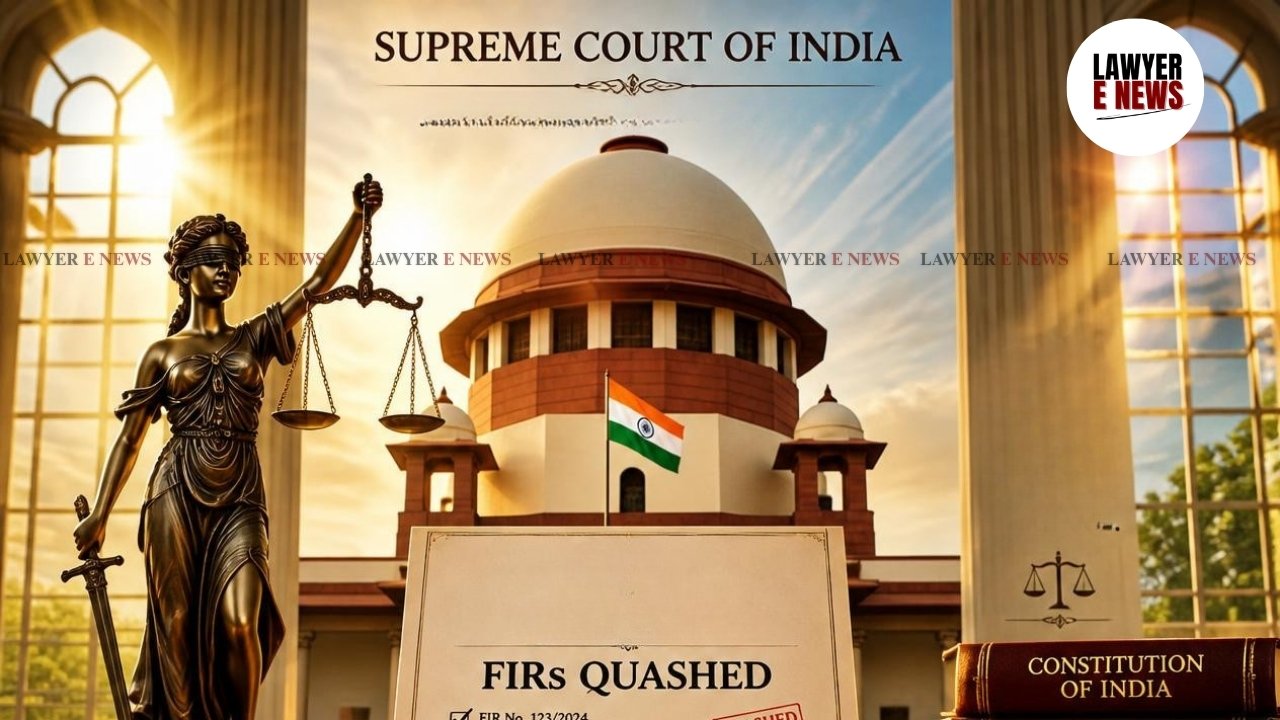
Supreme Court, in a significant ruling dated July 15, 2026, quashed a First Information Report (FIR) alleging cheating, impersonation, and fraudulent asset misappropriation in a property dispute between a brother and sister, observing that "continuation of the pending proceedings would not serve any fruitful purpose" after the parties successfully settled their differences through mediation. A bench of Justice Aravind Kumar and Justice Vipul M. Pancholi accepted the comprehensive settlement agreement, thereby consigning all associated civil and criminal proceedings to records.
An FIR (No. 92/2020) was registered against the appellant, Abhai Garg, at the behest of his uterine sister, Neha Garg (Respondent No. 2). She alleged that after their father's death, the appellant dishonestly dealt with the deceased's bank account and demat assets, causing impersonation and fraudulently liquidating shares and withdrawing money, despite her competing claim over the estate. The FIR was lodged for offences punishable under Sections 419, 420, and 201 of the Indian Penal Code, 1860. The appellant's petition to quash these proceedings was dismissed by the High Court, leading to the present appeal before the Supreme Court.
The primary question before the Supreme Court was whether the criminal proceedings, specifically FIR No. 92/2020, should be quashed in light of a comprehensive family settlement reached between the estranged siblings. The court also considered the efficacy of mediation in resolving long-standing familial disputes involving both civil and criminal facets.
Supreme Court Refers Matter to Mediation Centre
Noting the sensitive relationship between the parties as brother and sister, the Supreme Court, by its order dated November 21, 2025, referred the contentious matter to the Supreme Court Mediation Centre to explore the possibility of an amicable resolution.
Successful Mediation Leads to Comprehensive Settlement
The intervention of the mediator proved fruitful, leading to a comprehensive settlement agreement being entered into between the parties, effectively resolving their long-standing disputes concerning their deceased father's estate. The Court specifically noted that "wisdom having dawned on the parties, resulted in a settlement agreement."
Terms of Financial Settlement
Under the terms of the agreement, the appellant, Abhai Garg, committed to transferring an amount of Rs. 1,58,31,835/- to his sister, Neha Garg, which included the value of matured bonds and dividend amounts (after deducting taxes paid by the appellant). This payment was to be completed within thirty days of obtaining certified copies of orders for the withdrawal of various other pending cases.
Equal Division of Shares and Mutual Funds
It was further stipulated that all stocks/shares (as per Annexure A) and Mutual Funds (as per Annexure C) left behind by their deceased father would be divided equally between the siblings in a 50:50 ratio. The appellant undertook to transfer shares into the respondent's demat account within thirty days, and both parties agreed to move applications for transfer of mutual fund units, with any long-term capital gain tax liability on shares to be shared equally.
Relinquishment of Property Rights
Neha Garg unconditionally waived, relinquished, and released any right, title, interest, or claim she may have had in the residential house at C4/107, Sector-31, Noida, and agricultural land holdings at Jaganpur Doaba (admeasuring approximately 43 Bighas) in favor of Abhai Garg. The agreement explicitly stated that Abhai Garg would solely bear all liabilities, dues, and expenses related to these properties and would indemnify Neha Garg against any future claims arising thereof.
Division of Future Discovered Assets
The settlement also provided that any movable or immovable asset of the deceased discovered after the date of the agreement would be divided equally in a 50:50 ratio. Both parties undertook to disclose such discoveries promptly and cooperate in their division, including jointly accessing dormant bank accounts and lockers to divide balances, jewellery, or other valuables.
Mutual Withdrawal of All Pending Cases
A crucial aspect of the settlement was the mutual undertaking by both parties to withdraw all pending civil and criminal cases against each other before any court of law or other forum. This included various civil suits and a succession petition pending in Saket Courts, New Delhi, and Gautam Buddh Nagar.
Undertaking for FIR No. 16/2023
Notably, the agreement included a specific clause stating that the First Party (Abhai Garg) would "fully cooperate Second Party in getting the FIR No. 16/2023 under Sections 420/467/468/471/120B IPC at PS Sector-20, Noida quashed." This was a separate FIR from the one that was the subject of the Supreme Court appeal.
Family Arrangement as Non-Taxable Event
The parties expressly acknowledged that the arrangement constituted a "settlement of pre-existing rights among family members," rather than a sale, transfer, or conveyance of any asset. They further agreed that this family arrangement was a non-taxable event, being a distribution of the estate among legal heirs, and would not give rise to any capital gains or income under the Income Tax Act, 1961.
Settlement Declared Absolute, Final, and Binding
The Supreme Court confirmed that both parties were present (the appellant physically and the respondent virtually) and admitted the voluntary execution of the agreement without any force, threat, or coercion, and only after having fully understood its contents. The settlement was declared "absolute, final, and permanent," binding not only on the parties personally but also on their respective spouses, children, grandchildren, legal heirs, executors, administrators, assigns, and any future successors-in-interest.
Supreme Court Quashes FIR No. 92/2020
Despite there being no specific reference in the written settlement agreement regarding the outcome of FIR No. 92/2020 (the FIR that was the subject of the appeal before the Supreme Court), both parties and their advocates jointly submitted that these proceedings should also be quashed in view of the overall settlement.
"In the light of the aforesaid settlement having been arrived at between the parties, and the same being voluntary, we see no impediment to accept the same and accordingly, it stands accepted."
The Court, acceding to this submission and noting the voluntary nature of the settlement, quashed the proceedings pending in FIR No. 92/2020, registered by P.S. Connaught Place, Delhi.
All Other Proceedings to be Consigned to Records
The Bench further directed that all other civil and criminal proceedings pending before various courts, as agreed to under the settlement agreement, "shall stand consigned to records." The parties were instructed to take necessary steps by filing appropriate memos before the jurisdictional courts, bringing the settlement to their notice to enable the respective Courts to dispose of/consign the records for statistical purposes.
The Supreme Court's decision to quash criminal proceedings based on a comprehensive family settlement reached through mediation highlights the judiciary's pragmatic approach to resolving long-standing familial disputes. By upholding the consensual agreement, the Court not only brought an end to contentious litigation involving serious allegations of cheating and forgery but also prevented the continuation of proceedings that it deemed would "not serve any fruitful purpose," thereby promoting harmonious family relations over protracted legal battles.
Date of Decision: July 15, 2026