-
by sayum
10 August 2026 4:11 AM







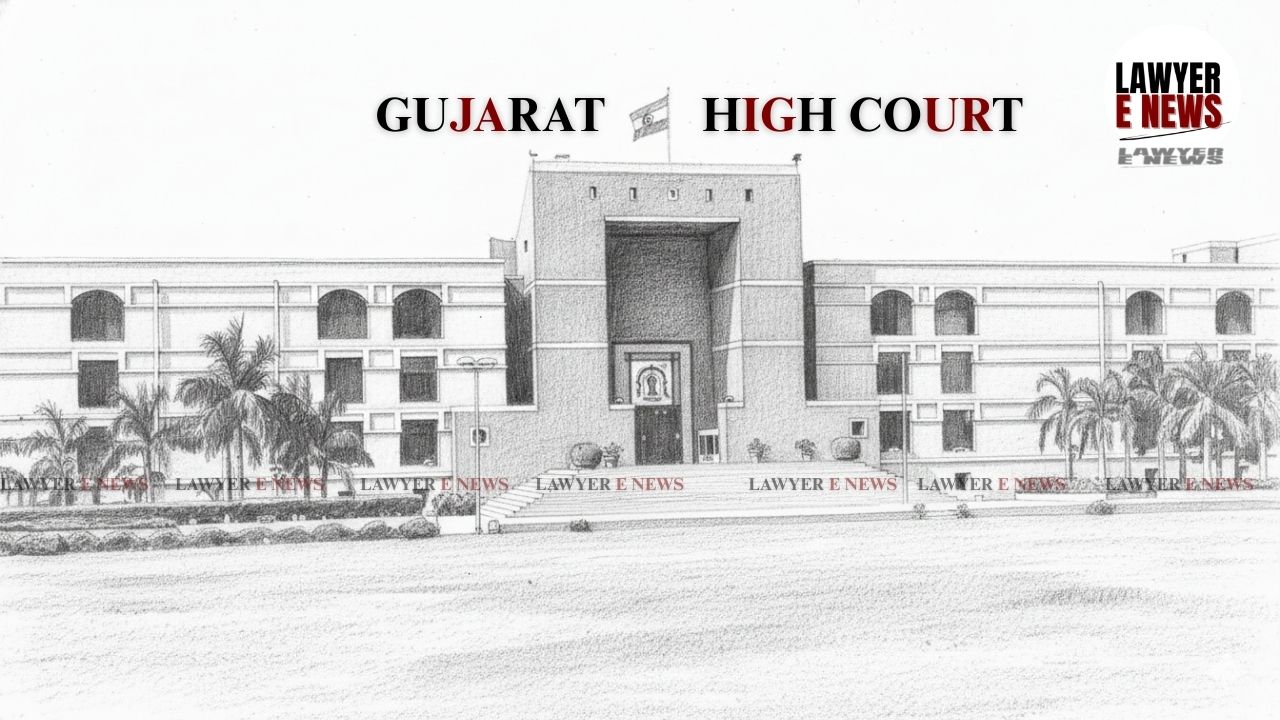
"Main object of PMLA is to prevent money laundering. The economic health of the Nation needs to be protected... It is needless to say that Sovereignty of nation always prevail over personal liberty." Gujarat High Court, in a significant judgment dated June 29, 2026, refused to grant regular bail to a former IAS officer and District Collector of Surendranagar accused of running a bribe-sharing syndicate for land use conversions.
A bench of Justice Hasmukh D. Suthar observed that money laundering is an "aggravated form of crime" with serious transnational impact, where the interests of the state's economic health must outweigh individual claims of personal liberty.
The Court emphasized that the "twin conditions" under Section 45 of the Prevention of Money Laundering Act (PMLA) create a "near-not bail" regime. The bench noted that the applicant, being the administrative head of the district, allegedly misused his substantial authority to facilitate the layering of illegal gratification through sham investments in the names of relatives.
The applicant, a 2015-batch IAS officer Sh. Rajendrakumar Mahendrabhai Patel, was arrested by the Enforcement Directorate (ED) following the registration of an ECIR in December 2025. It was alleged that during his tenure as the Collector of Surendranagar, a fixed bribe rate was established for 'Change of Land Use' (CLU) applications. The ED claimed that the applicant received a 50% share of all illegal gratifications collected by a syndicate involving subordinate revenue officials.
The primary question before the court was whether PMLA proceedings are maintainable in the absence of a charge-sheet in the predicate offence. The court was also called upon to determine if the applicant satisfied the mandatory twin conditions for bail under Section 45 of the PMLA and if medical grounds justified his release.
PMLA Offence As A Standalone Process
The Court dealt extensively with the argument that the PMLA complaint was not maintainable without a prior charge-sheet in the predicate offence under the PC Act. Relying on the landmark ruling in Vijay Madanlal Choudhary vs. Union of India, the bench observed that the offence of money laundering is an independent and standalone offence. The Court held that the arrest under Section 19 of the PMLA is a part of the investigation and does not depend on the progress of the scheduled offence.
The bench noted that as long as the scheduled offence is registered and not quashed or ended in acquittal, the ED is entitled to proceed. Justice Suthar remarked that the ED is not duty-bound to wait for the completion of the investigation into the predicate offence before taking action under the special statute.
Twin Conditions Of Section 45 PMLA Are Onerous - Court Explains High Threshold For Bail Under Special Statute
The Court highlighted that Section 45 of the PMLA reverses the presumption of innocence at the stage of bail. It noted that the court must be convinced there are valid reasons to believe the accused is innocent and unlikely to commit further offences. The bench characterized the PMLA as a "special statute" targeting economic offenders who ruin the economy of the State.
The Court observed that bail in PMLA cases is truly the exception and not the norm. It noted that the "triple test" of flight risk and tampering, applicable in general criminal law, is not the only criterion here, as the court must specifically satisfy itself regarding the "reason to believe" that the accused is not guilty.
Economic Offences Constitute A Distinct Class - Economic Crimes Affect The Social Fabric Of The Nation
Referencing State of Gujarat vs. Mohanlal Jitamalji Porwal, the Court observed that economic offences are committed with "cool calculation and deliberate design" for personal profit regardless of the consequence to the community. The bench noted that such white-collar crimes constitute a class apart and must be visited with a different approach than conventional crimes.
The Court stated that the magnitude of corruption in public life is incompatible with the foundation of democracy and the rule of law. It observed that as the administrative head of the district, the applicant was expected to perform his duties with integrity but instead allegedly indulged in "rampant large-scale corruption."
Role Of Former Collector And Potential For Tampering - Applicant Held To Be Kingpin Of The Bribe Syndicate
The Court took serious note of the digital evidence recovered, including 800 photographs of CLU applications on the applicant's personal mobile device. The bench observed that this indicated the applicant was monitoring the progress of files from which bribes were being generated. Furthermore, the Court highlighted the applicant's attempt to destroy evidence.
The bench noted that the applicant had searched "how to reset Samsung S24 Ultra" on Google just a day before the ED raid. "Such conduct speaks volume and clearly indicates that such photographs were not kept for supervision... but amounts to tampering with evidence," the Court observed. It held that the applicant was the final authority in the CLU process and played a key role in the deep-rooted conspiracy.
Denial Of Parity And Medical Grounds - Court Rejects Parity With Non-Arrested Co-Accused
The applicant had sought parity with other co-accused who were not arrested. The Court rejected this, stating that the applicant’s role as the final approving authority was different and higher than that of the subordinates. It noted that under the law, the investigating agency has the sole discretion to decide who shall be arrayed as an accused and who shall be arrested based on their individual culpability.
Regarding medical grounds, the applicant cited a "bucket handle tear of lateral meniscus" in his knee. However, the Court held that this did not fall into the category of "serious or life-threatening ailments" required under the proviso to Section 45 PMLA. The bench noted that the applicant could receive treatment and physiotherapy within the jail premises or seek temporary bail if a surgical emergency arose.
The Court concluded that the sovereignty and economic health of the nation must prevail over personal liberty in cases of grave economic distress. Finding no merit in the application and observing that the investigation into the concealment of the proceeds of crime was still ongoing, the High Court dismissed the bail plea.
Date of Decision: 29 June 2026