-
by sayum
11 August 2026 11:29 AM







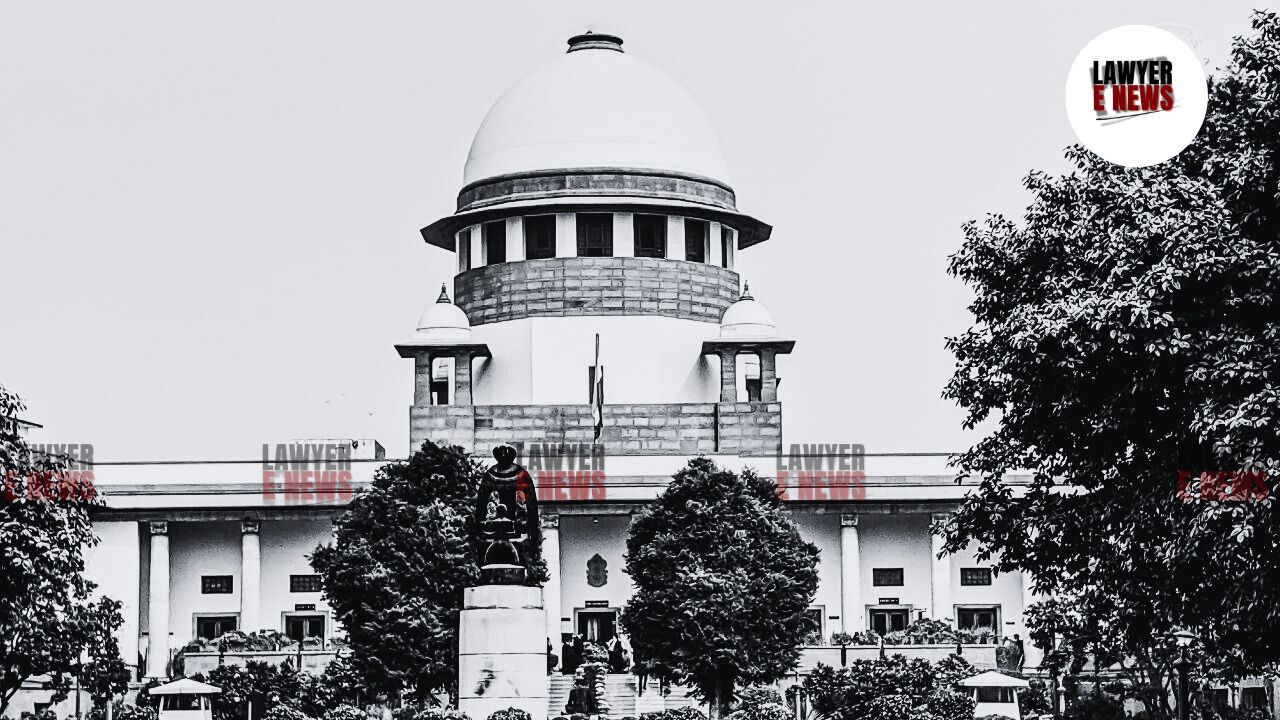
“If charges are not specific and the opportunity to defend is illusory, the entire inquiry collapses” — In a scathing rebuke of procedural lapses and violation of natural justice in disciplinary proceedings, the Supreme Court of India set aside the dismissal of a constable from the Bihar Police, declaring the entire inquiry process as "fatally flawed." Court held that the appellant had been "denied a proper and reasonable opportunity of defending himself" and that the charges levelled against him were "so bare that they were not capable of being intelligently understood.”
Justice Dipankar Datta, writing for the Bench, observed:
“The charges drawn up against him were vague, indefinite, unspecific and lacked essential particulars.”
The ruling reinstates the sanctity of fair process in disciplinary actions and sets a firm precedent against arbitrary dismissal, especially in cases involving similar allegations in criminal and departmental proceedings.
The appellant, Maharana Pratap Singh, joined the Crime Investigation Department (CID) of Bihar Police in 1973. On August 8, 1988, he was arrested on allegations of cheating, extortion, and impersonation in a case that later fell apart in criminal court. A departmental inquiry followed, and despite his acquittal by the Sessions Court in 1996, Singh was dismissed from service based on the inquiry’s findings.
The core charges included impersonation, failure to resume duty, and non-disclosure of his arrest. Singh challenged his dismissal before the High Court, where a Single Judge found the dismissal unlawful, but a Division Bench reversed that decision, prompting the appeal before the Supreme Court.
The Court dealt with multiple facets of fairness in disciplinary proceedings. At the heart of its reasoning was the failure of the authorities to supply a complete departmental file, even after a Supreme Court directive. This was considered damning.
“We regretfully record that neither has the departmental file been submitted for our perusal nor has the respondent-State of Bihar prayed for any extension of time. The consequence of non-compliance… is fatal,” the Court noted.
Critically, the Court held that the charges themselves were defective: “The charges were vague, indefinite, not specific and lacking in material particulars… The chargesheet contravened Rule 55 of the Rules of 1930.”
Citing Surath Chandra Chakrabarty v. State of West Bengal, the Court reaffirmed that disciplinary proceedings initiated with such defects are vitiated from the start.
The Court also flagged the denial of a fair opportunity to cross-examine a crucial witness (PW-1), whose testimony had formed the backbone of the inquiry report. The State failed to convincingly demonstrate that Singh had willingly waived this right.
“No reasonable person would voluntarily forgo a right of cross-examination, particularly when PW-1 was one of only two witnesses… and there were allegations of a personal vendetta,” the Court said.
Regarding the second witness (PW-2), the Court found that the Inquiry Officer chose to disbelieve his testimony purely because it came during cross-examination after a delay — a delay the State could not attribute to the appellant.
“Findings had to be returned neither on ipse dixit nor surmises and conjectures but on the basis of legal evidence,” the judgment emphasized.
While generally, acquittal in a criminal trial does not automatically negate findings in a departmental inquiry, the Court clarified that this principle breaks down where the charges, witnesses, and circumstances are identical.
“Where both proceedings rest on substantially similar foundations, sustaining dismissal after acquittal amounts to injustice,” the Court said, citing G.M. Tank v. State of Gujarat and Ram Lal v. State of Rajasthan.
It was especially telling that the complainant in the criminal case was never examined during the departmental proceedings and that both key witnesses refused to identify the appellant.
The Court acknowledged that the Single Judge may have overreached slightly into the merits, but stated that the Division Bench failed entirely to notice the glaring procedural violations.
“Such slip or oversight resulted in a failure of justice.”
The Supreme Court was categorical in finding that Singh's dismissal was not just harsh but unlawful, especially in light of the State's failure to produce the inquiry file.
While reinstatement was deemed impractical due to Singh's age (around 74 years), the Court ordered substantial monetary compensation, setting aside the orders of dismissal and awarding him ₹30 lakh in lieu of all service and retiral benefits, in addition to ₹5 lakh in costs.
“Ends of justice would be sufficiently served if we direct payment of a lumpsum compensation of ₹30 lakh,” the Court declared.
In holding the Bihar Police accountable for a fatally flawed disciplinary inquiry, the Supreme Court has drawn a firm line in defense of procedural justice. The message is unequivocal: vague charges, denial of cross-examination, and failure to produce records will not be tolerated, particularly when a public servant’s career and dignity are on the line.
“Natural justice is not a mere formality—it is the foundation of any disciplinary process.”
Date of Decision: April 23, 2025