-
by sayum
25 August 2026 9:55 AM







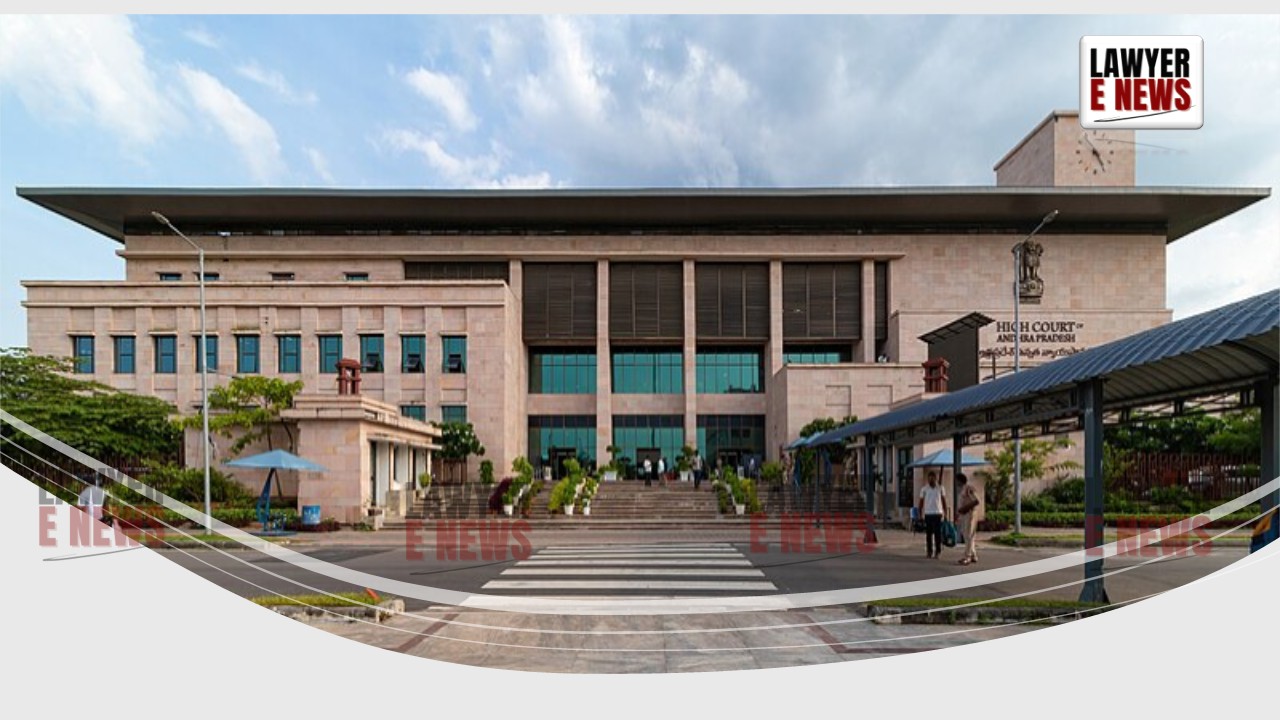
“This Court cannot pass orders on mere apprehensions... Demolition cannot be directed unless authority determines deviations and rejects regularization”: Andhra Pradesh High Court, in a common order delivered by Justice Harinath N., dismissed two writ petitions and closed a third in the matter of Tenneti Meenakshi Rajasekhar v. The State of Andhra Pradesh & Others, concerning allegations of unauthorized construction and misuse of residential property for hospital purposes. The court emphasized that “effective alternative remedies before municipal authorities must be exhausted, and writ jurisdiction under Article 226 cannot be used unless fraudulent misrepresentation is clearly established.”
The ruling dealt with three connected writ petitions—WP No. 12184 of 2024, WP No. 14603 of 2025, and WP No. 15771 of 2024—which arose out of a neighbour’s challenge to the construction of a multi-storey building in SBI Colony, Pedawaltair, Visakhapatnam, allegedly deviating from sanctioned plans and suspected to be intended for use as a hospital on a small residential plot.
Petitioner’s Allegations Based on Apprehension, Not Proven Facts: “This Court cannot pass orders on the apprehension of the petitioner”
The core of the petitioner’s grievance was that the private respondents (respondents 4 and 5) were constructing a “hospital-like” structure without due permission, allegedly violating setback norms and building regulations. However, the Court made it clear that no evidence had been placed before it to show a change in intended use or gross violations.
Refusing to act on speculation, the Court observed:
“As on date, the construction is still underway. This Court cannot determine as to what use the respondents 4 and 5 shall be putting the building to after completion of construction... This Court cannot pass orders on the apprehension of the petitioner.” [Para 22]
The Court noted that the building was approved for “mixed use” as defined under the Andhra Pradesh Building Rules, 2017, which includes residential and non-residential (except industrial) purposes. Since the respondents had clarified that they intended to open a doctor’s clinic and not a hospital or nursing home (which would require a minimum 300 sq.m. plot), the Court refused to interfere.
Writ Relief Not Maintainable When Effective Statutory Remedies Exist: Court Declines to Quash or Recall Building Permission
The petitioner had also sought cancellation of the building permission and demolition of the structure, claiming unauthorized construction. The High Court firmly held that such directions cannot be granted in writ jurisdiction unless there is proof of fraud or misrepresentation.
The Court relied on its earlier decision in WP No. 29895 of 2021 and reiterated:
“It is open for the petitioner to apply to the Commissioner seeking cancellation of permission by demonstrating material misrepresentation or fraudulent statement... Unless and until the respondent authorities determine the extent of deviations, there cannot be a direction issued for demolition.” [Para 25]
It further stressed that:
“The Commissioner of the 2nd respondent would have all the documents submitted by the applicant for approval. This Court, in a writ jurisdiction on the available material on record, cannot issue such a direction.” [Para 26]
Deviations Within Permissible Limits – Court Recognizes Right to Seek Regularization Under Government Orders
The respondents admitted minor deviations from the sanctioned building plan. However, they cited G.O.Ms.No.119 dated 28.03.2017, which permits compounding of minor deviations, and the newly introduced G.O.Ms.No.225 dated 12.11.2025, which enables regularization of unauthorized constructions subject to payment of penalties and compliance with specified criteria.
The Court accepted this submission and clarified:
“With the introduction of G.O.Ms.No.225... the respondents can invoke the said GO and submit the application seeking regularization... Until then, this Court cannot issue any adverse orders against the said construction.” [Para 25]
It also observed:
“The deviations in the subject building are claimed to be within the permissible limits for compounding... The petitioner cannot seek removal/demolition unless the regularization plea is rejected.” [Para 24]
Accordingly, the writ petitioners were directed to pursue their remedies under the statutory scheme.
Commissioner's Report Found No Construction Activity – Petitioner’s Objections Termed “Trivial”
An Advocate Commissioner was appointed by the Court upon the petitioner’s application to assess the alleged ongoing construction. The Commissioner found no current construction activity and could not determine when the prior activity had taken place.
The petitioner’s objections to the Commissioner’s report were rejected by the Court, which stated:
“The petitioner raised several trivial objections which are not substantive... The report of the Advocate Commissioner had clarified that there was no construction activity at the site.” [Paras 13-14]
This undermined the petitioner's case and supported the respondent's contention that the complaints were speculative and harassing in nature.
No Exceptional Circumstances Justifying Article 226 Jurisdiction – Petitions Dismissed with Liberty to Apply for Regularization
Ultimately, the Court held that there was no reason to invoke its extraordinary writ jurisdiction under Article 226 of the Constitution of India. It noted that the Municipal Corporation had already taken cognizance, issued notices under Sections 452(1) and 461(1) of the AP Municipal Corporations Act, 1955, and the respondents had replied and were willing to compound or regularize deviations.
Accordingly, the High Court dismissed WP Nos. 12184 of 2024 and 14603 of 2025, and closed WP No. 15771 of 2024, granting liberty to the private respondents to seek compounding or regularization, and directing the authorities not to interfere with construction pending such consideration.
Date of Decision: December 1, 2025