-
by sayum
04 August 2026 1:39 PM







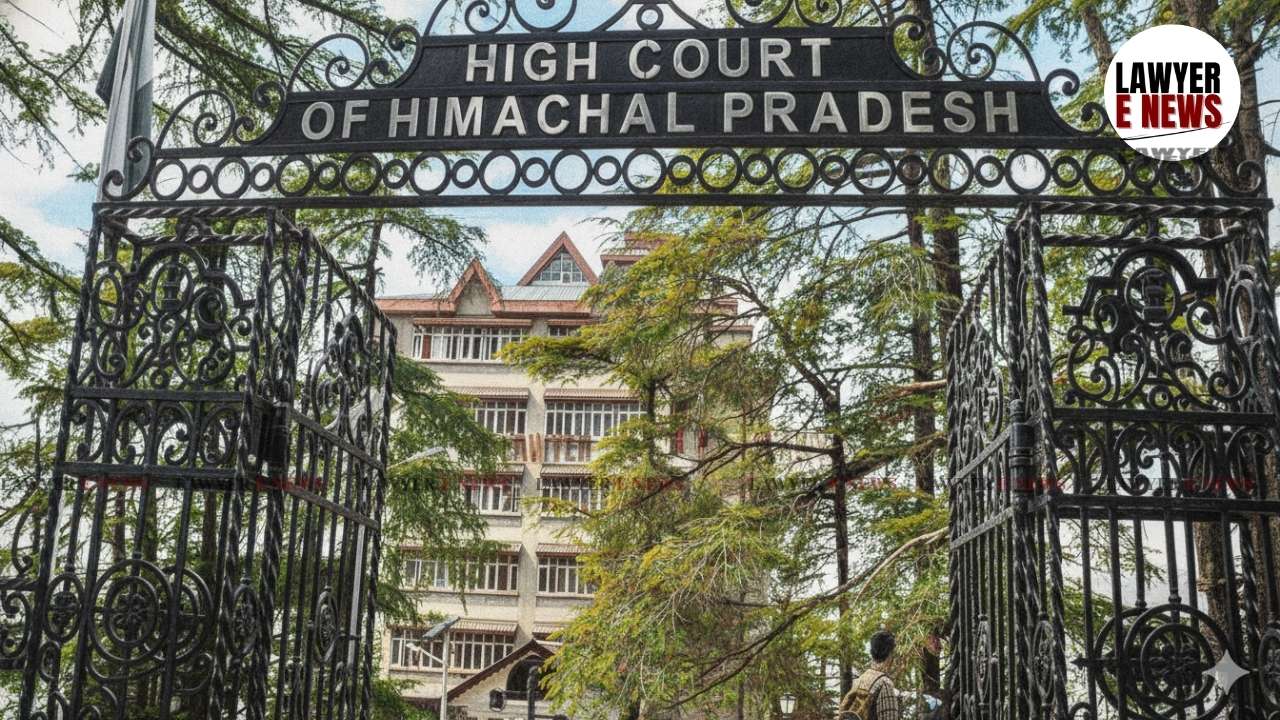
“Ownership Revives After De-Notification – Tenants Cannot Hide Behind Government Acquisition To Justify Illegal Construction”, In a decisive pronouncement on landlord-tenant relations, succession of tenancy, and ownership rights post land acquisition, the Himachal Pradesh High Court has upheld a mandatory injunction decree directing tenants to demolish two illegally constructed upper storeys of a building in Shimla. Justice Vivek Singh Thakur reaffirmed the right of the plaintiffs–landlords to seek demolition, notwithstanding the intervening land acquisition by the State.
“The eclipse on ownership due to acquisition does not extinguish the title. Once the acquisition was de-notified, the plaintiffs' ownership revived, and their right to seek demolition of unauthorized construction remained intact,” held the Court while rejecting the core plea of the tenants that the plaintiffs had no locus standi.
The dispute concerned premises situated in Ayercliff Estate, Shimla, originally leased to Dalip Chand Goel, the predecessor-in-interest of the appellants. The plaintiffs, legal heirs of Kulbhushan Bhagra, had instituted a suit seeking mandatory injunction for demolition of two upper storeys constructed without consent, claiming the structure was both unauthorized and dangerous.
“Succession of Tenancy Ends with the Widow – Others Are Unauthorised Occupants”
A critical question in the appeal involved the status of tenants after the death of the original tenant, Dalip Chand Goel. The appellants argued that the tenancy devolved collectively upon all legal heirs. The Court, however, held that under Explanation I and II of Section 2(j) of the Himachal Pradesh Urban Rent Control Act, 1987, only the widow of the deceased tenant, Smt. Jawala Devi, succeeded to the tenancy.
“After the death of the original tenant, only his surviving spouse, Jawala Devi, could lawfully succeed to the tenancy. Upon her death, the tenancy rights stood extinguished as per Explanation II. The remaining defendants are nothing but unauthorized occupants,” the Court ruled emphatically.
The Court observed that the defendants could not stretch the statutory scheme of succession under the Rent Act to claim continued tenancy rights beyond what is clearly provided.
“Explanation-II clearly mandates that the right to tenancy shall not devolve upon the heirs of a successor. This statutory limitation cannot be bypassed under any plea of extended family occupation,” Justice Thakur noted.
“Title Once Revived Cannot Be Denied: Plaintiffs Entitled to Relief Despite Acquisition History”
The tenants had contended that the plaintiffs had no right to sue since the land had been acquired by the State in 1989, and that the unauthorized construction occurred during the period when the State was the owner. However, this argument was firmly rejected.
“After de-notification in 1991, the ownership reverted to the plaintiffs. The temporary title of the State cannot defeat the plaintiffs’ permanent rights as owners. The doctrine of revival of title applies squarely,” the Court observed.
The Court elaborated that eclipse on title due to acquisition does not extinguish ownership, and after de-notification, the original title stood revived automatically.
In addition, the Court noted that rent continued to be paid to the landlords even after the acquisition, indicating clear acknowledgment of the landlord-tenant relationship despite the temporary acquisition.
“Illegal Construction Without Sanction or Consent Cannot Be Legalized by Delay or Sale”
Relying on the technical report (Ex. PW-4/A) and demolition order dated 24.01.1992, the High Court concluded that the construction was not only unauthorized but also structurally dangerous.
“The two additional floors were constructed without permission from the plaintiffs and without municipal sanction. The construction was found structurally unsafe, and the suit for demolition was both justified and necessary,” the Court affirmed.
Applications filed by the appellants to introduce additional evidence — including sale deeds and partition documents executed long after the suit — were rejected as irrelevant.
“These documents are unrelated to the suit premises and were generated long after the plaintiffs had instituted the suit. Post-suit transactions cannot defeat a cause of action that had already matured,” Justice Thakur held, citing Pasupuleti Venkateswarlu v. Motor & General Traders and Rajeshwar v. Jot Ram to reiterate that rights must be determined as on the date of institution of suit.
“Suit Maintainable Without Joining State or Municipality – Landlord’s Right to Protect Property Cannot Be Delayed by Technicalities”
The appellants also questioned the maintainability of the suit, arguing that the State and Municipal Corporation should have been impleaded. The Court squarely rejected this procedural objection.
“The suit was filed by the plaintiffs based on their independent ownership rights. The absence of the State or Municipal Corporation as parties does not render the suit defective when the core relief relates to unauthorized construction on the landlord’s premises,” the Court clarified.
Relying on decisions such as Kanaklata Das v. Naba Kumar Das and Kasthuri Radhakrishnan v. Chinniyan, the Court reiterated that a co-owner is competent to file a suit for enforcement of possessory rights, even without the joinder of all owners.
It further observed:
“Availing remedy under the Rent Control Act does not bar the landlord from initiating a civil suit for demolition of illegal construction. Remedies are not mutually exclusive.”
“Substantial Questions of Law Fail – Second Appeal Dismissed”
The High Court carefully analyzed and answered all six substantial questions of law, which included issues relating to valuation of the plaint, legal standing of the plaintiffs, succession of tenancy, and procedural objections. On each count, the Court sided with the plaintiffs and found no perversity or illegality in the first appellate court’s judgment.
“There is no irregularity or error in the first appellate court’s findings. The appeal lacks merit and is accordingly dismissed,” concluded the Court.
The judgment offers a comprehensive legal roadmap for practitioners dealing with unauthorized constructions by tenants, succession under rent laws, revival of title post-acquisition, and the scope of civil suits despite alternate statutory remedies.
Date of Decision: 11 November 2025