-
by sayum
24 August 2026 3:22 PM







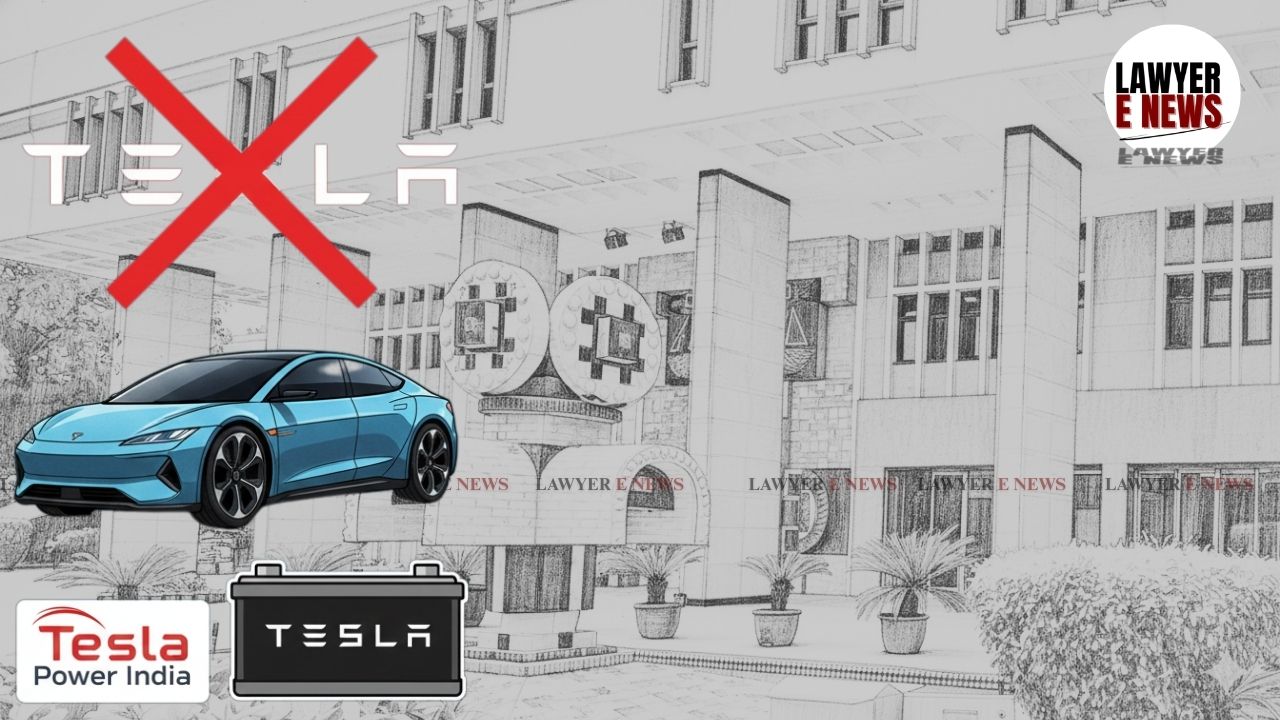
“This is a case of triple identity where the Plaintiff’s Trade Marks and the Impugned Trade Marks are identical, the product category is identical and the trade channel as also the consumer base is identical.” In a latest judgement High Court of Delhi clarifying the principles of trans-border reputation and the doctrine of 'initial interest confusion', has granted an interim injunction in favour of the US-based EV giant, Tesla Inc. The Court restrained the Defendants, Tesla Power India Private Limited and others, from using the trademarks ‘TESLA POWER’, ‘TESLA POWER USA’, or any other mark deceptively similar to the Plaintiff’s well-known ‘TESLA’ mark. The ruling categorically establishes that lead-acid batteries and inverters are "allied and cognate" to electric vehicles (EVs), thereby constituting infringement even if the specific goods differ slightly.
“The infringer’s objective may be served merely by diverting the consumer’s initial attention... even such transient confusion at the initial stage is sufficient to meet the requirement of deceptive similarity.”—High Court of Delhi affirms the test of Initial Interest Confusion
At the heart of the dispute in this case was the blatant adoption of the mark ‘TESLA’ by an Indian entity for marketing batteries, inverters, and UPS systems, while also alluding to a launch of electric vehicles. The Single Judge Bench of Justice Tejas Karia was seized of the question whether Tesla Inc., despite having limited direct sales of vehicles in India at the time of filing, possessed sufficient trans-border reputation to protect its mark against a local entity claiming to be inspired by the scientist Nikola Tesla.
The dispute arose when Tesla Inc. (Plaintiff), the registered proprietor of the ‘TESLA’ mark since 2013 in India (Class 12, 37, and 09), discovered that the Defendants were marketing products under the names ‘TESLA POWER USA’ and ‘TESLA POWER’. The Plaintiff, having adopted the mark in 2003 and generating a revenue of $98.6 billion in 2023, alleged that the Defendants were riding on its global goodwill. The Defendants argued that their mark was inspired by the inventor Nikola Tesla, that ‘TESLA’ is a common surname/generic term, and that they had been using it since 2020. They further contended that the Plaintiff had acquiesced to the use by delaying the suit until 2024.
The Court categorically held that the Plaintiff’s reputation is not confined to geographical borders. Citing the "overwhelming goodwill" and the massive traffic to Tesla’s website from India, the Bench noted that the reputation of the ‘TESLA’ mark had clearly travelled to India. The Court observed that in the modern digital era, physical presence is not a sine qua non for reputation. The Bench rejected the Defendants' reliance on Toyota Jidosha Kabushiki Kaisha v. Prius Auto Industries Ltd. to deny relief, distinguishing the present facts by noting the Plaintiff's actual use and significant global recognition which had permeated the Indian market.
The Bench noted that the Plaintiff held registrations in Class 12 (Automobiles) and Class 09 (Inverters). It held that batteries are an intrinsic and structural part of automobiles, particularly EVs. Consequently, the Defendants’ goods (batteries, inverters, UPS) were held to be allied and cognate to the Plaintiff’s goods. The Court reasoned that a consumer of average intelligence would inevitably associate ‘TESLA POWER’ batteries with the renowned EV manufacturer, Tesla Inc.
The Court came down heavily on the Defendants for adding the suffix "USA" to their mark (‘TESLA POWER USA’) despite having no client base or operations in the United States. The Bench termed this adoption as "prima facie dishonest" and intended to mislead consumers into believing a connection with the US-based Plaintiff. The Court applied the "Initial Interest Confusion" test, holding that even if the confusion is transient and cleared before the final purchase, the initial deception is sufficient to constitute infringement under Section 29 of the Trade Marks Act, 1999.
The Defendants attempted to argue that ‘TESLA’ is a generic word or common to trade (being a surname). However, the Court observed that the Defendants themselves had applied for registration of the ‘TESLA POWER’ mark. Invoking the principle of estoppel, the Court held that a party cannot "approbate and reprobate"—they cannot claim a mark is proprietary when applying for it, and simultaneously claim it is generic when sued for infringement.
Addressing the Defendants' argument that the Plaintiff delayed filing the suit from 2022 (Cease & Desist notice) to 2024, the Court relied on the Supreme Court’s ruling in Midas Hygiene Industries. It held that where the adoption of the mark is dishonest ab initio, delay or laches is not a valid ground to deny an interim injunction.
* Restrains the Defendants from using ‘TESLA POWER’, ‘TESLA POWER USA’, or any deceptive variation for batteries, inverters, UPS, or EVs.
* Confirms that batteries and inverters are allied/cognate goods to Electric Vehicles.
* Establishes that "Initial Interest Confusion" is a valid ground for finding infringement.
* Reaffirms that a defendant cannot claim a mark is "common to trade" if they have themselves applied for its registration.
Date of Decision: 24/11/2025