-
by sayum
25 August 2026 6:19 AM







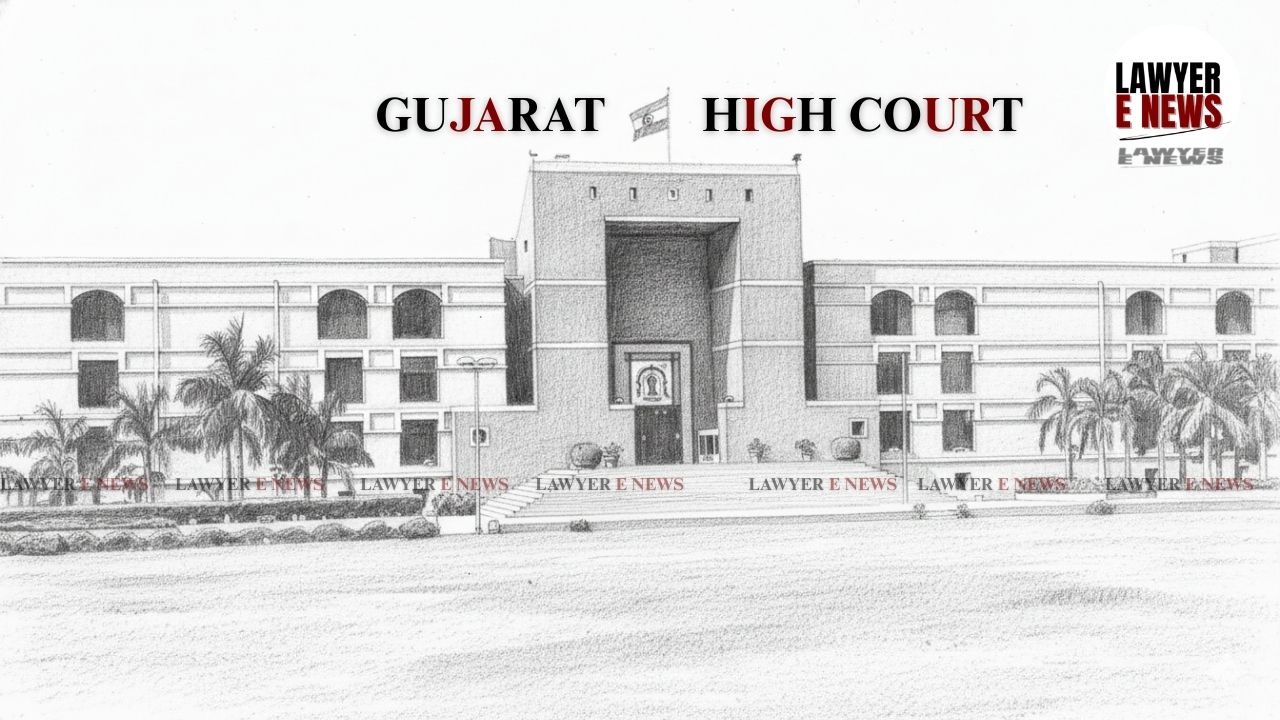
“Ocular testimony that suppresses fatal injuries on accused’s side while claiming a one-sided assault is unsafe for conviction” –High Court of Gujarat decisively dismissed a criminal appeal filed by the State challenging the acquittal of nine accused persons in a case arising out of a village group clash. In State of Gujarat v. Kanak Sinh Ganpat Sinh Parmar & Others [Criminal Appeal No. 213 of 2001], a Division Bench comprising Hon’ble Mr. Justice Ilesh J. Vora and Hon’ble Mr. Justice R.T. Vachhani upheld the trial court’s judgment and concluded that the prosecution’s case was riddled with inconsistencies, contradictions, and a fatal suppression of material facts — particularly, the failure to disclose the death of the accused’s father in the cross-case arising from the same incident.
The Bench reiterated that where the prosecution witnesses are themselves accused in the cross-case involving the death of a person, and where their statements selectively omit the version they gave to police, their evidence becomes inherently unreliable. The Court held:
“The ocular witnesses are not only closely inter-related but are themselves accused of murder and grievous hurt in the cross-case... they have made material improvements... by completely suppressing... the fatal injuries sustained by Ganpatsinh which they had candidly admitted before the police”.
“In Cross-Case Scenarios, Suppression of Facts is Fatal – Testimony Must Be Independently Corroborated”
The incident, which took place on 13.06.1993 in Halol Taluka, Panchmahals, involved two rival groups, each of which filed an FIR. In the prosecution’s version, the accused allegedly formed an unlawful assembly and attacked the complainant side with weapons including bhala, dhariya, knife, and sticks, causing serious injuries and threatening death.
However, the same witnesses — the complainant and his close relatives — were also named as accused in the cross-FIR C.R. No. I-170/1993 for the death of the accused’s father, Ganpatsinh, who succumbed to head injuries the day after the incident. The Court observed:
“The complainant’s failure to mention these fatal injuries in his court testimony, despite admitting them in police statements, renders his version deeply suspect. No court can sustain a conviction on such partisan and suppressed narrative”.
The Court noted that all the injured witnesses — PW-3, PW-4, PW-6, and PW-7 — admitted in cross-examination that they had told the police the incident was a mutual fight, but in court, they gave a wholly one-sided account. This amounted to deliberate suppression of facts.
“Medical Evidence Shows Only Simple Injuries – No Knife Injury to Chest as Alleged”
The Court found that the medical certificates (Exhs. 32–37, 41, 43) showed only abrasions and lacerated wounds, with no grievous or life-threatening injuries. This was entirely inconsistent with the prosecution’s allegation that a knife blow was delivered to the chest, or that a hand was nearly severed.
“The medical evidence does not support the ocular version. Injuries described as chest blows with knife turned out to be mere lacerations. This wholly undermines the credibility of the narrative of a lethal attack”.
Furthermore, the forensic report (Exh. 66) was inconclusive, and no tamancha (pistol) was ever recovered, despite threats under Section 506(2) IPC being a part of the charge.
“No Independent Witnesses Examined Despite Several Named in FIR”
Despite the FIR mentioning multiple independent villagers as interveners — including Somabhai Fulabhai and Mangal @ Yogibhai — the prosecution failed to examine a single independent witness. The village had 60–70 houses, yet all witnesses presented were close relatives of the complainant and themselves accused of murder in the cross-case.
“In factional village clashes giving rise to cross-FIRs... ocular evidence requires strong independent corroboration, which is conspicuously absent”.
The Bench criticized this approach and held that the prosecution’s failure to bring on record neutral testimony was a significant flaw that undermined the credibility of the entire prosecution case.
“Trial Court’s View Is Not Only Possible but Probable – Appellate Court Will Not Interfere”
Citing Supreme Court precedents, particularly Rajesh Prasad v. State of Bihar [(2022) 3 SCC 471] and H.D. Sundara v. State of Karnataka [(2023) 9 SCC 581], the Court reaffirmed that in an appeal against acquittal, the appellate court must respect the double presumption of innocence and interfere only if the trial court’s view is wholly untenable.
“If two reasonable conclusions are possible... the appellate court should not disturb the finding of acquittal recorded by the trial court” – Chandrappa v. State of Karnataka was once again cited as governing authority.
The High Court concluded that:
“The cumulative effect of the partisan testimony, medical inconsistencies, suppression of cross-injuries, lack of independent corroboration, and inconclusive forensic recovery compels us to hold that the trial court’s judgment is not only possible but proper”.
Acquittal Based on Sound Judicial Reasoning, Not to Be Disturbed
Ultimately, the Division Bench dismissed the State’s appeal, refusing to interfere with the acquittal recorded by the trial court 25 years ago. The High Court found that the prosecution had failed to prove the guilt of the accused beyond reasonable doubt, particularly in a situation involving cross-cases, mutual fight, and hostile village factions.
“The Writ Appeal is devoid of merits and is accordingly dismissed. Records and proceedings be remitted to the Court concerned forthwith”.
This judgment serves as a powerful reaffirmation of the criminal law principle that in cases of doubt, the benefit must go to the accused — especially where the prosecution’s own witnesses are deeply compromised.
Date of Decision: 02 December 2025