-
by sayum
25 August 2026 12:32 PM







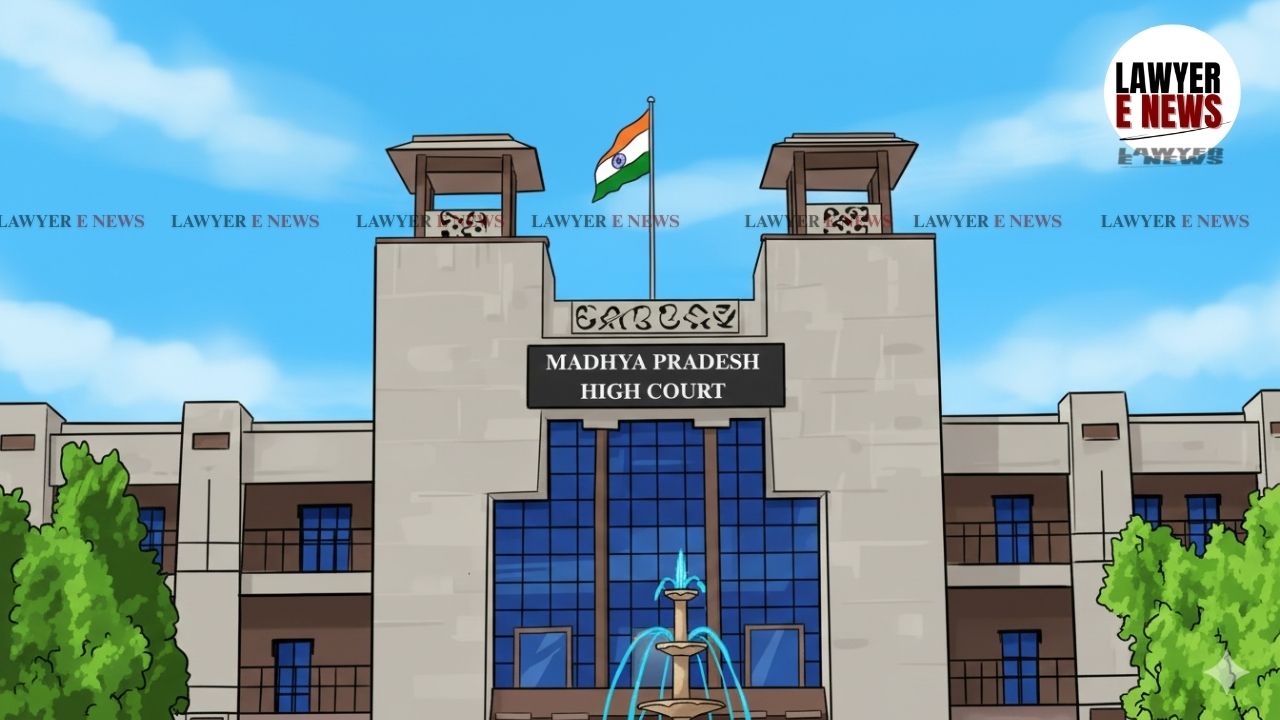
“Article 227 Is Not an Appellate Jurisdiction”, In a reportable judgment Madhya Pradesh High Court at Indore dismissed a petition under Article 227 of the Constitution challenging concurrent findings rejecting substitution of an alleged legatee in a long-pending partition suit.
Justice Alok Awasthi held that though an inquiry under Order XXII Rule 5 CPC is summary in nature, the Court must still be satisfied prima facie about the authenticity of the Will and the status of the applicant as legal representative. Where both the Trial Court and Appellate Court found the Will unproved and surrounded by suspicious circumstances, the High Court, exercising supervisory jurisdiction, cannot re-appreciate evidence as if sitting in appeal.
The Court concluded that no jurisdictional error, perversity, or manifest failure of justice was made out to warrant interference under Article 227.
Partition Suit, Death of Plaintiff and Claim Under Will
The litigation traces back to a civil suit for partition filed in 1982 by Shankarlal against his brother and other family members in respect of joint family agricultural lands.
During the pendency of the suit, Shankarlal died unmarried and issueless on 19.12.1992. It was claimed that he had executed a Will dated 05.03.1984 in favour of his nephew Fakirchand, who had allegedly been looking after him. On the strength of the said Will, Fakirchand filed applications under Order XXII Rules 3, 9 and 10 CPC along with an application under Section 5 of the Limitation Act seeking substitution as legal representative of the deceased plaintiff.
The matter witnessed a protracted procedural journey. The suit was dismissed for want of prosecution, restoration was sought and rejected, appeals followed, and the High Court earlier directed the Trial Court to specifically inquire “whether Fakirchand is a legal representative of Shankarlal on the strength of the will alleged to have been executed.”
Upon conducting the directed inquiry, the Trial Court, by order dated 24.11.2007, held that the Will was not proved and rejected substitution. Consequently, the suit was dismissed for want of a legal representative. The Appellate Court affirmed the finding on 30.06.2017. The present petition under Article 227 challenged these concurrent findings.
“Contradictions and Suspicious Circumstances Surround the Will”
The High Court examined the reasoning of the Courts below, particularly the testimony of the attesting witness Mohammad Farooq Ansari (PW-2).
The Appellate Court had noted significant contradictions. The witness admitted that the name of the person who prepared the document is ordinarily written on it, yet the alleged Will did not mention the typist’s name nor the drafting advocate. He was unable to say whether the advocate had signed the document. He further conceded that though the advocate had registered many documents, he did not know why this Will was not registered.
There were material inconsistencies regarding who was present at the time of drafting and typing. Fakirchand stated that he was present with Shankarlal, whereas the attesting witness claimed that no one else was there when he met Shankarlal. The witness also admitted that the thumb impressions on the first and second pages differed in thickness and appearance.
The Appellate Court concluded that the evidence was not credible and that execution of the Will dated 05.03.1984 was not satisfactorily proved.
Justice Awasthi observed that the petitioners had failed to produce the original Will and relied only upon a copy. The authenticity and due execution were not established in accordance with Section 63 of the Indian Succession Act and Section 68 of the Indian Evidence Act.
“Summary Inquiry Does Not Dilute Requirement of Prima Facie Satisfaction”
The petitioners argued that inquiry under Order XXII Rule 5 CPC is summary and that examination of one attesting witness suffices to prove a Will, relying upon Ram Bai Padmakar v. Rukmini Bai and Dashrath Rao Kate v. Brijmohan Srivastav.
The High Court acknowledged the settled principle that findings under Order XXII Rule 5 are summary and do not operate as res judicata inter se rival claimants. However, it emphasized that even in a summary inquiry, the Court must reach prima facie satisfaction regarding legal representation.
Where the evidence itself is found unreliable and contradictory, the Court is justified in refusing substitution. The High Court found that a detailed evaluation had already been undertaken pursuant to earlier directions, and no repetitive or mechanical acceptance of the Will was warranted.
The argument that in a partition suit the positions of plaintiff and defendant are interchangeable was also rejected in the factual matrix. While transposition is legally permissible, continuation of the suit requires a legally sustainable claim to represent the deceased’s estate. In absence of valid substitution, the suit could not proceed.
“Article 227 Is Meant to Keep Courts Within Bounds of Authority”
The High Court placed strong reliance on the Supreme Court’s authoritative pronouncement in Shalini Shyam Shetty v. Rajendra Shankar Patil, reiterating that Article 227 confers supervisory, not appellate, jurisdiction.
Quoting paragraph 49 of Shalini Shyam Shetty, the Court underscored that the High Court cannot interfere “on the drop of a hat” nor act as a Court of appeal. Interference is permissible only to keep subordinate courts “within the bounds of their authority,” or in cases of patent perversity, gross failure of justice, or violation of natural justice.
Justice Awasthi held that the orders of the Trial Court and Appellate Court neither suffered from jurisdictional error nor from perversity. The petition essentially invited re-appreciation of evidence, which is impermissible under Article 227.
No Interference – Liberty to File Fresh Suit
Finding no patent illegality or manifest injustice, the High Court dismissed the Miscellaneous Petition. However, liberty was reserved to the petitioners to institute a fresh partition suit, if so advised.
The judgment draws a clear line between a “summary inquiry” and a “casual acceptance” of a disputed Will. Even at the stage of substitution under Order XXII Rule 5 CPC, the Court must be prima facie satisfied about legal representation. Suspicious circumstances, contradictions in testimony, and non-production of the original Will can legitimately defeat a claim.
Equally significant is the Court’s reiteration that Article 227 is not a corrective forum for re-evaluating factual findings. Supervisory jurisdiction is to ensure discipline and legality in subordinate courts, not to function as a parallel appellate mechanism.
Date of Decision: 10 February 2026