-
by sayum
25 August 2026 12:32 PM







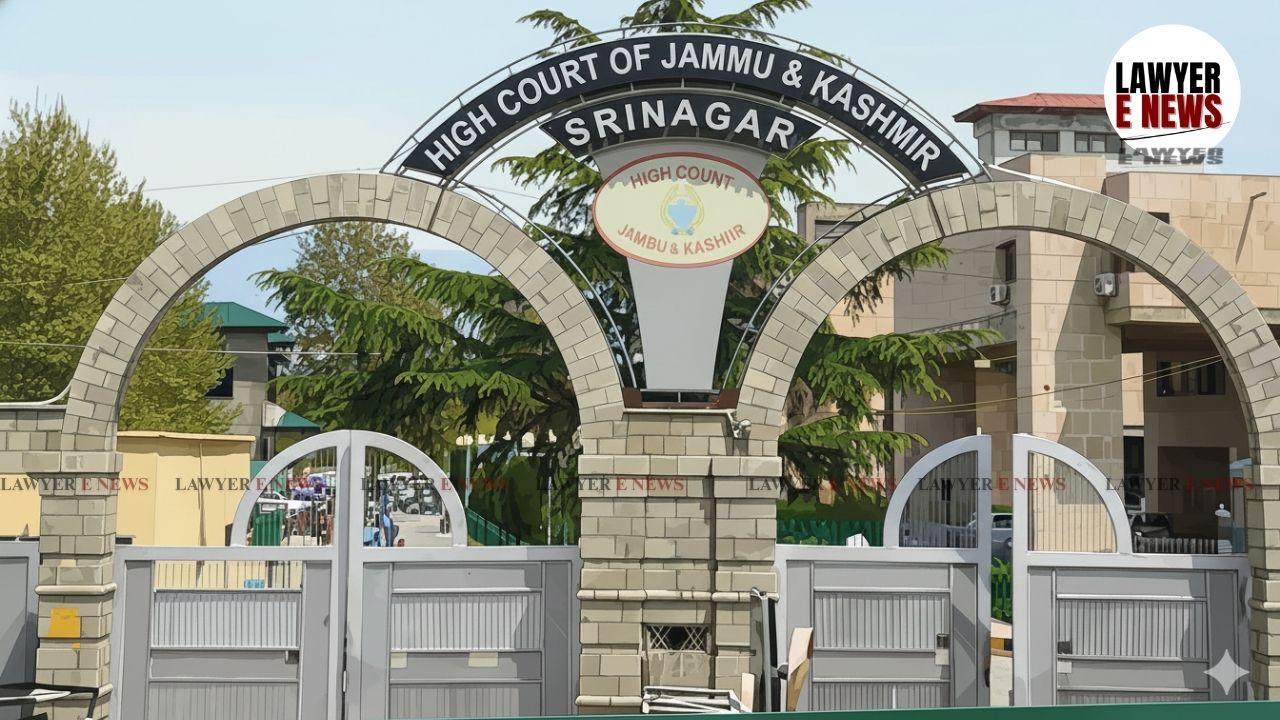
“Delay Cannot Legalise an Unconstitutional Occupation — Article 300-A Still Protects the Citizen’s Land”, High Court of Jammu and Kashmir and Ladakh at Jammu, through Justice Rajnesh Oswal, delivered a strongly worded and reportable judgment, holding that State instrumentalities cannot continue in unauthorized occupation of private land and then seek refuge behind technical pleas of delay and laches.
Allowing the writ petition, the Court declared that the continued possession of 41 kanals and 02 marlas of land at Village Birpur, District Samba, by SICOP and SIDCO without acquisition or compensation amounted to trespass and a clear violation of Article 300-A of the Constitution. The respondents were directed to either restore possession within three months or initiate acquisition proceedings under the 2013 Land Acquisition Act, along with payment of rental compensation for decades of illegal occupation.
The petitioners, heirs of late Thakur Lakshman Singh Charak, approached the High Court complaining that their ancestral land measuring 41 kanals 02 marlas under Khasra No. 1651, Village Birpur, had been under the unauthorized occupation of SICOP/SIDCO since 1983–84. Despite consistent entries in Jamabandi and Khasra Girdawari showing the petitioners as owners and cultivators, the land was allegedly taken over for the Birpur Industrial Estate without any acquisition proceedings, award, or payment of compensation.
The petitioners contended that they became aware of the illegal occupation only in 2021, after accessing revenue records that had earlier been seized in connection with the Birpur land scam. Multiple RTI replies, coupled with court-directed demarcation reports, revealed a startling fact — SICOP and SIDCO were physically in possession of the land, had even constructed a road, yet had no entry whatsoever in the revenue records.
The State and its agencies resisted the petition, raising objections of delay and laches, alleged disputed questions of fact, and claiming that the land had been transferred decades earlier for industrial purposes.
“Right to Property Is No Longer Fundamental, But It Is Still Constitutional and Human”
Rejecting the plea of delay outright, the Court held that the doctrine of laches cannot be used as a shield to justify continuing unconstitutional deprivation of property. Justice Rajnesh Oswal observed that dismissing such a petition on technical grounds would “effectively reward the State for its own high-handed conduct”.
Relying heavily on Supreme Court precedents, the Court reiterated that the right to property, though no longer a fundamental right, remains a constitutional and human right under Article 300-A, and deprivation is permissible only by authority of law. The judgment echoes the Supreme Court’s words in Tukaram Kana Joshi, noting that the State cannot treat a citizen as a “subject of medieval India” while occupying land without legal sanction.
The Court emphasised that unauthorized possession by the State constitutes a continuing wrong, and therefore, delay does not extinguish the cause of action. It held that “the State cannot be permitted to rely upon the doctrine of laches to legitimise an ongoing illegality”.
“Disputed Facts Is a Convenient Excuse When State’s Own Records Expose Illegality”
The respondents’ objection that the writ petition involved disputed questions of fact was firmly rejected. The Court noted that the revenue authorities themselves admitted the petitioners’ title and the absence of any entry in favour of SICOP or SIDCO, and that demarcation reports ordered by the Court conclusively established unauthorized possession.
Justice Oswal held that when official records, RTI replies, and admissions by the State clearly establish illegality, the writ court is not powerless. Quoting the Supreme Court, the Court observed that “merely labelling an issue as ‘disputed’ does not oust Article 226 jurisdiction,” especially when the State’s own material falsifies its defence.
“No Acquisition, No Compensation, No Revenue Entry — This Is Pure Trespass”
After an exhaustive analysis of the demarcation reports, the Court recorded that Khasra No. 1651 is physically occupied by SICOP and SIDCO, yet continues to stand in the names of the petitioners and their predecessors in the revenue records. The Court found it significant that the very list of survey numbers claimed to have been acquired for the Birpur Industrial Estate does not include Khasra No. 1651.
The judgment notes that while other lands belonging to the petitioners’ family were acquired through negotiation and compensation was duly paid, the land in question was never acquired at all. This omission, the Court held, was fatal to the respondents’ case.
Justice Oswal concluded in clear terms that the occupation of the land by SICOP and SIDCO was “a clear act of trespass, as they hold neither title nor valid revenue records in respect thereof”.
“The State Has Only Two Choices: Vacate or Acquire”
Holding that the State cannot seize private property through high-handedness, the Court ruled that the respondents had only two legally sustainable options. Either they must restore possession of the land to the petitioners, or they must initiate acquisition proceedings strictly in accordance with the Right to Fair Compensation and Transparency in Land Acquisition, Rehabilitation and Resettlement Act, 2013.
Importantly, the Court went a step further and directed that rental compensation must be assessed and paid for the entire period of unauthorized occupation, should the respondents opt to restore possession.
Allowing the writ petition, the High Court issued a powerful reaffirmation of constitutional governance, holding that Article 300-A is not an empty promise and that the State cannot normalise illegality by the mere passage of time. The judgment reinforces that courts must prioritise substantive justice over technical defences, particularly when citizens are dispossessed of their land without law, compensation, or accountability.
The decision stands as a sharp reminder that industrial development cannot be built on unconstitutional expropriation, and that the rule of law binds the State as firmly as it binds the citizen.
Date of Decision: 06 February 2026