
-
by sayum
25 August 2026 12:32 PM







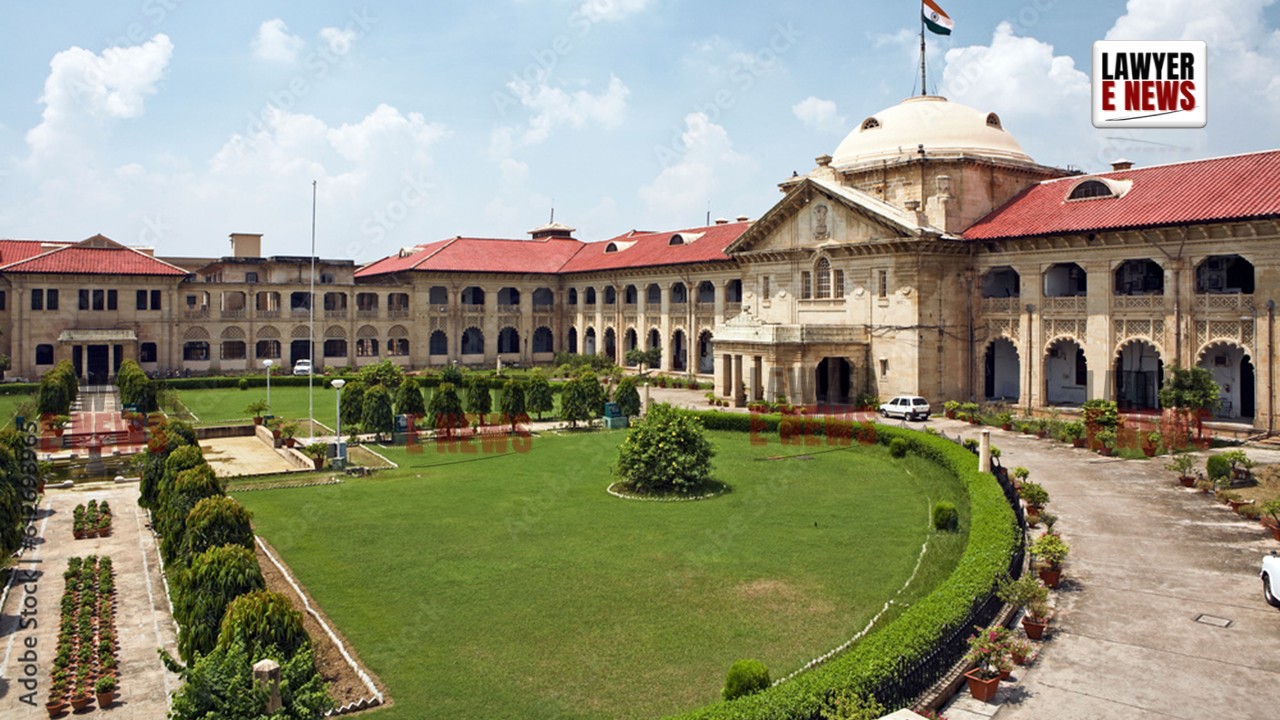
“Criminal Law Cannot Be Used to Intimidate RWA Officials Who Enforce Rules”: In a sharp and unequivocal ruling that underscores the judicial intolerance for misuse of criminal law to settle personal scores, the Allahabad High Court (Lucknow Bench) on 9 February 2026 quashed the entire criminal proceedings initiated against three members of the Resident Welfare Association (RWA) of Celebrity Greens, Lucknow, including the President, Secretary, and Caretaker, calling the case “a classic misuse of law to browbeat elected members of a housing society.”
Justice Pankaj Bhatia declared in no uncertain terms that the allegations in the FIR “do not even remotely satisfy the ingredients of the offences alleged,” and that the proceedings were motivated, frivolous, and designed to harass elected office bearers acting within the four corners of law.
“The conduct of the Investigating Officer is not just perfunctory, but borders on being malicious,” observed the Court, expressing deep displeasure at the biased and one-sided investigation, and even going so far as to direct the DGP to consider barring the officer from sensitive investigations in future.
The matter revolved around a ₹500 parking fine imposed under a duly passed RWA resolution, which the complainant – a resident who also described himself as a trustee of an RSS-affiliated trust – alleged to be an act of extortion, intimidation, and insult under the Bharatiya Nyaya Sanhita (BNS), 2023.
But the Court made it clear: “A ₹500 warning issued under housing society rules does not amount to extortion under Section 308(2) BNS.”
“Bhajan Lal Guidelines Fully Attracted – FIR Aimed at Personal Vendetta, Not Law Enforcement”
The judgment begins by invoking the Bhajan Lal principles, which permit quashing of criminal proceedings where even if all allegations are accepted as true, no cognizable offence is made out.
“The Bhajan Lal judgment continues to be the judicial benchmark for testing abuse of process. This case falls squarely within its categories,” said the Court.
It was further held that none of the three provisions invoked in the FIR—Section 308(2) (extortion), Section 351(2) (criminal intimidation), and Section 352 (intentional insult to provoke breach of peace)—could be sustained either in law or on facts.
“There is no whisper in the charge sheet or FIR that the petitioners ever received any amount, nor is there material to establish that the informant was intentionally put in fear,” said the Court while dealing with the extortion charge.
Similarly, on the allegation of criminal intimidation, the Court held that there was not even a rudimentary allegation that the petitioners threatened the complainant with injury to person or property.
“RWA Enforcing a Resolution Is Not a Crime – Such Allegations Are Insult to Common Sense”
In what will be a deeply reassuring precedent for housing societies across India, the High Court emphasized that society resolutions, when passed democratically, are enforceable in law, and that taking administrative steps to ensure compliance cannot be criminalised.
“Attempting to cast the elected representatives of a registered RWA as criminals for implementing a resolution reflects a disturbing trend of personal vendetta being clothed in the garb of criminal law,” Justice Bhatia remarked.
The complainant had alleged that his daughter’s car was targeted and a fine of ₹500 was demanded without authority. However, the Court found that:
“There is no allegation that the money was ever paid. Even if it was, the demand arose from a resolution passed by the governing body of the RWA. This does not constitute extortion under any stretch of the legal imagination.”
“One-Sided Investigation Betrays Fairness – Officer’s Conduct Deserves Adverse Entry”
The Court also delivered a strong indictment of the investigating officer, noting with concern that the entire charge sheet was built only on the statement of the informant and the accused, with no independent witnesses examined, despite the matter involving a residential community.
“No attempt was made to verify the RWA resolution, the rulebook, or obtain views of other residents,” the Court observed, terming the investigation “perfunctory and designed to support a predetermined narrative.”
“The Investigating Officer acted with a bias that renders the investigation legally unsustainable. His conduct deserves to be recorded with adverse remarks in his ACR,” the Court directed, forwarding the order to the Director General of Police (DGP) for further action.
“Misusing the Name of RSS for Petty Grievances Is Unethical” – Court Takes Note of Politicisation
In a remarkable observation, Justice Bhatia referred to the complainant’s repeated invocation of his association with an RSS-linked trust, noting that such references were “used as a tool of intimidation rather than a mark of public service.”
“The membership of a highly disciplined organisation like the RSS has been casually invoked, even misused, to pressurise housing society members,” the Court noted. “This Court does not intend to comment on internal matters, but such actions may well be seen as injurious to the organisation’s reputation.”
“Judicial Time Cannot Be Wasted on Trivial Disputes Turned Criminal by Malice” – Court Issues Stern Caution
The judgment concludes with a stern warning against the growing trend of criminalising civil and administrative disputes, especially those arising in cooperative housing environments.
“Judicial time is not meant to be squandered on matters where a ₹500 parking fine is attempted to be projected as a criminal conspiracy,” Justice Bhatia observed.
“The informant has clearly tried to misuse the legal system for personal ego battles. This cannot be permitted.”
The Court added that “with great power comes great responsibility,” noting that the informant had shown neither power used wisely, nor responsibility at all.
Entire Criminal Proceedings Quashed
The High Court proceeded to quash the FIR, the charge sheet, and the summoning order, bringing relief to the RWA officials who had faced months of stigma and litigation over what was fundamentally an internal matter of society regulation.
The Court also noted that since the complainant had already filed civil proceedings under the U.P. Apartment Act, where directions had been passed, the criminal proceedings were wholly redundant and malicious in intent.
Date of Decision: 9 February 2026





