-
by sayum
25 August 2026 9:55 AM







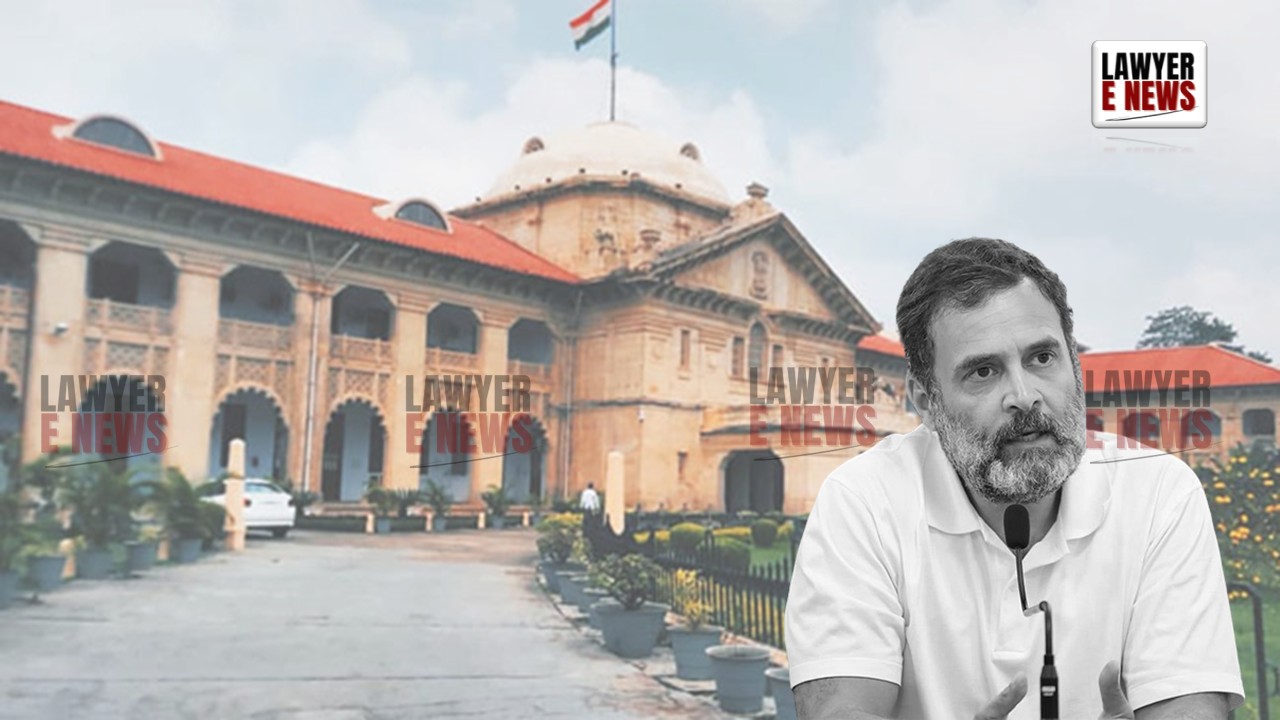
“The Moment a Higher Court Stays a Conviction, the Anathema of Conviction Goes Out of the Window” –In a latest judgement Allahabad High Court, in a judgment of constitutional and electoral significance, dismissed a writ petition seeking a writ of quo warranto against Congress leader Rahul Gandhi for allegedly holding the office of Member of Parliament (Lok Sabha) without authority of law due to his conviction in a defamation case. The Bench comprising Justice Shekhar B. Saraf and Justice Manjive Shukla categorically held that once the conviction is stayed by the appellate court, the disqualification under Section 8(3) of the Representation of the People Act, 1951, ceases to operate from the date of the stay.
“Stay of Conviction Renders the Conviction Non-Operative, Though Not Non-Existent”
Dismissing the writ petition filed by Advocate Ashok Pandey in Ashok Pandey v. Rahul Gandhi & Ors. [Writ – C No. 11593 of 2025], the Court rejected the petitioner’s argument that despite the stay granted by the Supreme Court on Rahul Gandhi’s conviction, he continued to be disqualified and was, therefore, illegally holding the office of MP from Raebareli.
The Court drew a clear constitutional and statutory distinction between a stay of sentence and a stay of conviction, observing:
“Where the execution of the sentence is stayed, the conviction continues to operate. But where the conviction itself is stayed, the effect is that the conviction will not be operative from the date of stay… though not rendered non-existent, it becomes non-operative.” [Para 13]
Defamation Conviction and Political Fallout
Rahul Gandhi was convicted by a Surat trial court under Section 499 IPC (criminal defamation) and sentenced to the maximum two years of simple imprisonment. As per Section 8(3) of the Representation of the People Act, such a sentence triggered an immediate disqualification. However, upon appeal, the Supreme Court in SLP (Crl.) No. 8644/2023 stayed the conviction on the ground that:
“No reasons were provided by the trial judge for awarding maximum sentence… It is only on account of the maximum sentence of two years that Section 8(3) of the RP Act got triggered.”
Emphasizing the “wide-ranging ramifications” of the disqualification, including both the right of the elected representative and the electorate, the Supreme Court ordered a stay of conviction pending final disposal of the criminal appeal. Consequently, Rahul Gandhi’s disqualification was reversed, and he resumed his parliamentary membership.
Does a Stay of Conviction Remove Disqualification Under Article 102 and Section 8(3)?
The central legal contention raised by the petitioner was that Rahul Gandhi remained disqualified, as the Supreme Court's stay order did not expressly permit him to contest elections, unlike in Afzal Ansari’s case where such permission was explicitly granted.
However, the Court rejected this distinction as legally unsustainable and held that once conviction is stayed:
“The bar under Section 8(3) would not apply… a person against whom such conviction is stayed, though not absolved, cannot be stated to be a convicted person.” [Para 16]
It clarified that the conviction remains in existence for all practical purposes but becomes non-operative for the duration of the stay.
The High Court relied extensively on the Supreme Court’s decisions in:
Lily Thomas v. Union of India [(2013) 7 SCC (LS) 811]:
“…where the conviction itself is stayed… disqualification arising out of the conviction ceases to operate.”
Ravikant S. Patil v. Sarvabhouma S. Bagali [(2007) 1 SCC 673]:
“An order granting stay of conviction is not the rule but an exception… As the conviction itself is stayed… the disqualification does not continue.”
Rama Narang v. Ramesh Narang [(1995) 2 SCC 513]:
Appellate courts have inherent powers to stay conviction under Section 389 CrPC and Section 482 CrPC, which affect statutory consequences under electoral laws.
B.R. Kapur v. State of Tamil Nadu [(2001) 7 SCC 231]:
The petitioner relied heavily on this case, arguing that a conviction continues to operate till set aside. The High Court distinguished this case, observing that:
“That statement was in reference to stay of execution of sentence, not stay of conviction… In the present case, since the conviction is stayed, the disqualification cannot operate.” [Para 16]
Rejection of the Petitioner’s Reliance on Afzal Ansari’s Case
The petitioner contended that in Afzal Ansari’s case, the Supreme Court explicitly permitted him to contest elections during the pendency of appeal, whereas no such direction was given in Rahul Gandhi’s case. Therefore, the latter must still be considered disqualified.
This argument was firmly rejected:
“We are not in consensus with the argument… the specific direction in Afzal Ansari’s case is not determinative of legal entitlement… The stay of conviction in itself is sufficient to remove the bar under Section 8(3).” [Para 16]
Quo Warranto Denied: No Usurpation of Public Office
Since there was no existing disqualification in view of the stay of conviction, the High Court held that Rahul Gandhi’s continuance as a Member of Parliament and as Leader of the Opposition was not without authority of law. The conditions for issuing a writ of quo warranto – that a public office is being usurped by someone not legally entitled to it – were not satisfied.
“In light of the stay of conviction, the present writ petition is devoid of merit.” [Para 18]
Prayer for Certificate Under Article 134-A Also Rejected
The petitioner sought certification for appeal to the Supreme Court under Article 134-A of the Constitution. The Court declined, holding that:
“No substantial question of law arises… the matter has been categorically settled by the Supreme Court and is no longer res integra.” [Para 19]
No Disqualification Upon Stay of Conviction
The judgment reaffirms the well-settled principle that conviction under Section 8(3) RP Act must be “operative” to trigger disqualification. Once stayed, the conviction does not render a person disqualified, and he may lawfully contest elections and hold office. The mere absence of a specific permission to contest, as seen in Afzal Ansari’s case, does not alter the legal position.
The Allahabad High Court has thus upheld the primacy of judicial orders staying conviction in determining electoral disqualifications, reinforcing the sanctity of due process and appellate remedies in democratic governance.
Date of Decision: 04 December 2025