-
by sayum
24 August 2026 6:22 AM







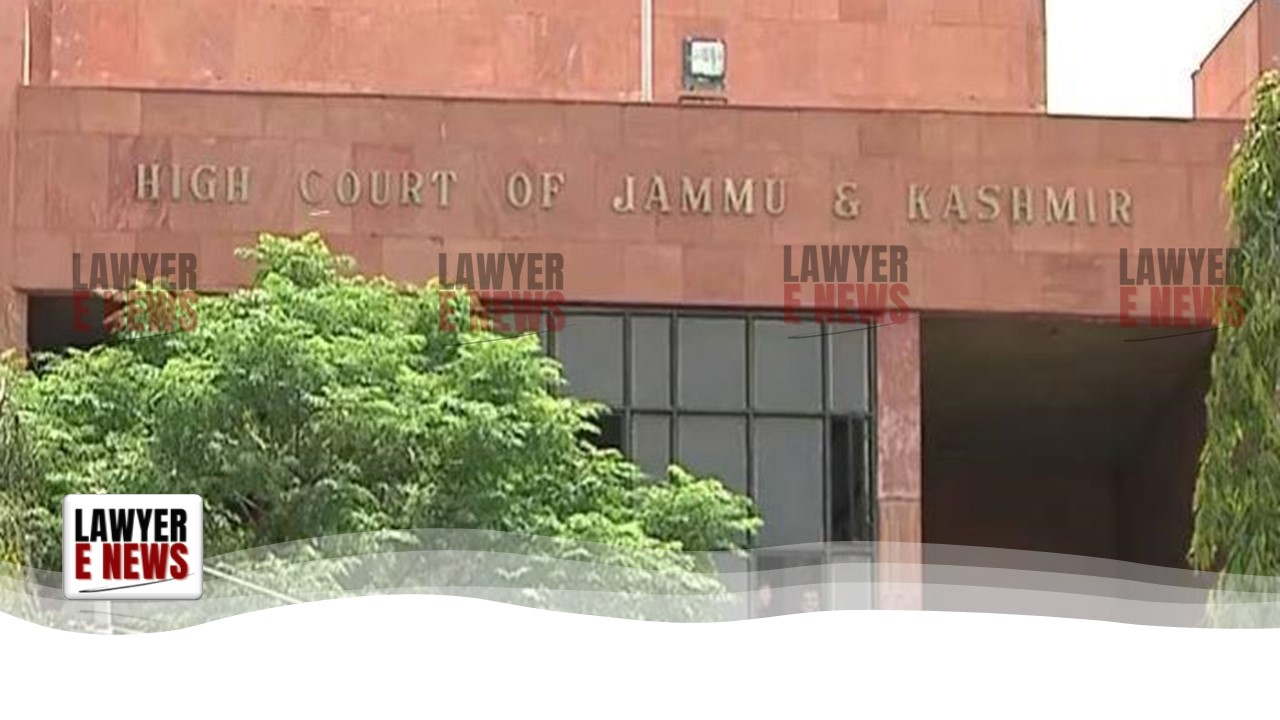
Government’s Ex-Gratia Policy Cannot Override Judicial Compensation for Negligence – In a landmark ruling Jammu & Kashmir and Ladakh High Court dismissed the State’s appeal challenging the award of Rs. 20 lakhs in compensation to a minor who suffered severe burn injuries and amputation due to electrocution. The Division Bench of Justice Rajnesh Oswal and Justice Mohd. Yousuf Wani, in the case of The State of J&K & Ors. v. Abrar Ahmad Tantray & Anr., held that the Power Development Department’s negligence in failing to insulate a high-voltage electric wire had led to the tragic injury of the child.
The Court categorically rejected the State’s argument that the minor was responsible for his injuries, ruling that "it was the bounden duty of the Power Department to ensure the safety of the public, and its failure to insulate the transformer or the electric wires amounts to negligence." The judgment reaffirms the constitutional power of courts to grant just compensation beyond statutory ex-gratia relief, ensuring that victims of state negligence are adequately compensated.
Victim Suffers Amputation After Contact with Exposed High-Voltage Wire
The case arose from a tragic incident in 2007, when eight-year-old Abrar Ahmad Tantray, while playing in his village Kujjar Kulgam, came in contact with a snapped 11KV electric wire, which was left exposed and uninsulated. The child suffered severe burn injuries on his left arm, head, and body, leading to amputation of his left arm.
Despite multiple surgical procedures, the victim suffered 78% permanent disability, requiring lifelong medical care and an artificial limb. The police registered an FIR, and official reports confirmed that the wire was open and uncovered at the time of the accident.
After attaining majority, the victim filed a writ petition in 2018, seeking Rs. 20 lakhs as compensation and a government job. The Writ Court ruled in his favor in July 2024, directing the Power Development Department to compensate him for his injuries and suffering. The State, however, challenged this decision, arguing that the victim was responsible for his injuries and that compensation was excessive.
"The Duty to Maintain Public Infrastructure Safely Lies with the State" – Court Rejects Negligence Argument
The High Court firmly rejected the State’s claim that there was no negligence on its part, holding that the admitted presence of an uncovered live wire in a public area was sufficient to establish liability. The Court observed:
"Once the appellants had installed an electric transformer in the village, it was their bounden duty to ensure that it was properly covered and insulated so that no human being comes in contact with it. The very fact that a child of merely eight years of age came in contact with the live wire is proof enough of negligence on the part of the authorities."
The Court further emphasized that "public safety is paramount, and failure to ensure secure electrical infrastructure directly endangers human lives."
"Ex-Gratia Compensation Cannot Bar Judicial Remedies" – Government Policy Does Not Limit Court's Power
The State relied on Government Order No. 454-F of 2019, which prescribes Rs. 7.5 lakhs for total disability and Rs. 2 lakhs for partial disability as ex-gratia relief for electrocution victims. The State contended that since compensation was fixed by policy, the Court should not have awarded Rs. 20 lakhs.
The High Court firmly rejected this argument, holding that: "The policy for ex-gratia relief cannot override the constitutional powers of courts to grant appropriate compensation. The very nature of ex-gratia relief is that it is voluntary and cannot bar judicial intervention where negligence is evident."
The Court further clarified that compensation must be determined based on the specific facts of the case, the extent of disability, and future medical needs, rather than being arbitrarily capped by government policies.
"A Minor Cannot Be Held Negligent – The Doctrine of Volenti Non Fit Injuria Does Not Apply"
The State attempted to argue that the child was responsible for his injuries, claiming that he "struck the electric wire while playing." The High Court rejected this argument outright, citing Sections 20 and 21 of the Bharatiya Nyaya Sanhita, 2023, which provide that a child below seven years is incapable of committing a crime, and similar principles apply in civil law.
The judgment states: "Even though the respondent was eight years old at the time, the immunity granted to minors under law remains the same. The doctrine of volenti non fit injuria (a person who voluntarily takes a risk cannot claim compensation) does not apply to children. The law grants absolute immunity to minors in civil and criminal matters, and the State cannot shift the burden of negligence onto the victim."
Court Upholds Rs. 20 Lakh Compensation Based on Disability and Future Needs
The victim suffered 78% permanent disability, including amputation of his left arm and loss of skull bone, requiring extensive future medical treatment. The High Court applied the principles from Kajal v. Jagdish Chand, (2020) 4 SCC 413, where the Supreme Court considered notional income and medical expenses while awarding compensation in motor accident cases.
The Court justified the Rs. 20 lakh compensation, observing: "The learned Writ Court has determined 78% disability, which is undisputed by the appellants. If compensation were assessed under various heads, including loss of amenities, pain and suffering, future medical expenses, and the cost of an artificial limb, the amount granted would be justified and even conservative."
The victim submitted medical estimates showing that Rs. 1.66 lakhs was required for neurological surgery and Rs. 7.40 lakhs for an artificial limb, further strengthening the case for compensation.
Delay in Filing Petition Not a Ground for Rejection – Court Acknowledges Legal Disability Due to Minority
The State argued that the petition was delayed, as the incident occurred in 2007 but the claim was filed only in 2018. The High Court dismissed this contention, holding that:
"The victim was legally incapacitated due to being a minor at the time of the incident. His parents were illiterate and unable to pursue legal remedies. The delay is fully justified, as he initiated legal action as soon as he attained majority."
The Court refused to dismiss the case on grounds of delay, emphasizing that legal disabilities like minority must be considered when assessing the timeliness of claims.
Final Judgment – "State Must Ensure Public Safety and Fair Compensation"
The High Court upheld the Writ Court’s ruling, directing the Power Development Department to pay Rs. 20 lakhs to the victim with 6% interest per annum from the date of filing the petition until realization. The Court concluded:
"State authorities must be held accountable for maintaining public safety. The doctrine of sovereign immunity does not extend to negligence that endangers human lives. The victim of state negligence must be fairly compensated."
The judgment reinforces the duty of government agencies to maintain public safety, clarifies that ex-gratia schemes do not limit judicial remedies, and upholds the principle that minors cannot be held responsible for injuries caused by unsafe public infrastructure. This ruling sets an important precedent for liability in electrocution cases and ensures that victims of negligence are not left without legal recourse.
Date of Decision: January 3, 2025