-
by sayum
13 August 2026 1:48 PM







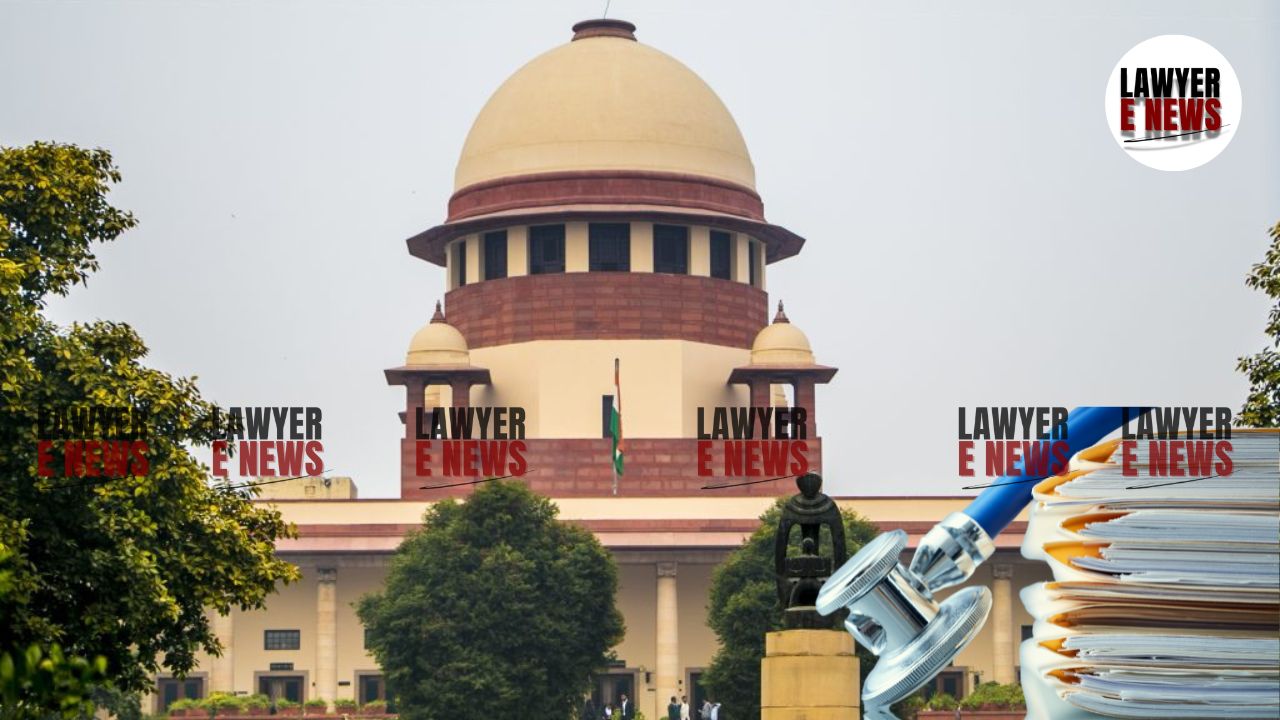
In a landmark ruling Supreme Court of India emphatically struck down residence-based reservations in Postgraduate (PG) Medical Courses, holding that such a practice violates Article 14 of the Constitution and undermines meritocracy in higher medical education. The three-judge bench of Justice Hrishikesh Roy, Justice Sudhanshu Dhulia, and Justice S.V.N. Bhatti upheld the Punjab & Haryana High Court’s decision, which had declared the 50% reservation in PG Medical seats for Chandigarh residents unconstitutional.
"There is only one domicile in India—that of the Union. The Constitution does not recognize State-specific domicile, and no State or Union Territory can carve out reservations in higher education on this basis," the Court observed, making it clear that residence-based preferences cannot dictate access to specialized medical education.
The case arose from a challenge to the Union Territory of Chandigarh’s policy of reserving 50% of its PG medical seats for students with a background in Chandigarh. The Supreme Court, after analyzing decades of legal precedents, ruled that while institutional preference (for students from the same medical college) is permissible to a reasonable extent, residence-based reservations are unconstitutional.
"Once a student is in the race for PG medical admissions, merit and performance in NEET must be the sole criteria. To grant preferential treatment based on residence alone is to create an artificial barrier that the Constitution does not permit," the Bench stated.
"A Policy of Exclusion: Supreme Court Criticizes Chandigarh's 'Domicile' Reservation as Arbitrary and Unjust"
The Supreme Court took strong exception to the Chandigarh administration’s attempt to justify its policy by equating ‘residence’ with ‘domicile’.
"This Court has repeatedly held that India has a single unified domicile. The practice of States using ‘domicile’ and ‘residence’ interchangeably is a dangerous trend that must end. States cannot exclude non-residents from medical education under the guise of domicile," the Court remarked.
In its ruling, the Supreme Court relied on a series of seminal judgments, including Jagadish Saran v. Union of India (1980), Dr. Pradeep Jain v. Union of India (1984), and Saurabh Chaudri v. Union of India (2003), all of which consistently held that while a limited degree of institutional preference is valid, residence-based reservations in PG Medical courses violate the principle of equal opportunity.
"Reservation at the PG level must be scrutinized more rigorously than at the undergraduate level because specialized medical education is a matter of national interest. The need of the hour is to ensure that the best talent is selected for higher medical education, not that seats are locked away for students based on arbitrary residence criteria," the Court observed.
The Bench noted that the Chandigarh policy effectively created an unjust system where even meritorious students from other States were denied admission simply because they were not residents of Chandigarh.
"An exclusionary policy that denies opportunity solely based on residence does not promote equality—it erodes it," the Court ruled.
"MBBS vs. PG Admissions: Why Residence-Based Quotas Cannot Extend to Higher Medical Education"
A crucial distinction drawn by the Supreme Court was between Undergraduate (MBBS) and Postgraduate (MD/MS) admissions. While limited residence-based reservations may be permissible for MBBS courses to address regional healthcare needs, such a system cannot extend to PG courses.
"The objective of MBBS education is to train general physicians who may serve their home States. But PG medical education is about specialization, which must be driven purely by merit, not regional boundaries," the Court held.
Referring to Justice Krishna Iyer’s observations in Jagadish Saran, the Bench reiterated:
"At the MBBS level, a reasonable degree of reservation based on residence may be justifiable to ensure healthcare access in backward regions. However, at the postgraduate level, the only acceptable criteria is excellence, not geography. A student from one State is no less competent than a student from another, and no artificial barriers should be placed on their education."
The Court noted that allowing residence-based reservations in PG courses would lead to a system where every State locks its medical seats for local students, severely limiting opportunities for deserving candidates across India.
"Such parochial policies not only stifle the free movement of talent but also weaken India's healthcare system by discouraging merit-based selection," the Court warned.
"Institutional Preference is Valid, But Residence-Based Quotas Are Not"
While striking down Chandigarh’s residence-based quota, the Supreme Court upheld institutional preference to a reasonable extent. The Bench reaffirmed that medical colleges may grant some preference to students who have completed their MBBS from the same institution since they are already trained in its ecosystem.
"Institutional preference can be justified as a valid classification because it fosters continuity in education. However, residence-based reservations do not serve the same purpose and are therefore unconstitutional," the Court clarified.
As a result, the 50% institutional preference quota in Chandigarh’s PG medical seats was upheld, but the 50% residence-based quota was struck down.
"The right approach is to ensure that institutional preference, if given, remains within reasonable limits. Any additional reservation based purely on residence criteria is impermissible," the Court ruled.
"Future PG Medical Admissions Must Follow NEET Merit: Supreme Court Ensures Fairness"
Recognizing the potential impact on students already admitted under Chandigarh’s residence quota, the Supreme Court declined to apply its ruling retrospectively.
"Students who have already been admitted or have completed their PG medical courses under the now-struck-down quota will not be disturbed. However, all future admissions must be strictly based on merit in NEET," the Bench directed.
This means that going forward, PG medical admissions in Chandigarh—and across India—must be conducted solely on merit, without residence-based quotas.
"The foundation of India's medical education system must be fairness and excellence. No student should be denied an opportunity because of an arbitrary residence requirement," the Court concluded.
A Judgment That Strengthens the Right to Equal Opportunity
With this historic ruling, the Supreme Court has reinforced that merit—not residence—must be the cornerstone of higher education in India.
By upholding institutional preference while striking down residence-based quotas, the Court has ensured that all students, regardless of where they live, will have an equal shot at specialized medical education.
"India belongs to all its citizens. No State can create artificial barriers to education based on where a student lives. The Constitution guarantees equal opportunity, and this judgment ensures that promise is upheld," the Supreme Court declared, ushering in a new era of fairness in medical admissions.
Date of decision: 29/01/2025