-
by sayum
13 August 2026 1:48 PM







An Ex-Parte Decision to Set Aside Selection Without Hearing Affected Candidates Stands Vitiated - In a significant ruling Supreme Court of India upheld the appointments of Shiksha Karmi Grade III teachers in Janpad Panchayat, Gaurihar, Madhya Pradesh, overturning their cancellation on grounds of bias and nepotism. The Court held that the cancellation of appointments without issuing notices to the affected candidates was a gross violation of the principles of natural justice.
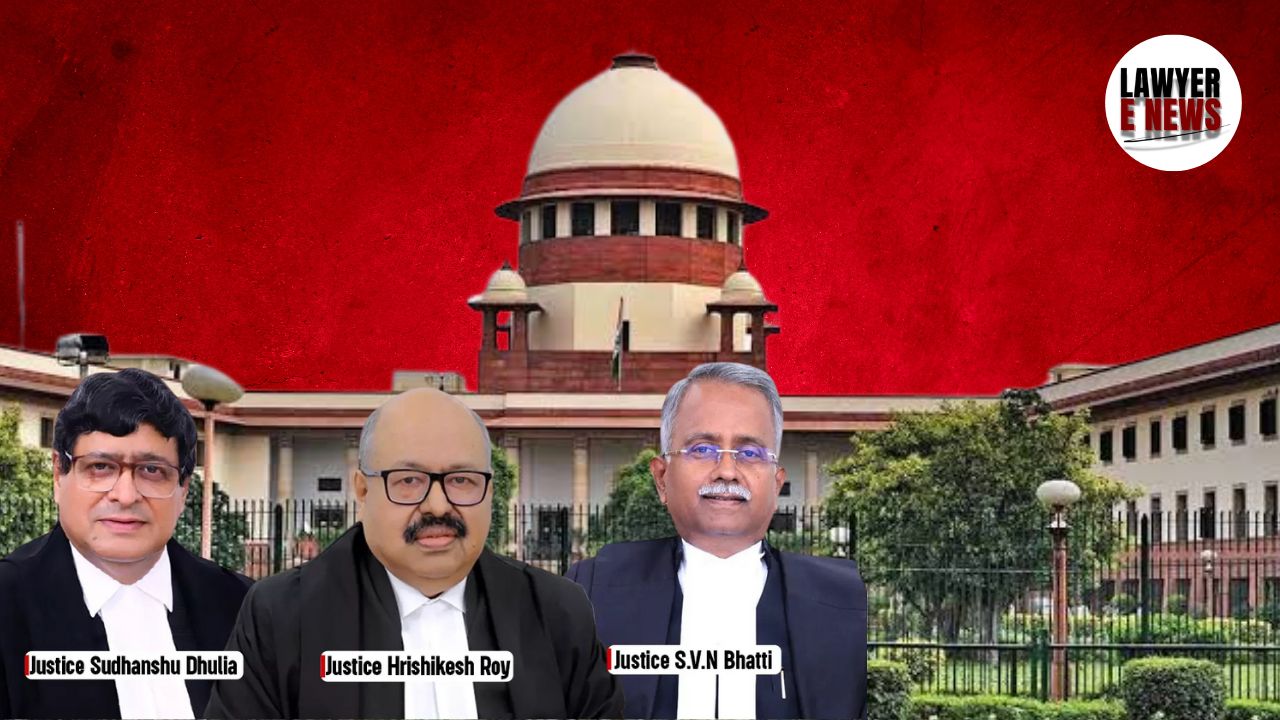
Justice Hrishikesh Roy, delivering the judgment on behalf of the full bench, emphasized:
"The principle of audi alteram partem is the cornerstone of justice, ensuring that no person is condemned unheard. An ex-parte decision to set aside the appellants’ selection, without hearing them, stands vitiated and cannot be sustained in law."
The case arose from the 1998 selection process for Shiksha Karmi Grade III teachers, which was challenged by an unsuccessful candidate, Archana Mishra, on allegations that relatives of selection committee members were appointed, violating the rule against bias (nemo judex in causa sua).
The Collector, Chhatarpur, quashed the selection on June 2, 1999, concluding that the recruitment was tainted by favoritism. However, this decision was made without issuing notices to the selected candidates or giving them a chance to defend their appointments.
The selected candidates filed a revision before the Commissioner, Revenue, Sagar Division, under Section 3 of the Madhya Pradesh Panchayat (Appeal and Revision) Rules, 1995, arguing that their selection could not have been set aside without hearing them. The Commissioner dismissed the revision, and the Madhya Pradesh High Court upheld the cancellation.
A split verdict was initially delivered by the Supreme Court in April 2024:
Justice J.K. Maheshwari ruled that the presence of relatives in the selection committee created a reasonable likelihood of bias, rendering the selection invalid. In contrast, Justice K.V. Vishwanathan held that denial of fair hearing at the original stage rendered the entire cancellation void ab initio.
The matter was then referred to a larger bench led by Justice Hrishikesh Roy, Justice Sudhanshu Dhulia, and Justice S.V.N. Bhatti, which ultimately upheld the appointments.
"Allegations of Bias Must Be Proven Through a Fair Process, Not Assumed Without Hearing the Affected Candidates"
The Supreme Court ruled that mere allegations of bias cannot vitiate a selection process unless they are proven through a transparent and fair procedure. The Court observed:
"An allegation of bias is not sufficient in itself; it must be tested through a process that allows the affected individuals to be heard. If a decision is taken ex parte, it cannot be assumed that bias exists without substantiating evidence."
The Court examined whether the selection committee members had directly participated in awarding marks to their relatives. It found that:
A unanimous resolution had been passed by the Janpad Panchayat, ensuring that members who had relatives appearing as candidates would recuse themselves from the selection process.
The relatives of the committee members did not participate in the interviews or influence the marking process.
No evidence was produced to show that the presence of committee members had a direct impact on the final selection of their relatives.
Justice Roy emphasized: "When a process ensures recusal of interested members, the presumption of bias does not automatically arise. Bias must be established through facts, not conjecture."
Thus, the Court concluded that the selection process was not vitiated by bias and that the cancellation of appointments without a hearing was legally unsustainable.
"Denial of Fair Hearing is an Incurable Defect That Strikes at the Root of Due Process"
Violation of the Principle of Audi Alteram Partem
The Supreme Court unequivocally held that cancellation of appointments without notice to the selected candidates was a grave violation of natural justice. It stated:
"Justice must not only be done but must be seen to be done. The denial of a fair hearing strikes at the very core of procedural fairness. Without affording the affected parties an opportunity to present their case, no administrative or judicial action can stand."
The Court referred to Ridge v. Baldwin (1964 AC 40) and S.L. Kapoor v. Jagmohan [(1980) 4 SCC 379], reiterating that:
"The non-observance of natural justice is itself a prejudice to any individual, and proof of additional harm is unnecessary. A decision taken without hearing the affected party is a nullity in law."
The Court also cited Rule 9 of the Madhya Pradesh Panchayat (Appeal and Revision) Rules, 1995, which explicitly requires an opportunity for a fair hearing before an adverse decision is taken. The Court held that the Collector’s failure to follow this mandatory procedure rendered his order legally void.
"A Defect at the Initial Stage Cannot Be Cured in Appeal"
Rejection of the Argument That Appellate Review Could Rectify the Violation of Natural Justice
The State argued that the appellate proceedings before the Commissioner of Revenue remedied any defect in the original cancellation order. The Supreme Court categorically rejected this contention, holding that:
"An appellate review cannot be a substitute for a fair hearing at the original stage. If natural justice is violated at the first instance, no subsequent proceeding can cure that fundamental defect."
The Court referred to Leary v. National Union of Vehicle Builders (1971), which established that:
"A hearing at the appellate stage cannot erase the injustice caused by a denial of hearing at the original stage. A person cannot be deprived of their right to a fair hearing simply because an appeal is available later."
The Court also noted that Rule 5(b) of the Appeal and Revision Rules, 1995, restricted revisions to questions of law, making it impossible for the Commissioner to fully redress the procedural flaw in the Collector’s decision.
"Remanding the Matter for Fresh Inquiry After 25 Years Would Be a Travesty of Justice"
Final Decision and Impact
Considering that the appointments dated back to 1998, and the appellants had continuously served for over 25 years, the Supreme Court ruled:
"To remand the matter for a fresh inquiry now would be both impractical and unjust. These individuals have dedicated over two decades to public service, and their rights cannot be rendered uncertain after such a long period."
The Court set aside the judgment of the Madhya Pradesh High Court, reinstated the appellants' appointments, and directed that no further proceedings be initiated against them.
Justice Roy concluded:
"Natural justice is not a mere technicality; it is the foundation of fair governance. This Court cannot allow administrative actions that disregard due process to stand."
With this ruling, the Supreme Court has reaffirmed that public employment decisions must adhere to constitutional principles of fairness, and affected individuals must always be given an opportunity to be heard before their rights are taken away.
Date of decision: 29/01/2025