-
by sayum
25 August 2026 5:15 AM







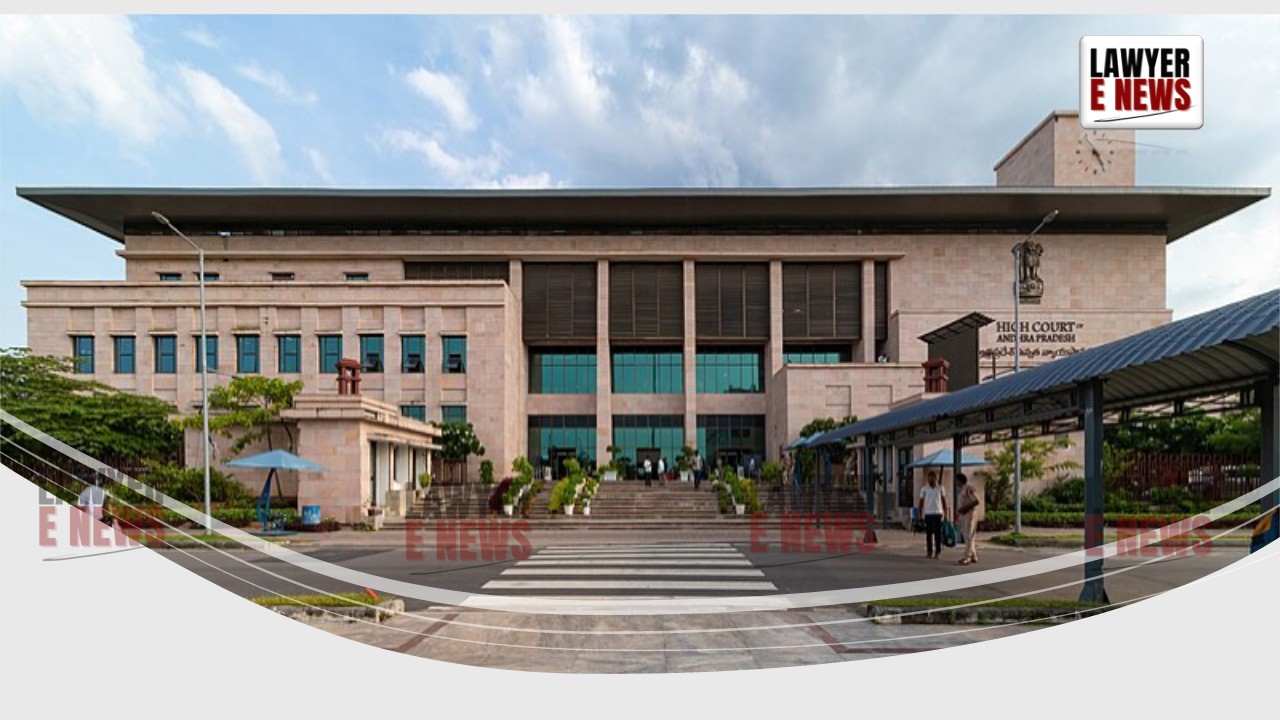
“Discretion under Article 190(3)(b) is not untrammelled — no constitutional functionary has the luxury of indefinite silence in the face of clear constitutional obligations,” Andhra Pradesh High Court declaring the Chairman’s inaction on the petitioner’s resignation from the Legislative Council as illegal, arbitrary, and violative of Article 14 of the Constitution.
The Court emphasized that Article 190(3)(b) read with Rule 190 of the Andhra Pradesh Legislative Council Rules does not permit open-ended delay in taking a decision on a resignation, especially when the only inquiry contemplated is into voluntariness and genuineness, and not political motivations or broader consequences.
Justice Gannamaneni Ramakrishna Prasad directed the Chairman of the Legislative Council to complete the inquiry and render a decision within four weeks, holding that the failure to act for over a year constituted “Wednesbury unreasonableness” and a breach of constitutional trust.
“Discretion must not degenerate into evasion — Speaker or Chairman is not above constitutional discipline”
The petitioner, Jayamangala Venkata Ramana, a Member of the Andhra Pradesh Legislative Council (MLC), submitted his resignation on 23 November 2024, but the Chairman failed to act upon it for more than nine months. The writ petition, filed on 13 August 2025, sought a writ of mandamus declaring such inaction as violative of Article 190(3)(b) and Rule 190 of the Council Rules.
The petitioner argued that the constitutional discretion vested in the Chairman was limited to ensuring voluntariness and genuineness of the resignation and that the prolonged inaction offended constitutional morality and eroded institutional credibility.
Justice Prasad held that “the Chairman’s constitutional role is not ceremonial; it is active, time-bound, and constrained by law.” Relying on State of Uttar Pradesh v. Jogendra Singh (1963), the Court interpreted the word ‘may’ in Rule 190(2) as imposing a mandatory duty, not a permissive option.
“The discretion is not a one-way traffic but a two-way obligation where the constitutional functionary who exercises this discretionary power shall endeavour to prevent sufferance on the part of the citizen,” the Court stated in no uncertain terms.
“Constitutional functionaries must exhibit neutrality and integrity — delay violates Article 14 and Wednesbury reasonableness”
Citing Shrimanth Balasaheb Patil v. Karnataka Legislative Assembly [(2020) 2 SCC 595], the Court reiterated that a member of the legislature cannot be compelled to continue in office and that the Speaker/Chairman must act independently while adjudicating resignations.
“Once the Speaker is satisfied that a resignation is genuine and voluntary, he has no option but to accept it. The inquiry must be conducted within a reasonable time and cannot be a tool to suppress political choice or delay democratic outcomes,” the Court observed.
Referring to the 33rd Constitutional Amendment debates, Justice Prasad clarified that the time to decide a resignation should ideally be a fortnight, and not more than a month.
“The Chairman’s action of scheduling personal interaction after one year defeats the very spirit of the 33rd Amendment,” the judgment noted.
“Speaker is not above judicial review — constitutional governance demands reasoned, timely decision-making”
The Court firmly rejected the Chairman's claim to unfettered discretion, reminding that no constitutional authority is exempt from accountability under Article 14. The reliance on Article 212 (bar on judicial interference in legislative procedure) was dismissed on the ground that judicial review is permissible where constitutional obligations are frustrated or delayed.
“This Court is not adjudicating whether the resignation is voluntary and genuine — that domain remains with the Chairman. However, this Court is duty-bound to ensure that such determination is not indefinitely postponed,” the Court clarified.
Relying on Maru Ram v. Union of India [(1981) 1 SCC 107], Khudiram Das v. State of West Bengal [(1975) 2 SCC 81], and Mohinder Singh Gill v. CEC [(1978) 1 SCC 405], the Court reiterated that even high constitutional functionaries are subject to judicial standards of fair play and accountability.
“Legislative authority is not insulated from constitutional discipline”
The Court also engaged with broader themes of constitutional morality, quoting from Manoj Narula v. Union of India [(2014) 9 SCC 1]:
“The principle of constitutional morality basically means to bow down to the norms of the Constitution and not to act in a manner which would become violative of the rule of law or reflectible of action in an arbitrary manner.”
The Court noted that the Chairman’s unexplained delay of over 12 months in initiating even the first step of personal interaction, scheduled only after court proceedings began, was constitutionally impermissible.
“Discretion must be judicial, not whimsical — delay of this magnitude amounts to refusal to exercise jurisdiction,” the Court stated, invoking the Wednesbury standard of administrative unreasonableness.
Chairman Directed to Decide Within Four Weeks
Summing up, the Andhra Pradesh High Court declared:
“The inaction for the prolonged period on the part of the Hon’ble Chairman is illegal and arbitrary and therefore violative of Article 14. The inquiry must be completed, and a decision rendered within a reasonable time, preferably within a fortnight, and at most within a month.”
The Chairman was directed to conclude the process and render a decision within four weeks. The petition was accordingly allowed, and all pending interlocutory applications were disposed of.
This decision is a strong assertion of judicial oversight over constitutional office-holders, and a clear reminder that deliberate inaction, even by high authorities, is not beyond judicial scrutiny—especially where it involves public office, democratic representation, and constitutional duties.
Date of Decision: 27 November 2025