-
by sayum
10 August 2026 1:57 PM







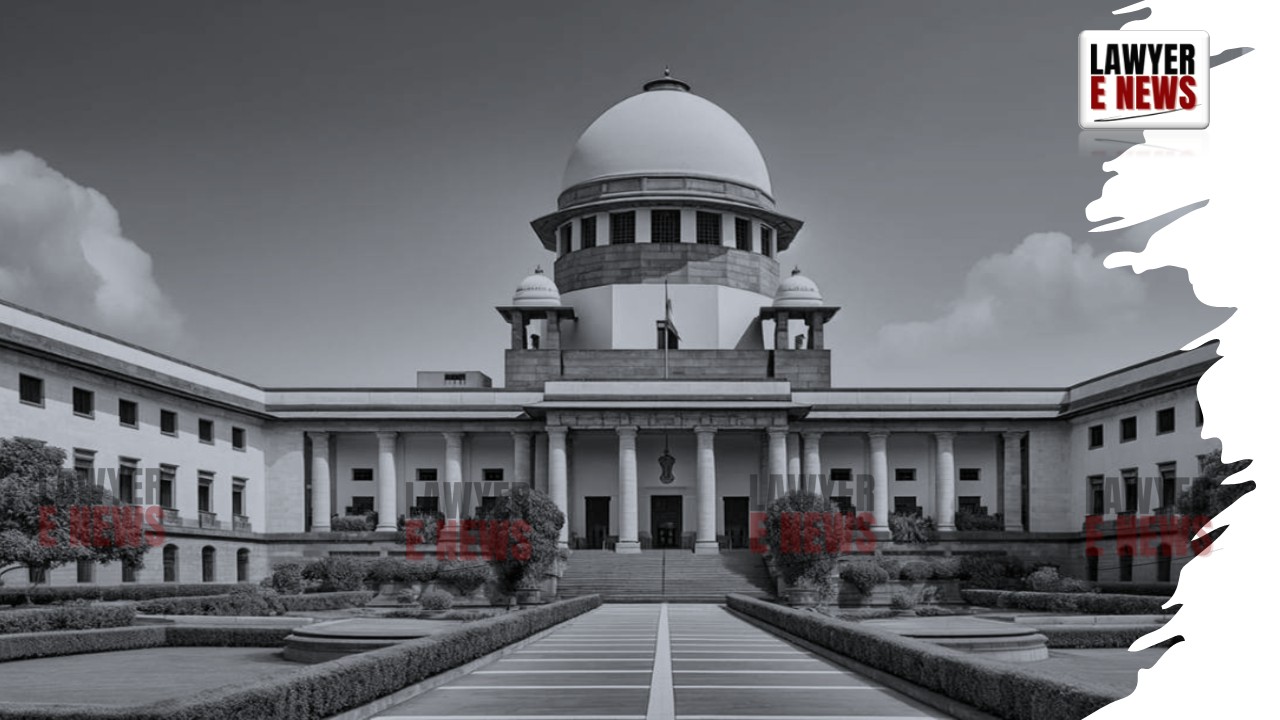
“When Demand Is Not Proved Beyond Reasonable Doubt, Mere Recovery of Money Cannot Lead to Conviction” — Supreme Court of India acquitted a retired Revenue Inspector , setting aside concurrent findings of guilt under Sections 7 and 13(1)(d) read with Section 13(2) of the Prevention of Corruption Act, 1988. The Court found that the prosecution failed to establish the foundational fact of demand of illegal gratification, a prerequisite for the presumption under Section 20 to operate.
The judgment reaffirms the principle that “mere recovery” of tainted money, without proof of demand and acceptance, cannot sustain a conviction under the PC Act.
The appellant, then serving as a Revenue Inspector at the Mandal Revenue Office, Gundala, Nalgonda District (then Andhra Pradesh), was accused of demanding a bribe of ₹2,000 on August 6, 2003, from a farmer (PW1) seeking compensation for drought-affected trees.
The Anti-Corruption Bureau (ACB) laid a trap based on a complaint dated August 8, 2003, and on August 11, the trap team followed the accused to the complainant's village. After a visit to the field and a tea session at PW1’s house, the tainted notes were allegedly kept by PW1 in a rexine bag attached to the fuel tank of the appellant’s motorcycle, purportedly at the appellant’s instructions. ACB officers recovered the amount, but phenolphthalein tests on the appellant’s hands were negative.
The Trial Court and High Court both convicted the appellant, reasoning that mere physical recovery of bribe money in close proximity to the accused sufficed, invoking the presumption under Section 20 of the PC Act.
“Foundational Fact of Demand Not Proved — Section 20 Presumption Inapplicable”
“When demand has not been proved, Section 20 will also have no application.” — Supreme Court quoting Om Prakash v. State of Haryana, (2006) 2 SCC 250
The Supreme Court held that the entire trap narrative suffered from inconsistencies, including contradictions between PW1 and his wife (DW1), and between PW1’s examination-in-chief and re-examination. These contradictions undermined the prosecution’s claim that the bribe was demanded and accepted by the appellant.
“The claimed/projected sequence of events by the prosecution… does not seem to inspire confidence. The same cannot be said to have been proved beyond reasonable doubt.”
The Court also rejected the High Court’s dismissal of prior animosity between the complainant and the appellant, noting: “PW3 had stated that a few days prior to the incident, there was hot talk between the complainant and the Appellant... However, the High Court has disbelieved this aspect without assigning any reason.”
“Mere Recovery of Money Without Proving Demand or Acceptance Not Sufficient”
“There was no occasion for the Appellant to be taken inside the house to get his hands dipped in the solution, as the Appellant had not touched the notes.”
The Court emphasized that the phenolphthalein test was negative, undermining the prosecution’s theory of acceptance. Further, it was noted that the appellant was not present when the money was kept in the bag, according to the original testimony of PW1.
Referring to Suresh Thipmppa Shetty v. State of Maharashtra, 2023 SCC OnLine SC 1038, the Court reiterated: “When the Court is to choose between the version proffered by the prosecution vis-à-vis the defence version, in the face of reasonable doubt... the Court should lean in the defence’s favour.”
“Presumption Cannot Replace Proof”
“The factum of demand, in the backdrop of an element of animus between the Appellant and complainant, is not proved.”
The Supreme Court reaffirmed that the presumption under Section 20 can arise only after proof of demand, citing T. Subramanian v. State of T.N., (2006) 1 SCC 401.
“Even otherwise, where demand has not been proved, Section 20 will also have no application.”
“The guilt of the Appellant has not been proved beyond reasonable doubt… This is a case where benefit of doubt was required to be given to the Appellant.”
The Supreme Court allowed the appeal, set aside the conviction and sentence, and directed that if any fine was deposited by the appellant, it must be refunded within four weeks.
The ruling underscores the inviolable standard of proof in criminal trials, especially under anti-corruption laws. It sends a strong message that mere possession of marked currency or weak procedural traps cannot override the constitutional guarantee of due process and presumption of innocence.
Date of Decision: May 9, 2025