-
by sayum
10 August 2026 1:57 PM







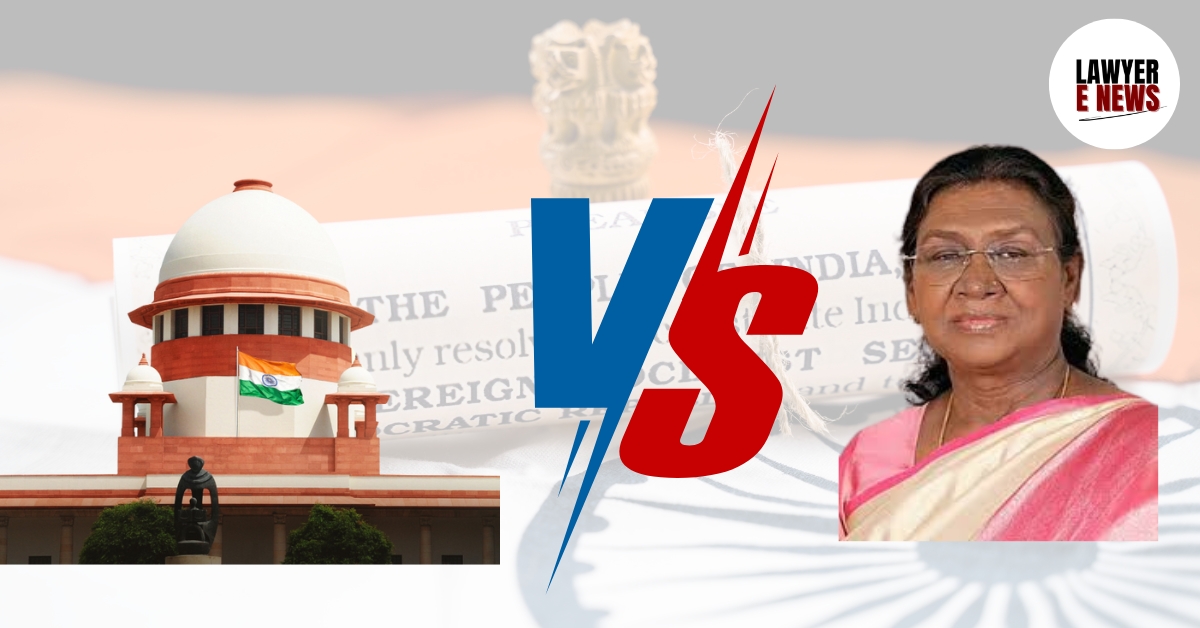
In a significant constitutional development, President Droupadi Murmu has referred 14 vital legal questions to the Supreme Court of India under Article 143(1) of the Constitution, seeking its advisory opinion on issues relating to the role of Governors and the President in the legislative process of state laws. This rare presidential reference follows the Supreme Court’s April 8 judgment in the Tamil Nadu Assent Delay Case, which had fixed a three-month deadline for Governors and the President to act upon state Bills presented for assent.
The President’s reference marks a pivotal moment in the history of India’s constitutional democracy, as it directly questions whether the judiciary can impose time limits on constitutional functionaries when the text of the Constitution is silent on such issues.
On April 8, 2025, a Constitution Bench of the Supreme Court, while hearing a case regarding Tamil Nadu Governor R.N. Ravi’s prolonged inaction on ten Bills passed by the Tamil Nadu Assembly, laid down a mandatory three-month time frame for Governors and the President to act on state legislation under Articles 200 and 201 of the Constitution. The Court observed that inordinate delay in giving assent undermines the functioning of democratically elected legislatures and offends the federal structure.
This ruling, while welcomed by many for upholding legislative sanctity, raised concerns within the executive regarding judicial overreach. It was argued that the Constitution does not provide any explicit timelines for assent, and it is not within the judiciary’s domain to legislate such timelines.
As a result, President Murmu, invoking her powers under Article 143(1), has now formally sought the Court’s opinion on whether such timelines are constitutionally valid and raised broader questions about the limits of judicial authority, executive discretion, and the separation of powers.
What is Article 143(1)?
Article 143(1) empowers the President to seek the advisory opinion of the Supreme Court on “any question of law or fact” that is of public importance and involves a substantial question of constitutional interpretation. While the Court’s opinion is not binding, it is treated with immense respect and often followed by all constitutional authorities.
This is the 13th time in Indian history that the President has invoked Article 143. Previous references include matters like the Babri Masjid-Ram Janmabhoomi dispute, NJAC Act, and the Berubari Union case.
The 14 Questions Referred by the President
The following constitutional issues have been placed before the Supreme Court for advisory consideration:
In the reference, President Murmu has emphasized that while the spirit of democratic accountability must be preserved, the solution must remain within the framework laid down by the Constitution. The President has asserted that imposing deadlines, absent constitutional text, may amount to judicial legislation, violating the doctrine of separation of powers.
The reference also reiterates that Articles 200 and 201 do not prescribe any timeline for granting or withholding assent and that any such prescription must come from the Parliament, not the judiciary.
Chief Justice B.R. Gavai is expected to soon constitute a five-judge Constitution Bench to examine and answer the reference. The Bench may hear all stakeholders including the Attorney General, State Governments, and possibly Governors’ offices.
Though advisory in nature, the Supreme Court’s opinion will carry tremendous weight and will likely guide future constitutional practice on the roles of Governors and the President, particularly in legislative assent matters.
Wider Implications
This reference has far-reaching implications for:
The President’s referral of 14 questions to the Supreme Court may become a turning point in India’s constitutional jurisprudence. It offers a unique opportunity to resolve persistent ambiguities over the timing, discretion, and justiciability of actions taken by Governors and the President in the legislative process.
At stake is not just the outcome of one Supreme Court ruling, but the structural integrity of Indian federalism and the limits of judicial intervention in executive functions. The nation now awaits the Supreme Court’s deliberation on this historic reference.