-
by sayum
25 August 2026 9:55 AM








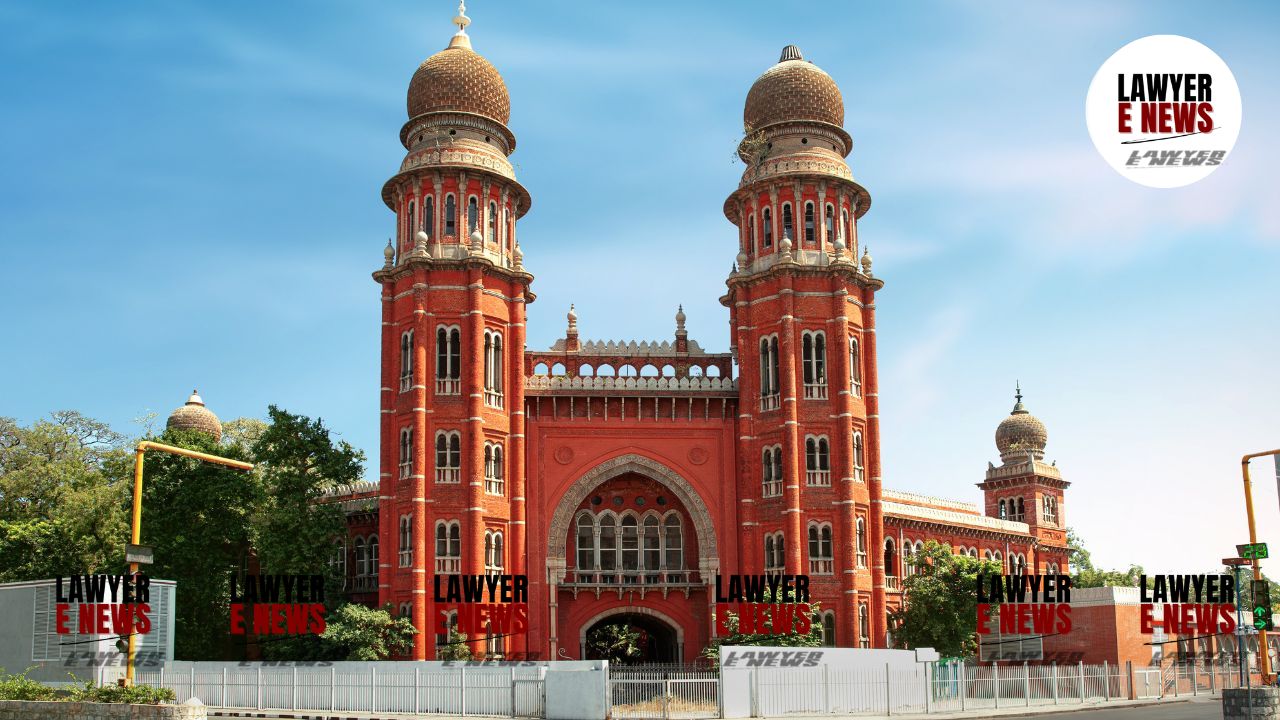
“Once premium cheque is dishonoured and cancellation is duly intimated, the insurer is not bound to indemnify any claim” – In a decisive judgment reinforcing the legal principle that a dishonoured insurance premium cheque nullifies the contract, the Madras High Court on 25 November 2025 upheld the exoneration of an insurer from liability in a fatal road accident involving a taxi and a lorry. The Division Bench comprising Dr. Justice G. Jayachandran and Justice Mummineni Sudheer Kumar dismissed both cross-appeals—one filed by the insurer and the other by the claimants—affirming the Tribunal’s findings on composite negligence and quantum of compensation, and declining to invoke the “pay and recover” doctrine.
The ruling came in C.M.A. Nos. 669 and 2014 of 2022, arising from the death of Balaji, an Assistant Vice President at Axis Bank, who was travelling with his family in a taxi when a collision with a 12-wheeler lorry near Ariyalur led to his death on the spot. His widow, minor son, and parents filed a claim for compensation of ₹2.02 crore. The Motor Accident Claims Tribunal, Ariyalur, had awarded ₹1.63 crore and fixed equal negligence (50:50) on both the taxi and lorry drivers. While the lorry was found to have a valid insurance policy, the insurance policy of the taxi stood cancelled prior to the accident due to bounced premium cheque.
“Insurance Is a Contract of Reciprocal Promises — No Premium, No Coverage”
The central issue in dispute was whether the insurance company of the taxi (New India Assurance Co. Ltd.) could be held liable under the “pay and recover” principle, despite the fact that the cheque for the insurance premium had bounced, and the cancellation of the policy had been intimated to both the vehicle owner and the RTO before the accident occurred.
The Court categorically rejected the claimants’ plea for invoking the “pay and recover” principle and observed:
“Pay and recover cannot be ordered when law does not permit. The contract was duly repudiated for want of consideration. The contractual relationship had severed on the day the cancellation was intimated.”
Citing Section 64-VB of the Insurance Act, 1938, the Bench reiterated that:
“No insurer shall assume any risk unless and until the premium is received by him… and in the case of cheque payment, risk may be assumed only from the date on which the cheque is honoured.”
The Court held that once the premium cheque dated 24.08.2016 was dishonoured, and intimation of cancellation was issued on 26.08.2016, there was no subsisting insurance contract on 09.10.2016, the date of the fatal accident. The Tribunal had rightly refused to fix any liability on the insurer of the taxi.
“Doctrine of Composite Negligence Applies – Both Drivers Equally at Fault”
The insurer of the lorry (Royal Sundaram General Insurance Co. Ltd.) had contested the 50% negligence attributed to the lorry driver. However, the High Court upheld the Tribunal’s reasoning based on site sketches (Ex.P5), vehicle damage reports (Ex.P6 and Ex.R5), and the eyewitness account of the deceased’s wife (P.W.1).
Despite the lorry driver’s claim that the taxi was solely at fault, the Court found:
“A 12-wheeler lorry, on a straight 30-foot-wide road, found turned at a 45-degree angle with damage on the rear right side, and a taxi sustaining frontal damage, supports equal negligence. One cannot blame the other for exclusive fault.”
The Tribunal's approach in treating the evidence of P.W.1 — who was also a co-passenger and widow of the deceased — as first-hand and credible, was upheld, while discrediting the belated and self-serving depositions of the lorry driver and investigating officer.
“Quantum Based on Proven Income and Dependency – No Excessive Award”
On the question of quantum, the insurer had also argued that the Tribunal awarded excessive compensation and had erroneously deducted only ¼ towards personal expenses, even though one of the claimants (the deceased’s mother) had died during the pendency of proceedings.
Rejecting this plea, the Court held:
“The deceased, aged 44, was earning ₹1,24,350 per month as Assistant Vice President in Axis Bank. The salary was substantiated through salary slips (Ex.X2 and Ex.P13) and income tax records (Ex.P16). The award is reasonable, just and fair.”
The Court added that future prospects were rightly considered, given the stable banking career and credible testimony of the bank’s HR representative (P.W.2). The dependency was not artificially exaggerated, and the Tribunal had rightly considered the surviving legal heirs.
“No Power to Mandate Pay and Recover Without Exceptional Circumstances”
The Court drew extensively from Supreme Court precedents including:
National Insurance Co. Ltd. v. Seema Malhotra [(2001) 3 SCC 151]
Deddappa v. Branch Manager, National Insurance Co. [(2008) 2 SCC 595]
United India Insurance Co. Ltd. v. Laxmamma [(2012) 5 SCC 234]
National Insurance Co. v. Sunita Devi & Ors., [2025 INSC 95]
Relying especially on Sunita Devi, the Bench observed:
“Where insurance was validly cancelled before the accident, and proper intimation was sent to both owner and RTO, insurer is not liable even under third-party cover.”
The Court clarified that Article 142 of the Constitution (which allows the Supreme Court to do complete justice) cannot be extended to High Courts, and therefore the claimants' plea for “pay and recover” could not be entertained.
Law Favours Insurers When Premium Cheques Bounce and Cancellation Is Intimated
Dismissing C.M.A. No. 669 of 2022 (filed by the insurer) and C.M.A. No. 2014 of 2022 (filed by the claimants), the Madras High Court confirmed that:
Insurer of the taxi is not liable, due to non-payment of premium and cancellation of policy before accident.
Insurer of the lorry is liable to pay 50%, with the taxi owner personally liable for the remaining 50%.
No exceptional circumstances exist to invoke the doctrine of “pay and recover”.
Quantum of ₹1.63 crore is upheld as reasonable and based on proven income and dependency.
“Insurance is a contract of reciprocal promises. Where premium fails, the promise fails. The insurer cannot be compelled to indemnify when there is no contract.”
Date of Decision: 25.11.2025