-
by sayum
24 August 2026 3:22 PM







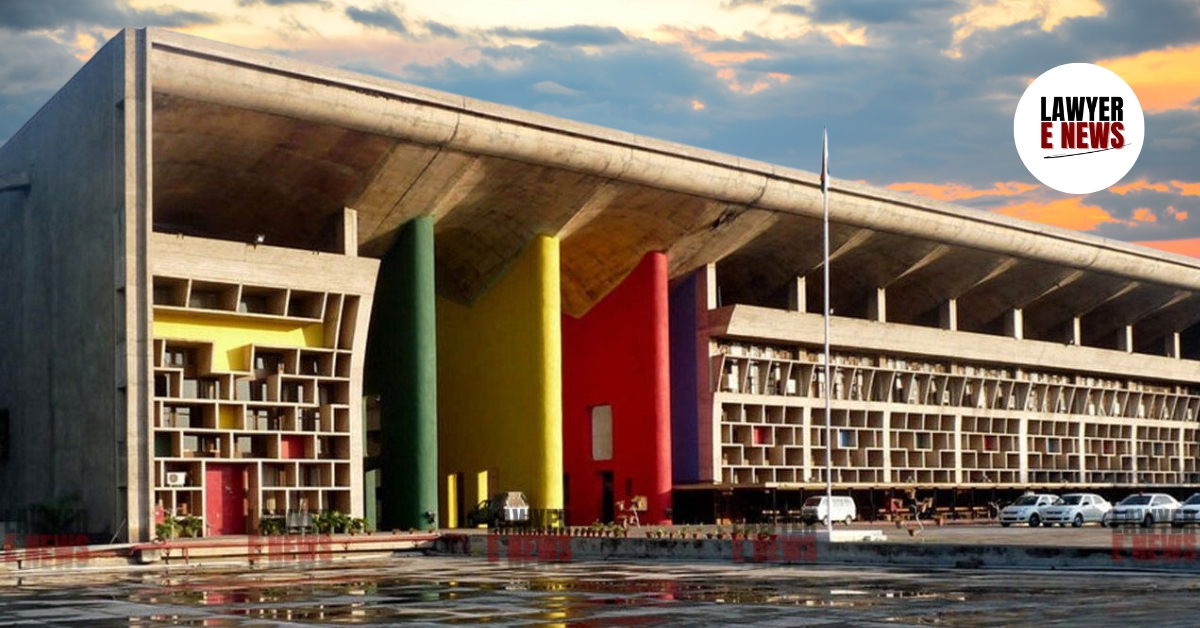
“A Transaction That Does Not Inspire Confidence Cannot Be Protected by Interim Injunction” – In a latest judgement Punjab and Haryana High Court delivered a reportable ruling that reaffirms the foundational principles for grant of interim injunctions under Order 39 Rules 1 and 2 of the Code of Civil Procedure, 1908. Justice Alka Sarin, while dismissing a civil revision petition, upheld the First Appellate Court’s order reversing a trial court’s ex parte injunction order in a specific performance suit, after finding that no prima facie case, irreparable injury, or balance of convenience existed in the petitioner’s favour.
The petitioner-plaintiff had approached the Court seeking interim protection against alienation of agricultural land in a suit based on an alleged agreement to sell. However, the Court noted serious irregularities in service of summons, the credibility of the agreement itself, and inconsistencies in the plaintiff’s conduct that undermined the equitable basis for an injunction.
“Ex Parte Order Based on Improper Service and Disputed Documents Cannot Sustain” – High Court Warns Against Abusing Interim Reliefs to Create Possession
The Court began by recounting the procedural history—where the trial court, relying on a refusal report without verifying affixation, proceeded ex parte and granted an interim injunction on 01.08.2024. The defendant allegedly learned of the proceedings only after resisting an attempted forcible possession, and later moved the First Appellate Court, which set aside the injunction.
Justice Sarin observed: “A report of refusal without affixation as mandated under the CPC cannot be the sole basis to proceed ex parte. The appellate court was right in noting procedural impropriety.”
Further, the Court referred to the police complaint filed by the defendant following the alleged attempt at illegal possession, and the subsequent police report that hinted at collusion between the plaintiff and his court clerk friend, casting doubt on the plaintiff’s intent.
The High Court held: “The ex parte injunction was obtained in circumstances that not only lack procedural sanctity but also raise substantive questions about the fairness of the plaintiff’s conduct.”
“No Prima Facie Evidence, No Irreparable Injury, No Balance of Convenience” – Essential Tests for Injunction Not Met
While reiterating the legal threshold for granting interim injunctions, the Court referred to the plaintiff’s reliance on Ramakant Ambalal Choksi v. Harish Ambalal Choksi (2025) and Union of India v. Chaturbhai M. Patel (1976), but held that the present case failed to meet any of the essential conditions.
“There is no prima facie case which has been made out by learned counsel for the plaintiff-petitioner. The First Appellate Court has dealt with all the glaring facts, which are apparent on the face of the record.”
The Court particularly noted:
Moreover, a contradiction emerged between the plaintiff’s pleadings and his counsel’s admission before the First Appellate Court that the plaintiff was not in possession of the suit property—a critical inconsistency that shattered the foundation of his plea for protection.
“Once the counsel for the plaintiff-petitioner had made a statement that the plaintiff was not in possession, the question of restraining the defendant from dispossessing him does not arise.”
Section 52 of Transfer of Property Act Protects Petitioner from Third-Party Claims – But Does Not Justify Injunction
Though the petitioner invoked the doctrine of lis pendens under Section 52 of the Transfer of Property Act, 1882, the Court clarified that this statutory protection from third-party alienation during litigation does not entitle the plaintiff to an injunction by default, especially where other elements are missing.
“Though injunction is refused, Section 52 of the Transfer of Property Act would protect the petitioner from third-party alienation during the pendency of the suit. But that cannot substitute for lack of prima facie evidence.”
The Court also rejected the photograph submitted by the petitioner (Annexure P-15) allegedly showing the suit land being sold, noting that the name "Sanjeev Takru" on the board could not be linked to the respondent “Sanjeev” in the suit, nor to the subject property.
“Injunctions Are Equitable Reliefs – Not Instruments to Assert False Possession”
In one of the strongest observations, the Court emphasised that interim reliefs, especially injunctions, are rooted in equity, and where a party’s conduct casts doubt on its credibility, courts must exercise caution.
“It would be a travesty of justice if, on mere averment of payment of ₹1,00,000 as earnest money, an injunction is granted over land worth ₹2,00,00,000, especially when such payment is not prima facie proved and is disputed by the defendant.”
The Court found that the Trial Court had lifted text verbatim from judgments without applying its mind to the facts, and that the Appellate Court rightly reversed it with a fact-based, reasoned approach.
“Though not spelled out as ‘perversity’, the appellate court’s findings unmistakably show that the trial court's order suffered from serious non-application of mind.”
Conclusion: Revision Dismissed – No Relief for Plaintiff in Absence of Proof and Consistent Conduct
Summing up its decision, the High Court held that all three essential elements—prima facie case, balance of convenience, and irreparable injury—were absent, and the plaintiff’s own shifting stands and procedural lapses defeated his claim.
“In view of the above, the present revision petition being devoid of any merit is dismissed. Pending applications, if any, also stand disposed of.”
While dismissing the petition, Justice Alka Sarin made it clear that the observations are not to influence the final adjudication of the suit, thus preserving the trial on merits, but affirming the appellate court’s right to lift an unjustified interim order.
Date of Decision: 28 October 2025