-
by sayum
04 August 2026 1:39 PM







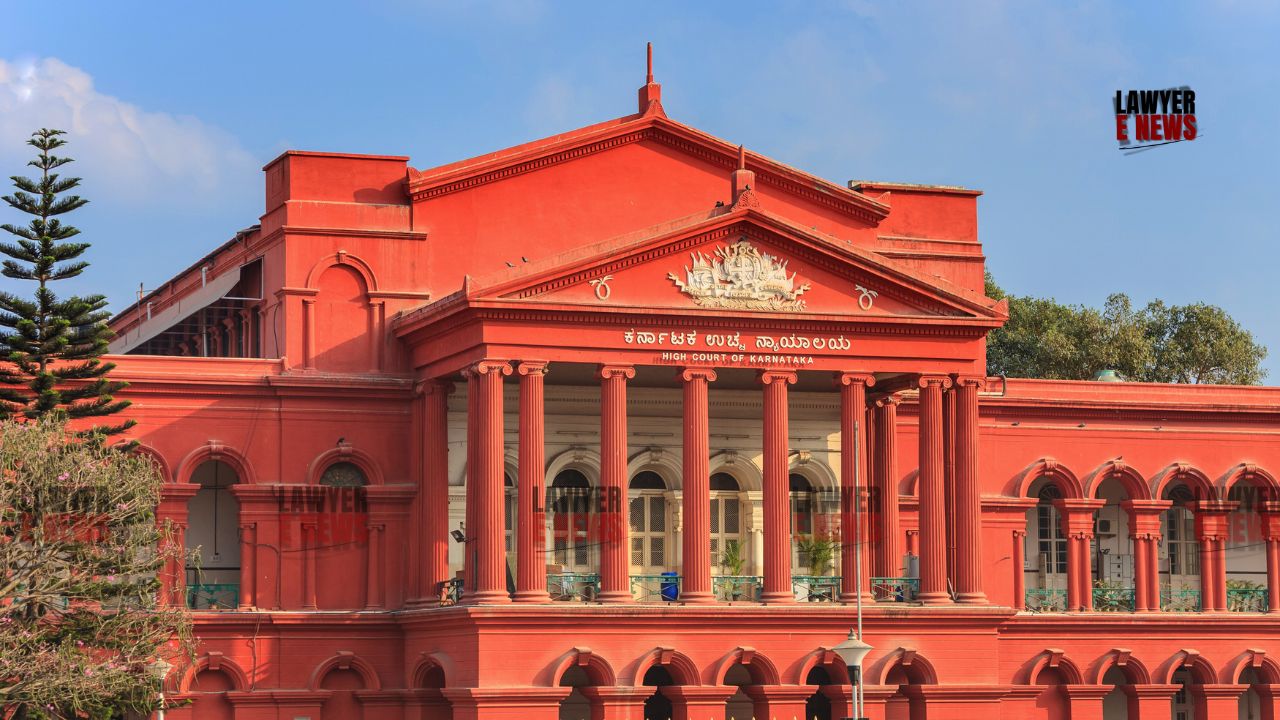
“Admission in Excess of Sanctioned Intake Shall Be Void Ab Initio”, Division Bench of the Karnataka High Court comprising Chief Justice Vibhu Bakhru and Justice C.M. Joshi dismissed a writ appeal in Apputha Raj v. Rajiv Gandhi University of Health Sciences & Others, upholding the Pharmacy Council of India’s (PCI) regulatory authority and reiterating that admissions made in excess of the sanctioned intake are illegal and “void ab initio.” The court ruled that neither a college nor a court has the power to regularise such admissions, even on humanitarian or equitable considerations.
The decision reinforces the inviolability of professional education regulations and marks a significant refusal by the judiciary to interfere in academic policy, particularly in pharmacy education where student-teacher ratios are strictly mandated.
Student Removed After Admission Found Beyond PCI Sanctioned Intake
The appellant, Mr. Apputha Raj, had enrolled in the M.Pharma (Drug Regulatory Affairs) course under the management quota at a private pharmacy college affiliated to Rajiv Gandhi University of Health Sciences. However, on 15.02.2025, his admission was cancelled after it was discovered that the college had admitted one student more than the PCI’s sanctioned intake.
The appellant’s plea before the Single Judge sought reinstatement or, in the alternative, cancellation of another student's admission (Respondent No.3), whom he claimed had joined later. When the Single Judge refused to grant relief, the appellant challenged the dismissal in a writ appeal under Section 4 of the Karnataka High Court Act, 1961.
Can Excess Admissions Be Legalised?
Addressing the first and fundamental question, the Division Bench held that there was “no authority either with the College or the Court” to approve or regularise admissions that violate the sanctioned student intake prescribed by the Pharmacy Council of India.
The Court highlighted that the Pharmacy Act, 1948, empowers the PCI to frame binding regulations governing pharmacy education and that these regulations are “mandatory and not directory.”
Citing the PCI's communication dated 23.06.2025, the Bench reproduced the regulatory body’s clear stance:
“Any admission made in excess of the sanctioned intake, in violation of the norms and regulations prescribed by the Pharmacy Council of India, shall be deemed unlawful and void ab initio. No institution has the authority to unilaterally exceed the intake capacity approved by the PCI, and any such admission cannot be regularised post facto under law.”
The Council also cited the teacher-student ratio as essential to maintaining academic standards and the integrity of healthcare education, stating that allowing such over-admissions would “set a detrimental precedent” and erode regulatory discipline.
Rejecting the appellant’s plea for a writ of mandamus compelling the PCI to accept the admission as a “special case,” the Court categorically held:
“We are unable to accept that this Court can issue any directions for regularising admissions beyond the permissible limit as mandated under the relevant regulations.”
Allegation of Arbitrary Removal Rejected: First-Come-First-Serve Policy Backed by Records
The appellant further argued that his removal was arbitrary and that respondent No.3’s admission should have been cancelled instead, as he was allegedly admitted earlier.
However, the Court noted that the college followed a documented “first come, first serve” admission policy for management quota seats and the admission process involved online acceptance and digital fee payment — both of which were complied with by Respondent No.3, but not by the appellant.
In a detailed factual assessment, the Court held that while the appellant had physically accepted the offer and paid part of the fee in cash — a method not recognised under the prescribed process — Respondent No.3 had completed the online acceptance and fee payment formally and in accordance with the offer letter terms.
“The appellant did not accept the offer through the electronic mode, but had accepted the same physically. He did not pay the registration fee electronically but through physical mode... which was not in accordance with the letter of offer and thus, was not recorded in the system.”
Moreover, the payment timeline showed Respondent No.3 completed the full fee payment by 31.05.2024, while the appellant only completed his on 01.07.2024. Accordingly, the Bench concluded:
“In the given circumstances, we are unable to accept that the admission of respondent No.3 was required to be cancelled instead of the appellant.”
No Equitable Relief: Non-Compliance with Prescribed Procedure Fatal to Claim
The appellant’s counsel had urged the Court to consider the irreparable academic prejudice to the student, submitting that he was not at fault for the college’s administrative error. However, the Court found that the appellant himself had failed to comply with the specific terms of the offer letter, which explicitly mandated online acceptance and digital fee payments.
Despite the Court’s acknowledgment of the appellant’s predicament, it refused to override PCI’s decision or issue directions inconsistent with binding regulations. The Bench held that courts cannot be instruments to compel statutory bodies to breach their own rules, stating unequivocally:
“The decision of the Pharmacy Council to strictly follow its regulations cannot be faulted.”
Judicial Non-Interference with Regulatory Authority Affirmed
The Court reaffirmed the principle that judicial review cannot extend to overriding statutory discretion of autonomous regulatory authorities like the Pharmacy Council of India, especially in matters involving academic standards.
The appellate Bench found “no illegality or perversity” in the decision of the learned Single Judge and upheld the dismissal of the writ petition.
Admission Voided for Non-Compliance with PCI Norms – Court Declines Relief
Ultimately, the Karnataka High Court dismissed the writ appeal, holding that the appellant’s admission — having been made in excess of the approved intake and in violation of the prescribed procedure — was unlawful and incapable of judicial validation. The Pharmacy Council’s rejection of ex post facto regularisation was found to be justified, and no arbitrariness was found in the college’s adherence to its documented policy.
The ruling underscores the supremacy of academic and regulatory discipline over equitable considerations in professional education and signals a strong message against administrative lapses by educational institutions.
Date of Decision: 21 November 2025