-
by sayum
11 August 2026 11:29 AM







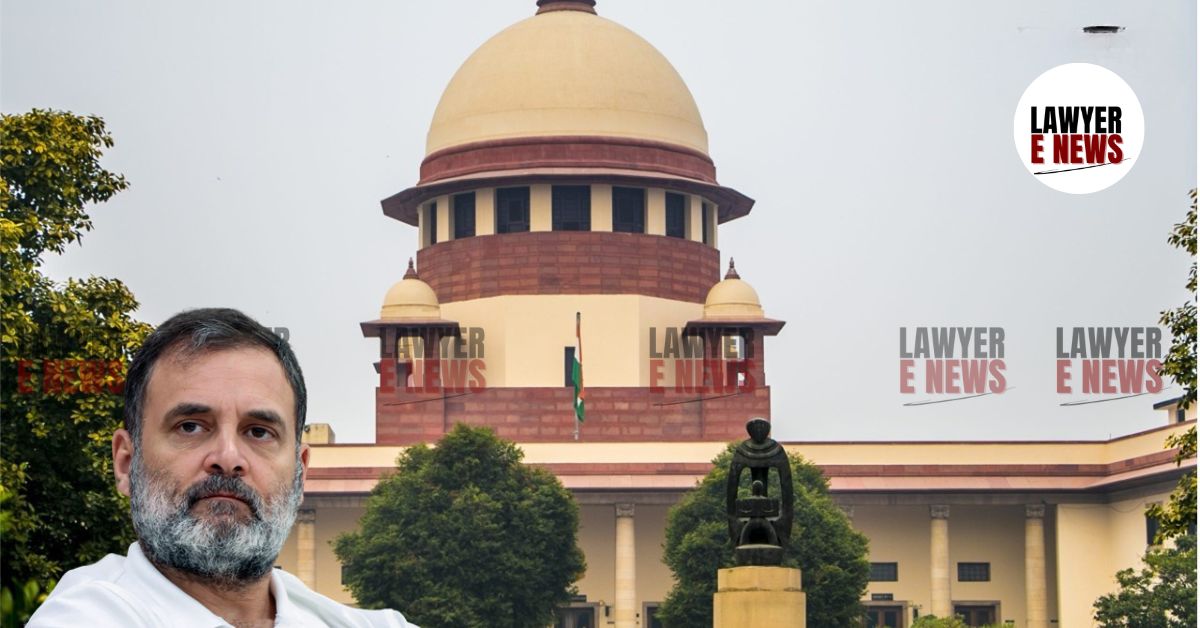
"You Are Encouraging These Kind of Statements...Even Mahatma Gandhi Used 'Your Faithful Servant'": SC Slams Rahul Gandhi For Comment Against Savarkar, On April 25, 2025, the Supreme Court of India stayed criminal defamation proceedings pending against Rahul Gandhi before a Lucknow court for his controversial remarks about Vinayak Damodar Savarkar. However, the Court issued a stern oral warning, indicating that any repetition of such statements may invite suo motu action. The case, Rahul Gandhi v. State of U.P. and Anr., was heard by a bench comprising Justice Dipankar Datta and Justice Manmohan.
The Court’s sharp observations underline the sensitive nature of public comments made by political leaders and their potential to trigger unrest or historical misrepresentations. While granting Gandhi interim relief, the Supreme Court made it clear that "irresponsible statements about freedom fighters will not be tolerated."
The controversy arose from a press conference held by Rahul Gandhi, where he allegedly stated that VD Savarkar was a servant of the British and had received a pension from the colonial government. A private complaint was filed by Advocate Nripendra Pandey in a Lucknow court, claiming that Gandhi's remarks were aimed at spreading hatred and enmity in society and insulted the basic characteristics of the nation.
On December 16, 2023, the Additional Civil Judge (Sr. Div.)/ACJM, Lucknow, Alok Verma, summoned Gandhi as an accused, observing:
“Distributing previously printed pamphlets and leaflets at press conferences demonstrates that Rahul Gandhi had weakened and insulted the basic characteristics of the nation by spreading hatred and enmity in the society.”
Gandhi had approached the Allahabad High Court seeking relief, but Justice Subhash Vidyarthi declined to grant him protection, observing orally that he could approach the Sessions Court under Section 397 CrPC (now Section 438 BNSS). Gandhi then moved the Supreme Court.
The primary issue was whether Rahul Gandhi’s comments constituted criminal defamation under Section 499/500 IPC, and whether the continuation of criminal proceedings was justified in light of his political stature and constitutional rights under Article 19(1)(a).
However, the legal question soon gave way to a moral rebuke by the Bench, especially by Justice Dipankar Datta, who expressed serious concern over Gandhi’s choice of words. Justice Datta questioned the historical accuracy and intention behind Gandhi’s statement, noting:
“Does your client know Mahatma Gandhi also used 'your faithful servant' while addressing the Viceroy?”
He further pointed out that Indira Gandhi, Rahul Gandhi’s grandmother and former Prime Minister, had praised Savarkar in official correspondence, asking rhetorically:
“Does your client know that his grandmother, when she was the Prime Minister, also sent a letter praising the gentleman, the freedom fighter?”
Justice Datta also warned:
“Let him not make irresponsible statements about freedom fighters. You have laid down a good point of law, and you are entitled to stay. But this is not the way you treat our freedom fighters.”
He added that such comments “encourage dangerous historical mischaracterizations” and reminded the counsel that:
“Even Judges of the Calcutta High Court used to address the Chief Justice as ‘Your Servant’ during British times. Someone does not become a servant like this.”
Though the Court granted Gandhi interim protection by staying the defamation proceedings, it orally imposed a clear warning:
“We will grant you stay...but we will restrain you from making irresponsible statements. Let’s be clear, any further statement and we will take suo motu action—no question of sanction!”
Senior Advocate Abhishek Manu Singhvi, appearing for Gandhi, gave an oral undertaking that no such comments would be made in the future.
Interestingly, the Court did not record this condition in its written order, but made its stance unambiguously clear during the hearing.
The Supreme Court's ruling provides Rahul Gandhi interim relief from prosecution, but comes with a veiled ultimatum. The bench’s strong oral observations serve as a powerful reminder to public figures that freedom of speech, though constitutionally protected, must be balanced with responsibility and respect for the nation’s history and its freedom fighters.
The Court’s warning also sets a precedent that could influence future discourse on defamation, free speech, and political rhetoric—especially when aimed at historically sensitive personalities like Savarkar.
Date of Order: April 25, 2025