-
by sayum
04 August 2026 1:39 PM







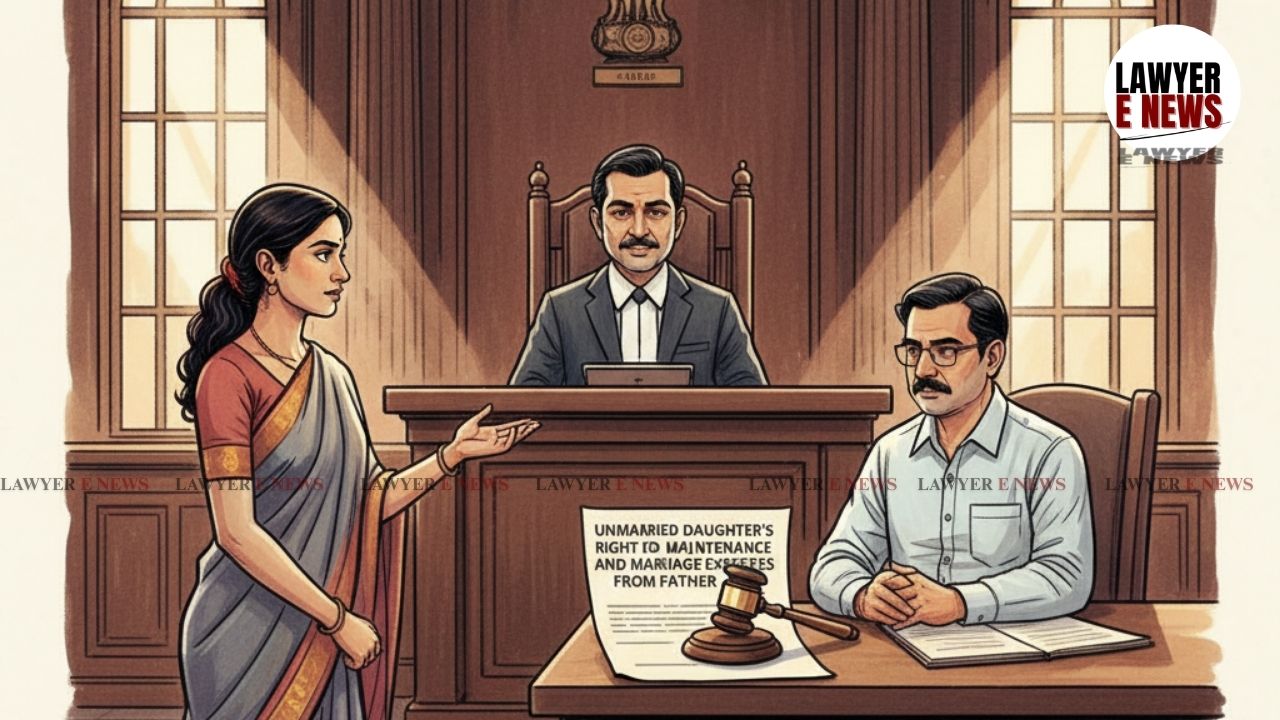
“A Hindu father’s obligation to maintain and marry off his daughter is absolute under personal law; cannot abdicate duty merely because daughter is major”, In a significant reaffirmation of Hindu personal law obligations, the Chhattisgarh High Court dismissed a father’s appeal challenging an order granting monthly maintenance and marriage expenses to his unmarried major daughter, holding that a Hindu father has both a legal and moral duty to maintain and provide for the marriage of his daughter until she is married or becomes self-sufficient.
A Division Bench comprising Justice Sanjay K. Agrawal and Justice Sanjay Kumar Jaiswal ruled that the obligation under Section 20 read with Section 3(b) of the Hindu Adoptions and Maintenance Act, 1956 is statutory in nature and enforceable even when the daughter has attained majority, provided she is unable to maintain herself.
“A father has a duty and an obligation to maintain his daughters and to take care of their expenses, including towards their education and marriage. This obligation is legal and absolute in character and arises from the very existence of the relationship between the parties,” the Court quoted from Poonam Sethi v. Sanjay Sethi, (2022 SCC OnLine Del 69), placing it at the heart of its ruling.
Father earning ₹44,642/month refused to support 25-year-old daughter; Family Court awarded ₹2,500/month and ₹5,00,000 towards marriage
The appellant-father, a government school teacher drawing ₹44,642 per month, had challenged the Family Court’s decree dated 02.09.2024 passed in Civil Suit No. 56A/2022, which awarded his 25-year-old unmarried daughter ₹2,500 per month as maintenance and ₹5,00,000 as marriage expenses.
The father argued that the daughter had reached the age of majority and hence was not entitled to maintenance under personal law. He further objected that no affidavits of income were filed, allegedly contrary to Rajnish v. Neha, AIR 2021 SC 569. However, the Court rejected both contentions.
The daughter had pleaded that she was unable to maintain herself, and that her father, having remarried and started a second family, had neglected his responsibility towards her. The Family Court had found her claim credible and allowed her application under Section 20 read with Section 3(b) of the 1956 Act.
“Maintenance includes marriage expenses” – Court invokes expanded definition under Section 3(b)(ii)
The Court laid emphasis on the statutory definition of “maintenance” under Section 3(b) of the Act, which includes:
“(ii) in the case of an unmarried daughter, also the reasonable expenses of and incident to her marriage.”
The judges noted that this inclusive definition reflects the social reality and the obligations deeply embedded in Hindu familial norms, stating:
“Though the respondent/plaintiff is a major, aged about 25 years, she, being an unmarried daughter, is clearly entitled for maintenance from her father till she is married, as well as marriage expenses, which is her statutory right.”
“Obligation under Section 20(3) is enforceable against father even after majority” – Court follows Supreme Court in Abhilasha v. Parkash
Relying on the landmark judgment in Abhilasha v. Parkash [(2021) 13 SCC 99], the High Court emphasized that Section 20(3) of the 1956 Act imposes a clear statutory obligation on a Hindu father to maintain his unmarried daughter if she is unable to maintain herself:
“The right of an unmarried daughter under Section 20 to claim maintenance from her father… is absolute and rightly granted under personal law, enforceable by her in law.”
The Court clarified that this obligation is independent of Section 125 Cr.P.C. and flows from Hindu personal law, making it stronger in scope and content.
Sale of pious obligation argument rejected – Daughter’s right grounded in personal law, not charity
In rejecting the appeal, the Bench stated:
“The appellant, being the father, has a moral and legal responsibility and obligation to maintain his daughter, who is unmarried, even though she has attained majority.”
The judges underscored that "Kanyadaan is a solemn and pious obligation of a Hindu father, from which he cannot renege", drawing on established Hindu jurisprudence and citing with approval Poonam Sethi v. Sanjay Sethi.
No merit in appeal – Father directed to pay maintenance regularly and deposit ₹5 lakhs within 3 months
At the time of hearing, it was submitted that the father had neither paid the monthly maintenance nor deposited the ₹5,00,000 towards marriage expenses. Upon being confronted, the father’s counsel assured the Court that the amount would be deposited within three months and monthly payments would be resumed.
Accordingly, the Court dismissed the appeal:
“In view of the legal position and factual findings recorded by the Family Court, we find no merit in this appeal. The decree is affirmed.”
This decision provides strong judicial reinforcement of the rights of unmarried daughters under Hindu personal law. It clarifies that:
The ruling also serves as a strong caution to fathers attempting to sidestep obligations toward daughters from first marriages after entering new matrimonial alliances.
Date of Decision: 21 November 2025