-
by sayum
10 August 2026 1:57 PM







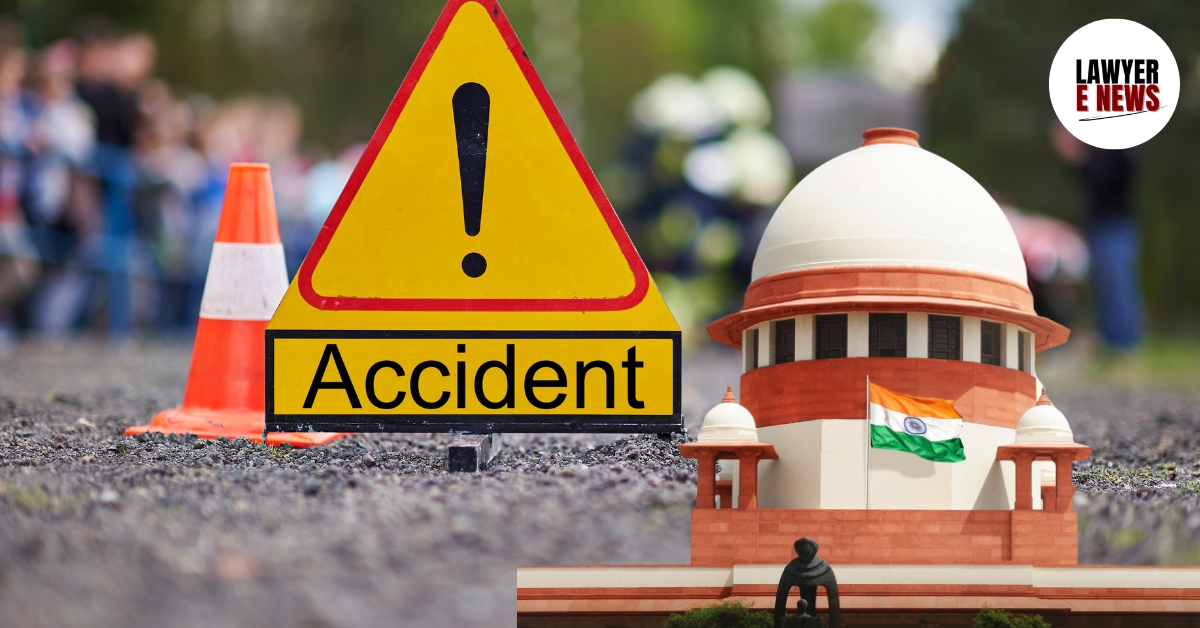
“The Tribunal rightly accepted ₹10,000 as monthly income… an unskilled labourer in 2014 would reasonably earn this amount with marginal annual increases.” – Supreme Court of India delivered a compelling judgment wherein it restored the full compensation awarded by the Motor Accident Claims Tribunal to the family of a deceased truck driver. The Court firmly held that the High Court erred in reducing the income to ₹4,076 and that the original figure of ₹10,000 per month was realistic and justifiable for a skilled worker in 2014. The decision reinforces the judicial trend of recognizing human dignity and economic realism in accident compensation cases.
The deceased, a 28-year-old truck driver, had stopped his vehicle and was in the process of re-boarding when he was struck and killed on the spot by another rashly driven truck. His family—comprising his widow, three minor children, and parents—approached the Tribunal for compensation. Based on the claimed monthly salary of ₹10,000, future prospects, and standard deductions, the Tribunal awarded them ₹23,07,000, including damages for consortium, loss of estate, and funeral expenses.
The insurance company, however, challenged the award before the High Court, which drastically cut the compensation to ₹12,34,105. The High Court pegged the income at a much lower ₹4,076, applying minimum wages for a driver and denying consortium compensation to children and parents.
Rejecting the High Court's reasoning, the Supreme Court invoked its precedent in Ramachandrappa v. Royal Sundaram Alliance Insurance Co. Ltd. and emphatically stated:
“Even a coolie would get an income of Rs.4,500/- in the year 2004. Hence, an unskilled labourer considering the marginal and incremental increase in each successive year @ Rs.500/- per year would be entitled to get almost Rs.10,000/- in the year 2014.”
Reinforcing the Tribunal’s original assessment, the Court declared:
“The claim made before the Tribunal with respect to the driver of a heavy vehicle getting Rs.10,000/- as wages per month must be necessarily accepted.”
This pronouncement sends a strong message against mechanically applying minimum wage rates without considering the actual skill and nature of the work.
“Consortium Is Not Just for Wives”: Court Restores Compensation to Children and Parents
Addressing the High Court’s removal of consortium damages for parents and children, the Supreme Court turned to its ruling in New India Assurance Co. v. Somwati, and reaffirmed:
“It has been held… that even the children and the parents are entitled to compensation for loss of consortium.”
The Court insisted that even though the claimants had not appealed the High Court decision, “the award made as compensation for loss of consortium to the children and the parents by the Tribunal has to be retained.”
This observation is significant—it reasserts that the loss of love, affection, and companionship is not exclusive to spousal relationships, and that the law now recognizes the emotional void suffered by children and aging parents alike.
The Supreme Court concluded by restoring the Tribunal’s award in its entirety and directed disbursal of compensation within two months. The justices added:
“If any of the minor children have not attained majority, the amount shall be kept in a fixed deposit, the interest of which can be disbursed to the mother who is the guardian.”
In doing so, the Court balanced legal finality with compassionate justice, while reaffirming its commitment to judicial sensitivity in cases of wrongful death.
This judgment is a strong reaffirmation of the judiciary's evolving approach to just, fair, and realistic compensation in motor accident cases. Rejecting rigid and outdated benchmarks, the Court leaned into ground realities and human dignity, stressing that tribunals and courts must treat the economic value of life with the respect it deserves.
“We set aside the order of the High Court restoring the order of the Tribunal… the insurance company shall deposit the amounts within the period stipulated.”
Date of Decision: May 15, 2025