-
by sayum
10 August 2026 1:57 PM







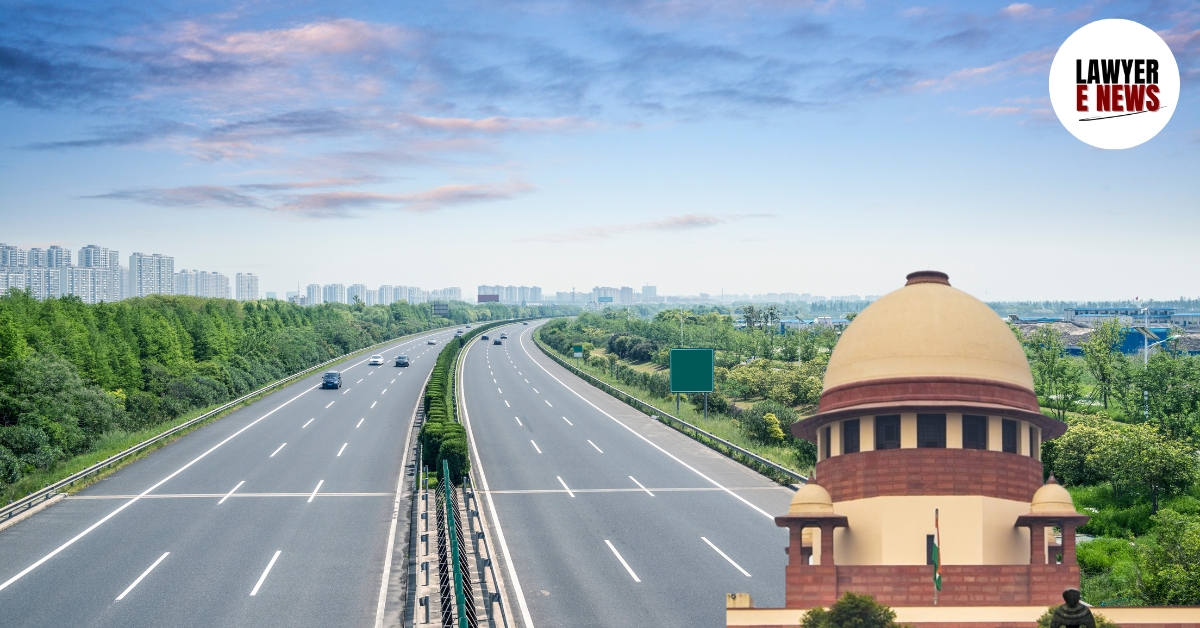
“Judicial notice will have to be taken of the fact that in different parts of India, there are unauthorized encroachments on highway land… The machinery is available only on paper.” - In a far-reaching judgment aimed at improving road safety across the country, the Supreme Court of India, on 21 May 2025, issued a continuing mandamus directing the Government of India and Highway Administrations to urgently address the widespread encroachments on National Highways, calling them a direct threat to public safety and a blatant violation of statutory mandates.
Justice Abhay S. Oka and Justice Augustine George Masih, delivering the order, observed: “There is no effective implementation of the provisions of the 2002 Act. The machinery is available only on paper.”
“Highway Administrations Must Do More Than Exist on Paper”—Court Slams Poor Enforcement of 2002 Act
The Court took serious note of the inaction by the Highway Administrations under the Control of National Highways (Land and Traffic) Act, 2002, despite rising casualties on Indian roads. The bench emphasized that the statutory functions under Sections 24 and 26, including prevention and removal of unauthorized occupation, have not been enforced in spirit:
“Unless survey is regularly carried out, the Highway Administrations will have no source of knowing whether there is any unauthorized occupation of highway land.”
The Court was particularly critical of the fact that no machinery existed for citizens to file complaints, nor had the administration conducted periodic surveys or created a grievance redressal system:
“There is no grievance redressal mechanism created for the benefit of the citizens… Judicial notice will have to be taken of the fact that there are unauthorized encroachments in different parts of India.”
“Encroachments Endanger Life and Mobility”—Court Stresses Duty of Centre to Act Under National Highways Act, 1956
Under the National Highways Act, 1956 and the 2002 Act, the Centre is the owner and custodian of highway lands. The Court noted that with this ownership comes the duty to maintain roads and ensure they remain free of obstruction:
“It is the obligation of the Central Government to maintain the National Highways… Maintenance includes keeping them in good condition, free of encroachments and, most importantly, ensuring road safety.”
The Court noted a complete failure of statutory obligations and administrative vigilance. Even though a toll-free number and a mobile app ("Rajmargyatra") existed, the Court was unsatisfied: “It is not specifically mentioned that complaints about unauthorized occupation can be lodged through the toll-free number. The mobile application is still being revamped.”
“We Cannot Allow Highways to Become Hazards”—Court Directs Surveillance, SOPs, Citizen Participation, and Timely Redressal
Issuing a set of detailed binding directions, the Court ordered a revamp of highway inspection, public reporting mechanisms, and the establishment of surveillance teams with the help of State Police.
“We direct the Union of India to constitute surveillance teams consisting of State Police… The duty of the surveillance teams will be to do patrolling regularly and punctually.”
“Highways must be kept under surveillance by CCTV cameras… Rajmargyatra mobile app must be widely publicized and integrated with a complaint-tracking system.”
The Court also directed the development of a grievance redressal portal, allowing citizens to lodge complaints with photo and location data and track action taken.
“Continuing Mandamus Required for Systemic Change”—Petition to Remain Pending
Acknowledging the persistent efforts of the petitioner, Gyan Prakash, and the assistance of Amicus Curiae Ms. Swati Ghildiyal, the Court declared that the petition would remain pending:
“As far as this petition is concerned, it must remain pending… This is a fit case where this Court will have to issue a continuing mandamus.”
It ordered the next compliance hearing for 15 September 2025 and directed detailed compliance affidavits from the Ministry of Road Transport & Highways (MoRTH), the National Highways Authority of India (NHAI), and Highway Administrations.
This judgment lays bare a long-ignored aspect of Indian infrastructure governance—the gap between statutory mandates and their enforcement. The Supreme Court has now created a blueprint for real-time, accountable highway governance, rooted in citizen participation, administrative transparency, and judicial oversight.
As the Court summed up: “Both provisions of Sections 24 and 26 must be implemented in their true letter and spirit.”
The message is clear: Encroachments are not just illegal—they are lethal. Road safety is not a privilege; it is a public right.
Date of Decision: 21 May 2025