-
by sayum
25 August 2026 12:32 PM







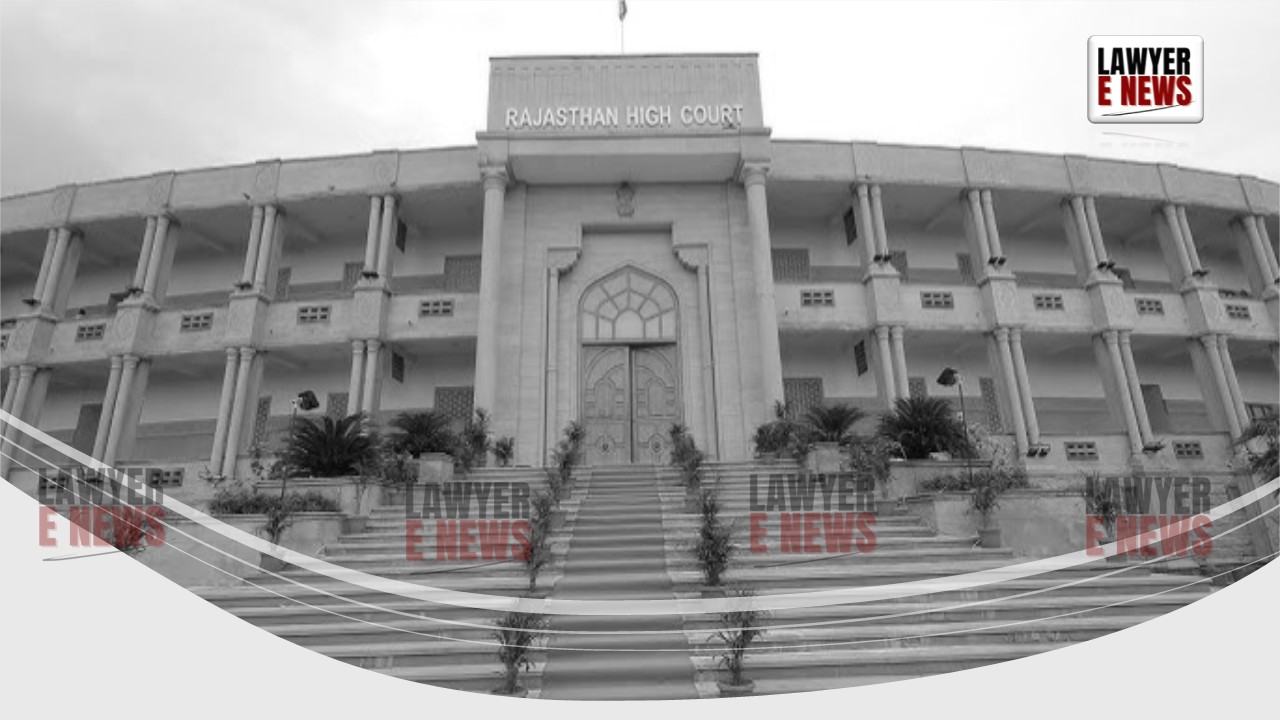
"Under no circumstances can both these issues be said to be overlapping… Documents deposited for admission cannot be retained as a tool to compel fee payment" – In a decisive ruling Rajasthan High Court, Jaipur Bench, in the case of Eshita Gupta v. Jaipur National University, came down heavily on the practice of private universities withholding original academic documents of students as a coercive measure for fee recovery. Justice Anuroop Singhi, presiding over the matter, directed Jaipur National University to immediately release the original Transfer Certificate and Migration Certificate of the petitioner, a former MBBS student, stating that “such action unjustifiably hampers the student’s right to education and career progression.”
The Court made it unequivocally clear that educational institutions cannot use students' original documents as leverage, regardless of pending financial dues. The ruling marks a critical reaffirmation of students’ rights in the face of increasingly commercialised educational practices.
"Intent of the State and Supreme Court is to enable fee recovery – but not by forcefully retaining original certificates"
The matter arose when Eshita Gupta, an MBBS student who had completed two years of study at Jaipur National University and paid three years' fees, withdrew from the course due to health issues. She later secured admission in a Bachelor of Design course at Pearl University, Delhi. However, she was barred from appearing in her upcoming examinations as her original certificates remained in possession of Jaipur National University, which insisted that she first pay the fee for the remaining two years of the MBBS course.
Appearing in person, the petitioner argued that the refusal to return her Transfer Certificate dated 04.08.2021 and Migration Certificate dated 25.10.2021 placed her new academic career in jeopardy. The University contended that under the admission booklet and affidavits signed by the student and her parents, they were entitled to recover the entire course fee and retain the certificates until dues were cleared.
But the Court rejected this position in its entirety, observing that: "The document deposited by a student solely for seeking admission in the course by no stretch of imagination can be retained as a tool to compel her to deposit the fee. Imposing such a condition would defeat the very object of furnishing the original documents by a student at the time of seeking admission, which is to ascertain and verify the documents and eligibility of that student and nothing more."
“Certificates are individual property – no institution can retain them without lawful authority”
Justice Singhi drew support from binding judicial precedents, relying heavily on decisions of the Punjab and Haryana High Court in Sukhmanpreet Singh Cheema v. Union of India and Monika v. PT. B.D. Sharma University, as well as the Madras High Court's ruling in M. Kesavan v. Principal, Cheeran College of Pharmacy. All these decisions uniformly held that no educational institution has any legal right to retain original certificates for enforcing payment of dues.
Quoting the Punjab & Haryana High Court, the Court reiterated: "Certificates of a student are his/her individual property. No other institution or individual can retain the same without lawful authority... Adopting the method of retaining original certificates/documents is unfair to say the least."
The Court further clarified that while institutions are well within their rights to recover outstanding fees through appropriate legal remedies—including encashment of post-dated cheques or initiating civil suits—they cannot act outside the law by impairing a student’s future.
"A Student’s Future Cannot Be Collateral" – Court Directs Immediate Release of Certificates
The University had also pointed to the student’s affidavit acknowledging liability for the remaining course fees and agreeing to the institution’s right to recover the same. However, the Court noted that:
"Even those affidavits failed to give any unfettered right to the university to keep the documents, so much so to prejudice and hamper the further career growth of a student."
In fact, the Court observed that the student had already paid fees for three academic years despite studying only for two, and there was no rational or legal basis for refusing to release her certificates. It dismissed the argument that information booklets or reporting conditions authorised such retention.
Quoting directly from the judgment:"It is writ large that the intent of the State as well as of the Hon’ble Supreme Court is to enable the institution to recover its fees but certainly not by way of forcefully retaining the original documents of a student."
Ultimately, Justice Anuroop Singhi ordered the University to "release the Transfer Certificate and Migration Certificate to the petitioner forthwith and not later than by 04/12/2025”, noting that her exams were to commence the next day. The main writ petition has been listed for further hearing on 22nd January 2026.
Legal Fee Recovery Cannot Violate Student Rights
This ruling reinforces the principle that coercion has no place in educational administration, and any recovery of dues must strictly follow the rule of law. By refusing to allow educational institutions to turn students’ documents into instruments of economic pressure, the Court has protected not only the petitioner but also set a precedent safeguarding the educational and constitutional rights of students across India.
In doing so, the Court has sent a powerful message to universities:"Recover your dues through law – not by holding a student’s future hostage."
Date of Decision: 03/12/2025