-
by sayum
25 August 2026 6:19 AM







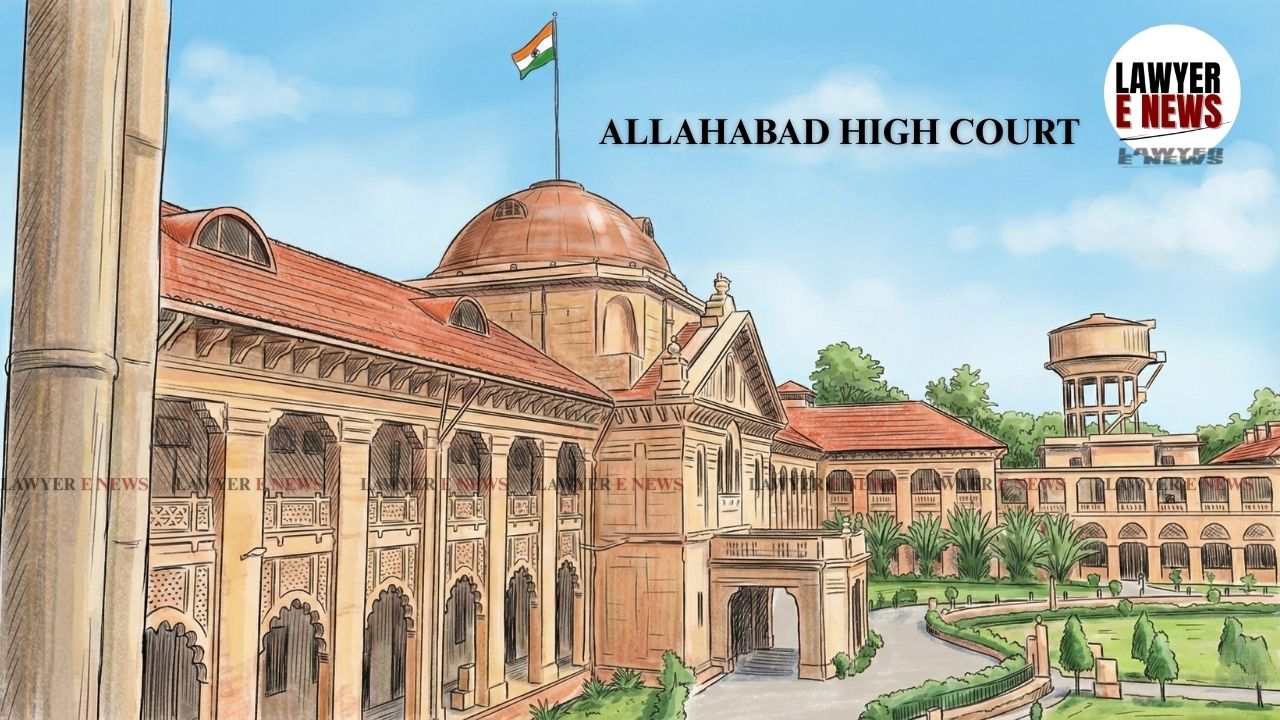
“No Crush Injuries, No Broken Limbs, No Witness Reliability — Acquittal Affirmed in Bolero Murder Case”. Allahabad High Court delivered a reasoned judgment in Criminal Appeal No. 560 of 2025, Mewati Devi vs. State of U.P. & Others, declining to interfere with the acquittal of nine accused persons charged with murder under Sections 302/149 IPC, observing that the prosecution failed to establish guilt beyond reasonable doubt. The Division Bench comprising Justice Rajeev Misra and Justice Dr. Ajay Kumar-II ruled that there were “no compelling reasons” to disturb the trial court’s judgment since the conclusions reached were neither perverse nor based on a misreading of evidence.
The case involved the allegation that the accused intentionally ran a Bolero over the deceased multiple times, resulting in his death. The appellant, Mewati Devi, wife of the deceased, filed the appeal under Section 413 of the Bharatiya Nagarik Suraksha Sanhita, 2023 (BNSS), assailing the acquittal judgment dated 30.08.2025 passed by the Sessions Judge, Azamgarh.
The High Court found that the trial court had “properly scrutinized every aspect of the prosecution’s case, including the timing and authenticity of the FIR, the credibility of the alleged eyewitnesses, and the medical evidence,” and rightly concluded that the prosecution version “does not inspire confidence.”
“The Trial Court’s View Was a Plausible One Based on Evidence — Acquittal Cannot Be Overturned Merely Because Another View Is Possible”
The Bench began by reiterating the settled legal principle governing appeals against acquittal. Citing Bharwad Jakshibhai Nagjibhai v. State of Gujarat, (1995) 5 SCC 602, the Court noted:
“Though Cr.P.C. makes no distinction between powers of the appellate court while dealing with conviction or acquittal, the normal rule is that an order of acquittal is not to be disturbed if two views of the evidence are reasonably possible.”
It was further observed, quoting Babu Sahebagouda Rudragoudar v. State of Karnataka, 2024 SCC OnLine SC 561:
“The appellate court can reverse an acquittal only if the judgment suffers from patent perversity, is based on misreading or omission of material evidence, or where only one conclusion — that of guilt — is possible.”
The High Court found none of these grounds present in this case and upheld the acquittal as a “natural consequence of the prosecution’s failure.”
“Medical Evidence Does Not Support the Prosecution’s Story — No Crush Injuries, No Broken Limbs”
One of the most decisive factors in the Court’s affirmation of the acquittal was the contradiction between ocular evidence and medical findings. According to the appellant, the deceased was run over three to four times by a Bolero driven by the accused, and that his limbs were broken.
However, the post-mortem report told a different story.
“The deceased’s limbs were found intact — no fractures were recorded, no crush injuries were found, and only abraded contusions were visible. The ocular version is not corroborated by medical evidence and raises serious doubts about the prosecution’s narrative,” the Court said.
This mismatch led the Court to question the very core of the prosecution’s case, as it found the injuries “inconsistent with the alleged manner of death.”
“Witnesses Were Not Only ‘Chance Witnesses’ — Their Presence Itself Was Unreliable”
The Court was particularly scathing in its assessment of the two primary witnesses — the deceased’s wife (P.W.1) and minor son (P.W.2). Both had claimed to witness the incident while returning from a medical visit, but their presence on the spot was found to be unconvincing.
“They are not natural witnesses to the crime. Their presence was not explained satisfactorily, and their statements were riddled with contradictions regarding timing, medical treatment, and travel details.”
The Court quoted Shakarlal v. State of Rajasthan (2004) 10 SCC 632, affirming that:
“A chance witness must adequately explain his or her presence at the scene of crime. Where such presence appears doubtful, the testimony loses reliability.”
Furthermore, contradictions between the testimonies were not minor. For instance, P.W.1 stated that Lal Bahadur was driving the Bolero, while P.W.2 said it was Subhash. One claimed she was administered glucose, the other denied it. One said nine people were in the Bolero, the other described a different configuration and sequence of events.
“Such discrepancies strike at the root of the credibility of the witnesses. Their depositions do not inspire confidence,” the Court noted.
“Delayed FIR, Contradictory Statements, and Lack of Independent Corroboration Undermine the Case”
Another significant aspect of the judgment was the Court’s assessment of the FIR. Though registered on the same day, the FIR was found to be of dubious origin, with the Court noting that the informant's version of how it was registered conflicted with the Investigating Officer’s account.
“P.W.1 stated the FIR was handed over to police on the spot, while G.D. entries suggest it was submitted at the police station. The Check FIR reached the Magistrate after four days and the Circle Officer after two — such delays cast a long shadow of doubt.”
The Court held that these contradictions raised “serious questions regarding the credibility of the prosecution’s initial narrative.”
“Acquittal Is a Result of Careful Appreciation, Not Error”
The Court concluded that the trial court had meticulously analysed every piece of evidence and found that the prosecution failed to remove reasonable doubt.
“It cannot be said that the only view consistent with the evidence is that of guilt. The trial court's findings are plausible, well-reasoned, and consistent with settled legal principles,” the Bench stated.
Accordingly, the appeal under Section 413 BNSS was dismissed, and the acquittal of all nine accused affirmed.
Date of Decision: 3rd December 2025