-
by sayum
25 August 2026 4:32 AM







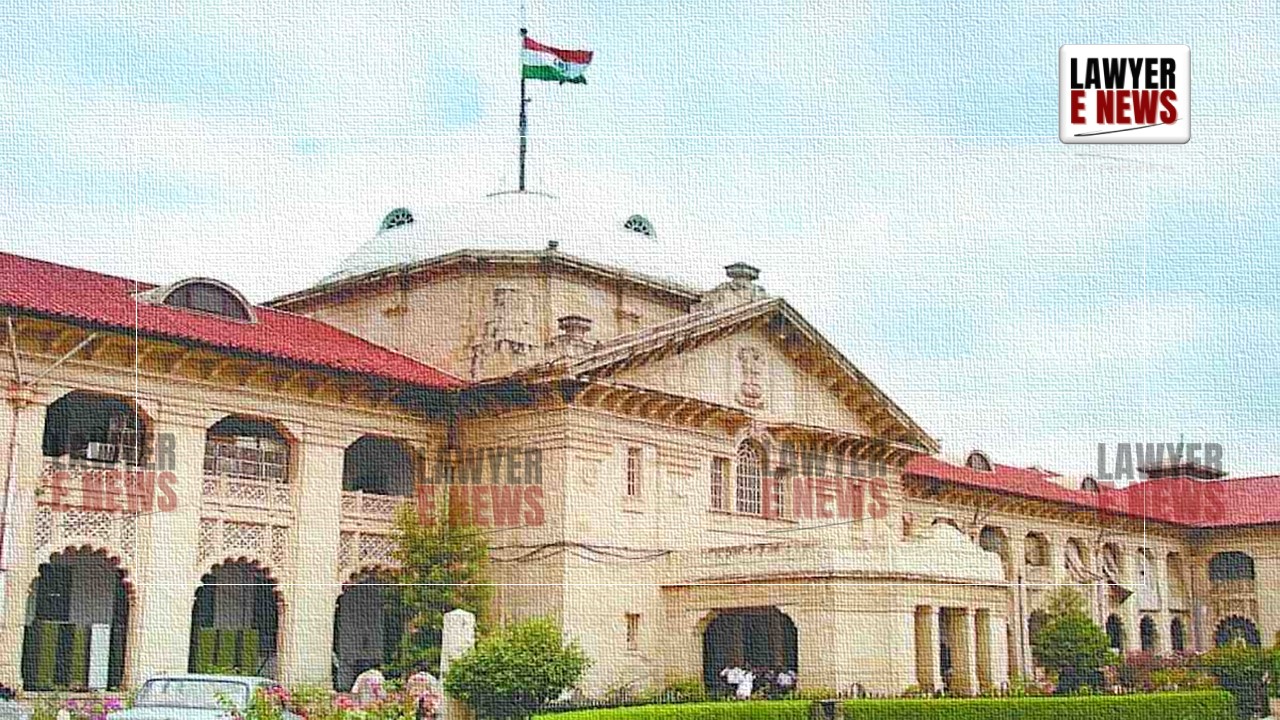
In a significant ruling for service law jurisprudence, the Allahabad High Court held that Rule 12(8) of the U.P. Secondary Education Service Selection Board Rules, 1998 does not confer a right on candidates to insist that waiting lists must be prepared up to 25% of the advertised vacancies. Instead, the rule merely provides an upper ceiling, and the selection authority retains discretion to fix a percentage below that limit.
Justice Saurabh Shyam Shamshery unequivocally stated that: “The Board cannot be held to bear a mandatory obligation to draw up a list equalling at least 25% of the total number of vacancies which were advertised. It is essentially a ceiling, not a floor.”
The judgment, while rejecting the petitioners’ demand for enlargement of the waiting list in LT Grade Assistant Teacher recruitment (Advertisement No. 01/2016), affirms that recruitment processes must conclude within a reasonable timeframe, and no indefeasible right flows from being close in merit to the last selected candidate.
“Waiting List is Not a Right But a Discretionary Mechanism”: Court Cites Rule 12(8), Upholds Board’s Interpretation
The primary contention of the petitioners was that vacancies still existed under the 2016 recruitment cycle for LT Grade Assistant Teachers, and the waiting list should have been prepared uniformly up to 25% of the advertised 7950 posts, in all subjects. Petitioners claimed that non-uniform percentage allocation per subject—ranging from 1 to 25%—was arbitrary and violated principles of equality and transparency.
However, the Court firmly rejected this premise, relying on a strict interpretation of Rule 12(8):
“The language used is ‘not larger than twenty-five percent’... The clear command of the statute is that the Board shall not draw up a select list of candidates numbering more than 25%... It places a negative restraint—not a positive mandate.”
Drawing from its earlier precedents, including Gaurav Kumar v. State of U.P. (2025:AHC:32016) and Ambrish Kumar v. State of U.P. (2021:AHC:72924), the Court reiterated that no candidate has a vested right to demand a waiting list of a particular extent, particularly years after the process has practically concluded.
“Uniformity Ideal, Not Mandatory – Absence of Equal Application Does Not Amount to Arbitrariness”: Court Dismisses Plea of Discrimination in Subject-Wise Waiting List Percentages
The petitioners had relied on alleged arbitrary differentiation in waiting list percentages applied across various subjects. For instance, the waiting list for subjects with 1–5 vacancies had 1 additional candidate, while for larger subjects with over 500 posts, the list was limited to only 5%.
Advocates Ashok Khare and R.K. Ojha, appearing for the petitioners, argued that such non-uniform application of waiting list criteria violated principles of administrative fairness, especially when petitioners were close in merit to the last selected candidates.
The Court, while acknowledging that uniformity would have been preferable, held:
“Only on the ground that uniformity was not followed, a decision itself would not become arbitrary. Petitioners have failed to show that any statutory provision was violated.”
The Court noted that no mala fides or illegality was demonstrated, and that the decision was taken after due communication between the Board and Directorate, especially post the enactment of the U.P. Education Service Selection Commission Act, 2023, which restructured the recruitment machinery.
“Process Cannot Be Resurrected Indefinitely”: Court Relies on Sudesh Kumar Goyal to Emphasize Finality in Recruitment
The Court also addressed the issue of delay and protraction, noting that the recruitment process initiated in 2016 had already seen multiple rounds of litigation, supplementary panels, and counselling. At some point, a line must be drawn.
Quoting from the Supreme Court’s judgment in Sudesh Kumar Goyal v. State of Haryana, (2023) 10 SCC 54, the Court observed:
“It would be a travesty of justice to keep open the selection process for such a long time... even a selected candidate has no indefeasible right of appointment... A selection process initiated so far back cannot continue indefinitely.”
The Court also noted that the petitioners were neither in the merit list nor in the existing waiting list, and had no enforceable right to demand inclusion based on subsequent developments or speculative vacancies.
“Court Cannot Interfere in the Policy Domain Unless Clear Illegality is Established”: Judicial Review in Recruitment Must Be Restrained
The judgment underlines the limited scope of judicial review in service matters, particularly where statutory rules confer discretion to authorities, as under Rule 12(8).
The Court concluded:
“At the request of petitioners, no direction could be issued to the respondents to publish a fresh waiting list to particular extent. It is discretion of respondents to publish waiting list to any extent up to 25%.”
Noting that no statutory provision was violated, and that number of vacancies were also not concretely placed on record, the Court found no ground to interfere.
Key Legal Takeaways
For practitioners in the field of service law, the judgment reiterates several settled yet commonly contested principles:
Rule 12(8) is permissive, not mandatory – clients must be advised that no right exists to demand 25% waiting list.
Waiting list candidates have no indefeasible right to appointment, even when vacancies exist.
Judicial review is limited where discretion is exercised within the legal framework.
Delay and finality are crucial elements – petitions filed years after recruitment are inherently weak unless exceptional circumstances exist.
Policy uniformity is desirable but not enforceable unless it rises to the level of legal arbitrariness or discrimination.
The Allahabad High Court’s decision in Nitish Maurya & Ors. v. State of U.P. & Ors. is a definitive reminder that recruitment processes cannot remain in perpetual motion, and administrative discretion under a clear statutory ceiling like Rule 12(8) cannot be supplanted by judicial mandates. While the desire to accommodate deserving candidates may be compelling, courts must strike a balance between equity and finality, especially in public employment.
This judgment reinforces a core service law principle: “No candidate, not even one in the waiting list, has a right to appointment merely because vacancies exist.”
Date of Decision: 19 November 2025