-
by sayum
25 August 2026 12:32 PM







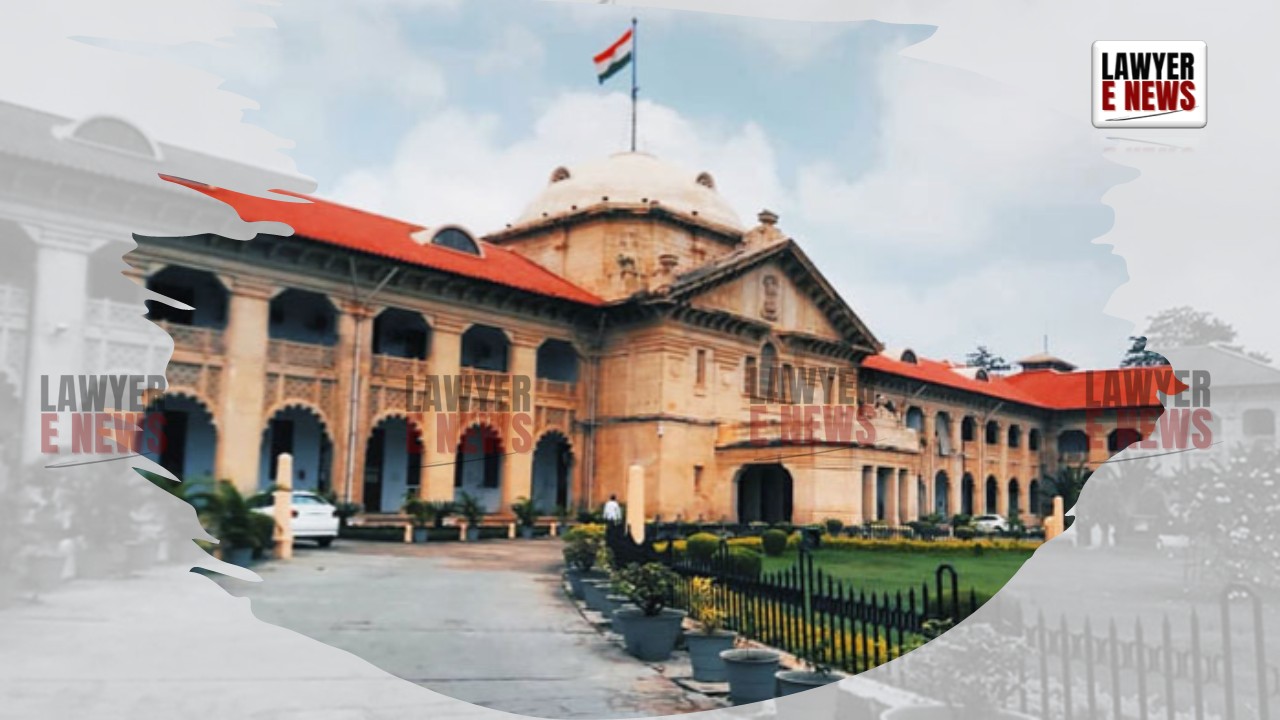
"Conviction Cannot Rest on a TIP Conducted After Two Months with No Motive or Independent Evidence", In a landmark decision that underscores the essential safeguards in criminal trials, the Allahabad High Court acquitted Bhola, who had been serving a life sentence for murder under Section 302 IPC, holding that his conviction rested solely on an unreliable Test Identification Parade (TIP) conducted after an unexplained delay of two months. The Court also found the absence of any established motive and lack of corroborative evidence, rendering the prosecution’s case “highly doubtful and unbelievable.”
Justice Vinai Kumar Dwivedi and Justice Salil Kumar Rai.
"The test identification lacks the requisite element of reassurance to support the conviction" — Court Relies on Supreme Court’s Ruling in Harinath v. State of U.P.
The Court extensively referred to the Supreme Court’s decision in Harinath and another v. State of U.P., (1988) 1 SCC 14, to hold that TIP conducted after a long delay, especially where the accused is already known to the witnesses, cannot be the basis for conviction. The Court observed:
“The delay of about two months in conducting the test identification parade after arrest of the accused-appellant Bhola, even without any explanation of delay, itself becomes highly doubtful and suspicious. Therefore, only on the ground of test identification parade… Bhola could not be held guilty.”
Midnight Attack, FIR Without Bhola’s Name, Acquitted Co-accused
The case arose from a late-night attack on 27 May 1981, when a group of five individuals allegedly assaulted the family of the informant, Lalmani Dubey, with lathi-danda and firearms. His nephew Rakesh Kumar was shot dead during the attack.
The FIR named only two persons — Brahm Shankar and Vijay Shankar — and mentioned three unknown assailants, including the one who fired the fatal shot. Bhola’s name was conspicuously absent.
During the trial, all other co-accused were acquitted, and only Bhola was convicted solely under Section 302 IPC, based on identification in a TIP and eyewitness testimonies of PW-1 Lalmani Dubey and PW-2 Chaturgun, the deceased’s father.
No Motive Alleged, No Independent Evidence, Only Suspicion
Noting that Bhola was not named in the FIR, and no motive was attributed to him, the High Court observed:
“No single sentence has been stated about the motive, reason or cause, that has motivated or inspired the accused-appellant Bhola to commit the alleged crime… This fact, in absence of any motive against the accused-appellant Bhola, makes the prosecution story suspicious and doubtful.”
Even the investigating officer (PW-7 Sarju Prasad Chaudhary) admitted in cross-examination that Bhola’s arrest was made merely on suspicion and a statement by a co-accused, not based on any direct evidence.
“From the above, it is clear that only on the ground of suspicion and doubt, the accused-appellant Bhola got involved and implicated in this case as an accused.”
Test Identification Parade: Delayed and Questionable
The Court gave detailed reasons for discrediting the TIP conducted more than two months after Bhola’s arrest, stating:
“The prosecution failed to offer any explanation for the delay of over two months between arrest and test identification. Such delay, when coupled with prior familiarity between the accused and witnesses from neighboring villages, renders the identification parade highly doubtful.”
In fact, PW-1 admitted in cross-examination that he had known Bhola for over 4½ years, and that Bhola was a resident of the nearby village Bhagwas, where the informant also had agricultural land.
The Court highlighted this contradiction:
“From the contradictory statement of PW-1 Lalmani Dubey and PW-2 Chaturgun, it becomes amply clear that PW-2 is purposely trying to conceal this fact that he did not know or was acquainted with Bhola.”
The court-ordered TIP conducted by PW-10 Isht Dev Prasad Rai, was also found to be flawed because witnesses were already familiar with Bhola, defeating the very purpose of the identification parade.
Acquittal of Named and Allegedly Motivated Accused Undermined Case Against Bhola
The trial court had acquitted the named and allegedly motivated co-accused — Brahm Shankar, Vijay Shankar, Nirahoo, and Awadh Narain — giving them the benefit of doubt. Bhola, who was not named in the FIR, and against whom there was no motive or direct evidence, was convicted solely on the basis of the flawed TIP, which the High Court found untenable.
“Despite the so-called enmity between the family of the informant and other accused, those accused were acquitted… In absence of any motive against the accused-appellant Bhola, this makes the prosecution story suspicious and doubtful.”
Prosecution Case Lacks the Element of Reassurance"
Concluding the judgment, the High Court held: “Only on the ground of test identification parade even after delay of more than two months, accused-appellant Bhola could not be held guilty for the commission of the heinous crime like murder… The prosecution story as projected… becomes highly doubtful and unbelievable.”
The Court thus allowed the criminal appeal, set aside Bhola’s conviction and sentence, and acquitted him by extending the benefit of doubt.
Date of Decision: December 5, 2025