
-
by sayum
25 August 2026 12:32 PM







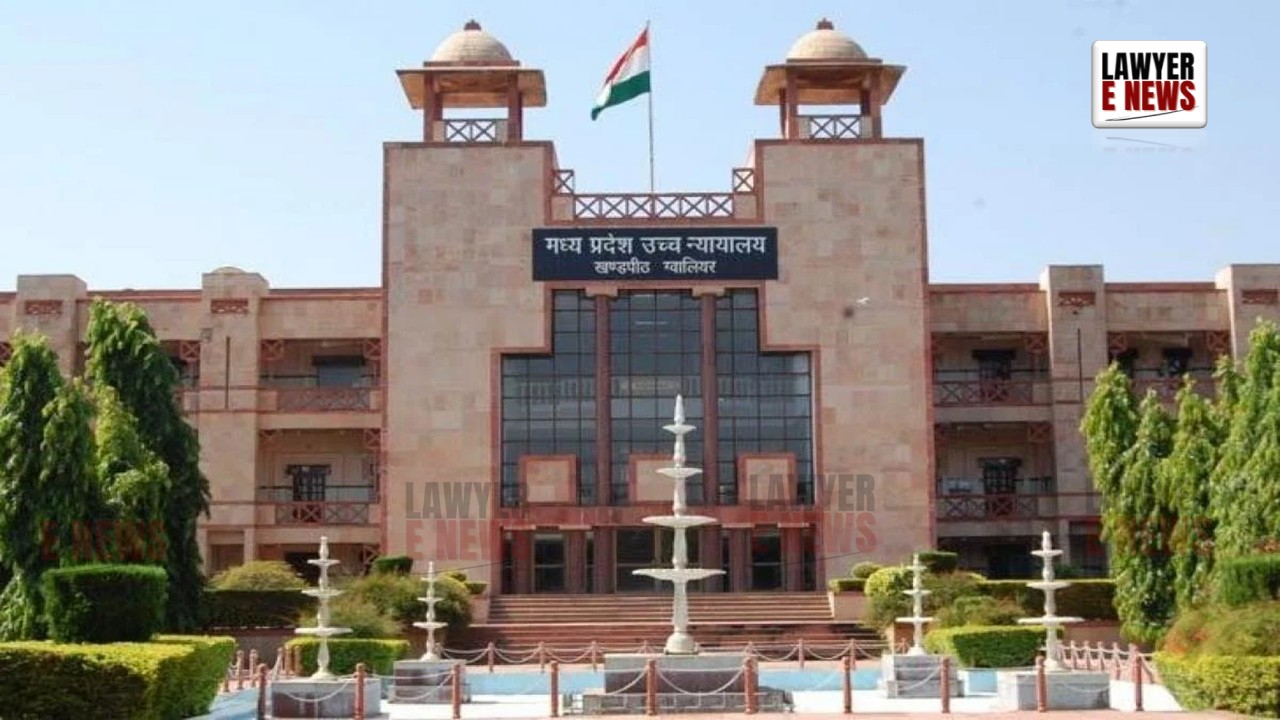
"Police Officer Exceeding Authority Has No Shield of Sanction—Custodial Torture Is Not A Lawful Function" — In a significant ruling that reiterates constitutional protections against custodial violence, the Madhya Pradesh High Court on 5th December 2025, dismissed a petition by a Sub-Inspector seeking quashing of criminal proceedings initiated against her under Section 482 of the Code of Criminal Procedure. The petitioner had claimed that no prior sanction under Section 197 CrPC was obtained before proceeding against her for alleged custodial assault, humiliation, and illegal detention, and thus, the complaint was not maintainable.
The Court, however, strongly disagreed, holding that “acts of custodial abuse and assault are wholly outside the purview of official duty”, and that Section 197 CrPC offers no immunity for such conduct. The petition was dismissed, clearing the path for trial.
“There Must Be A Reasonable Connection With Duty – Beating In Custody Is Not It”: Justice Rajesh Kumar Gupta Affirms Supreme Court's Jurisprudence on Section 197 CrPC
High Court refused to quash proceedings initiated against a Sub-Inspector accused of serious custodial violence and humiliation, including alleged beating, stripping, and public abuse of a female complainant and her brother.
Relying on a robust line of Supreme Court precedents, including D.K. Basu, Devinder Singh, and Dr. S.M. Mansoori, the Court held that Section 197 CrPC applies only when there is a reasonable connection between the act and official duty, and not in cases involving outright abuse of power.
The Court concluded: “Section 197 protection arises only when there is a reasonable connection with official duty. In cases of custodial torture, third-degree treatment, abuse, or fabrication, that nexus is absent.”
The petition arose from a private complaint filed by Pooja Kushwah, alleging that on 12 October 2019, her brother Dhirendra was stopped by police officials, including Sub-Inspector Mamta Gurjar, beaten in public without provocation, and later illegally detained, stripped, and tortured inside the Bargawan Police Station.
When Pooja arrived at the station to inquire, she was allegedly abused, slapped, beaten with sticks, her dupatta pulled, and molested, including a shocking allegation that a male officer bit her shoulder and mouth.
Despite multiple complaints to the SP, DGP, Home Ministry, and Human Rights Commission, no action was taken, prompting her to file a private complaint before the JMFC, Sheopur, which took cognizance of the offences under Sections 294, 342, 323, 34 and 506 (Part-1) IPC.
The petitioner moved an application under Section 197 CrPC (now Section 218 BNSS) arguing that the alleged actions were performed during the course of official duties, and without prior sanction from the Government, the proceedings were barred in law. Both the trial court and revisional court dismissed the application, prompting the petition under Section 482 CrPC before the High Court.
The central issue before the High Court was whether the acts alleged — namely, custodial beating, illegal detention, public abuse and humiliation — had any reasonable nexus with the discharge of official duty, so as to attract protection under Section 197 CrPC.
Justice Rajesh Kumar Gupta categorically held that no such connection existed.
“If an act is wholly unrelated to official duties, or manifestly beyond the scope of official duty, then Section 197 of the CrPC does not apply. The alleged custodial assault and humiliation were not required by the situation. These acts cannot be considered part of any lawful duty.”
The Court cited the “reasonable connection” test, consistently applied by the Supreme Court, to determine the applicability of Section 197 CrPC:
“The central test is whether the impugned act bears a reasonable connection with the discharge of official duties… Not every offence by a police officer automatically gets protection.”
Custodial Violence Is Not a Protected Function — Judicial Precedents Reiterated
Justice Gupta relied heavily on landmark rulings of the Supreme Court, including:
D.K. Basu v. State of West Bengal (1997) 1 SCC 416
“Custodial violence is unconstitutional and cannot, by any stretch, be considered part of the duties of a police officer.”
P.P. Unnikrishnan v. Puttiyottil Alikutty (2000) 8 SCC 131
“A police officer who assaults a person in custody cannot claim protection under Section 197 unless such force was used in lawful defence.”
Devinder Singh v. State of Punjab (2016) 12 SCC 87
“Abuse of power and illegal acts in custody fall outside the domain of official duty.”
Dr. S.M. Mansoori v. Surekha Parmar (2023 SCC OnLine SC 436)
“At the stage of cognizance, no sanction is required — the nature of duty and protection under Section 197 is a matter of evidence.”
The Court thus rejected the petitioner’s argument that the alleged acts were “official acts” or done in the performance of her police responsibilities.
Magistrate Cannot Recall Summoning Orders – Proper Remedy Lies Under Section 482
In addition, the Court addressed the petitioner’s challenge to the issuance of process by the Magistrate, and her plea that summons or bailable warrants were not served. The Court clarified:
“A Magistrate has no power to recall or review an order taking cognizance or issuing process. The only remedy lies under Section 482 CrPC.”
Citing Adalat Prasad v. Rooplal Jindal (AIR 2004 SC 4674) and Subramanium Sethuraman v. State of Maharashtra (AIR 2004 SC 4711), the Court affirmed that neither the trial nor revisional court committed any error in refusing to recall the summoning order.
The Madhya Pradesh High Court’s judgment in Mamta Gurjar v. Pooja Kushwah strongly affirms that Section 197 CrPC is not a shield for police brutality. The Court has rightly reaffirmed the principle that no law can protect a public servant who acts outside the bounds of legality and constitutional norms.
Where power becomes abuse, the law must intervene, and official immunity ends where personal malice and brutality begin.
By refusing to quash the complaint, the Court has upheld the rights of citizens against police excesses and restored faith in judicial oversight of custodial practices.
Date of Decision: 5 December 2025





