-
by sayum
10 August 2026 1:57 PM







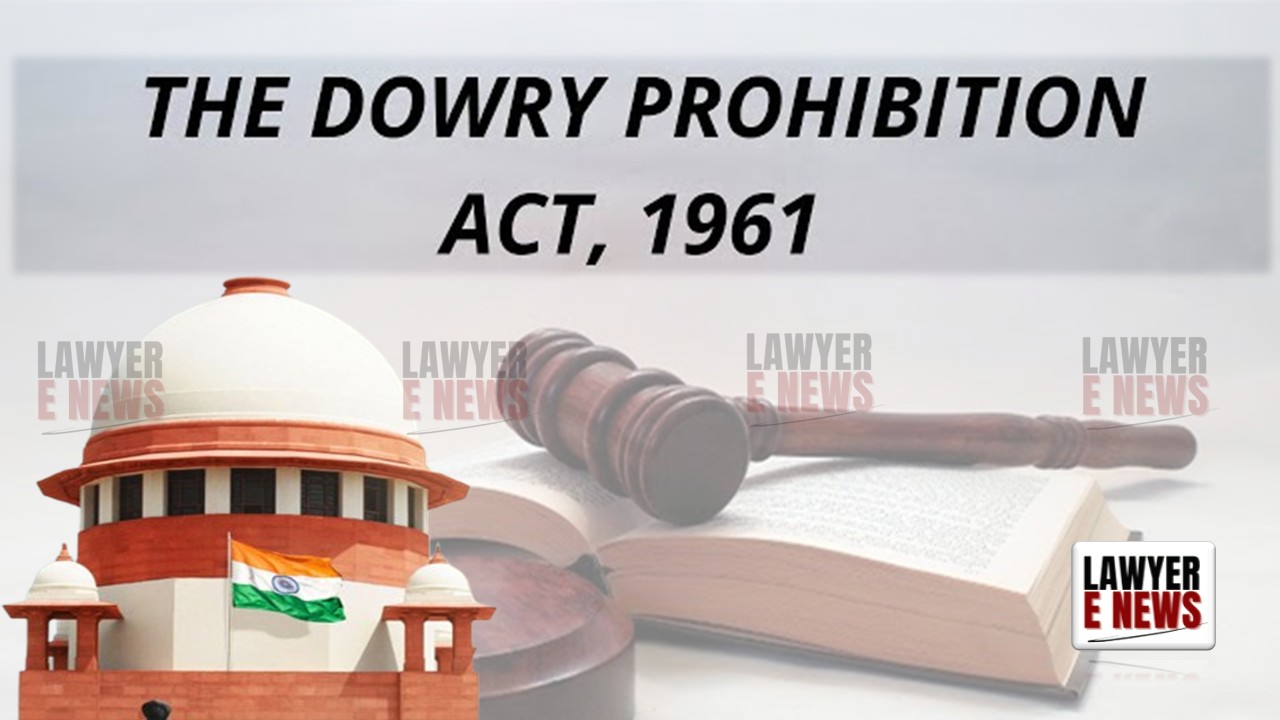
“The term ‘cruelty’ is subject to rather cruel misuse... vague, sweeping accusations unsupported by particulars cannot form the basis for prosecution”, - In a significant ruling Supreme Court of India overturned the conviction of a husband under Section 498A IPC and Section 4 of the Dowry Prohibition Act, 1961. The Court ruled that the prosecution's case—based solely on vague, general allegations without medical or independent corroboration—did not meet the threshold of cruelty or dowry demand as defined under law.
The appellant, Rajesh Chaddha, was convicted by the Chief Judicial Magistrate, Lucknow, in 2004 for subjecting his wife Mala Chaddha to cruelty and demanding dowry. The complaint alleged that Mala was mentally and physically tortured, drugged, coerced into attending parties, ousted while pregnant, and subjected to a miscarriage due to assault. It was further claimed that she was forced to resign from her job before marriage and later coerced to work, with her salary taken by her in-laws.
Her complaint, registered in December 1999, led to charges under Sections 498A, 323, 506 IPC and Sections 3 & 4 of the Dowry Prohibition Act. The trial court acquitted the appellant of physical assault and criminal intimidation but convicted him under Section 498A IPC and Section 4 of the Dowry Act. This conviction was upheld by the Sessions Court and the High Court in 2018.
The Supreme Court critically examined whether the conviction under Section 498A IPC and Section 4 of the Dowry Act could be sustained in the absence of specific, substantiated acts of cruelty or unlawful demands.
Quoting the statutory threshold under Section 498A IPC, the Court observed:
“An act of ‘cruelty’ for the purpose of Section 498A, corresponds to a willful conduct of such nature, that may cause danger to the life, limb and health of the woman, which is inclusive of the mental and physical health... the demand for dowry in terms of Sections 3 and 4 of the D.P. Act, 1961 refers to both a direct or indirect manner of demand.”
However, the Court found the complainant’s statements lacking in particularity. It noted: “The allegations made by the Complainant are vague, omnibus and bereft of any material particulars... she has not mentioned the time, date, place, or manner in which the alleged harassment occurred.”
“No medical document from any medical institution or hospital or nursery was produced to substantiate the allegations [of miscarriage].”
The Court held that reliance solely on the statements of the complainant and her father, without independent or medical evidence, was insufficient. It stressed: “Apart from the statements of PW-1 and PW-2, there is no evidence to substantiate the allegations of harassment and acts of cruelty... the Trial Court had passed the order of conviction... merely on the possibility that the allegations... are true.”
Judicial Criticism of Misuse and Overreach in 498A Cases:
The Court lamented the growing misuse of Section 498A and the dowry laws, noting: “The tendency of roping these sections, without mentioning any specific dates, time or incident, weakens the case of the prosecutions, and casts serious suspicion on the viability of the version of a Complainant.”
Referring to its own decision in Dara Lakshmi Narayana & Ors. v. State of Telangana & Anr. (2025) 3 SCC 735, the Court reiterated: “A mere reference to the names of family members in a criminal case arising out of a matrimonial dispute, without specific allegations indicating their active involvement should be nipped in the bud.”
The Supreme Court held that the High Court, while exercising its revisionary powers, had failed to examine the correctness of the trial court’s findings in the light of available evidence. It added: “A cursory or plausible view cannot be conclusive proof to determine the guilt of an individual under Section 498A & Section 4 of the D.P. Act, 1961... especially to obviate malicious criminal prosecution of family members in matrimonial disputes.”
It also noted that the FIR was filed months after the appellant had already initiated divorce proceedings, casting further doubt on the genuineness of the allegations.
Concluding that further prosecution of the appellant would amount to “an abuse of process of law,” the Court acquitted him of all charges.
The Supreme Court’s decision in Rajesh Chaddha v. State of U.P. reinforces the necessity for concrete, specific, and independently verifiable evidence in cases of matrimonial cruelty and dowry demand. The ruling underscores the judiciary’s growing caution against misuse of protective statutes and the essential need for precision in criminal allegations.
Date of Decision: May 13, 2025