-
by sayum
04 August 2026 1:39 PM







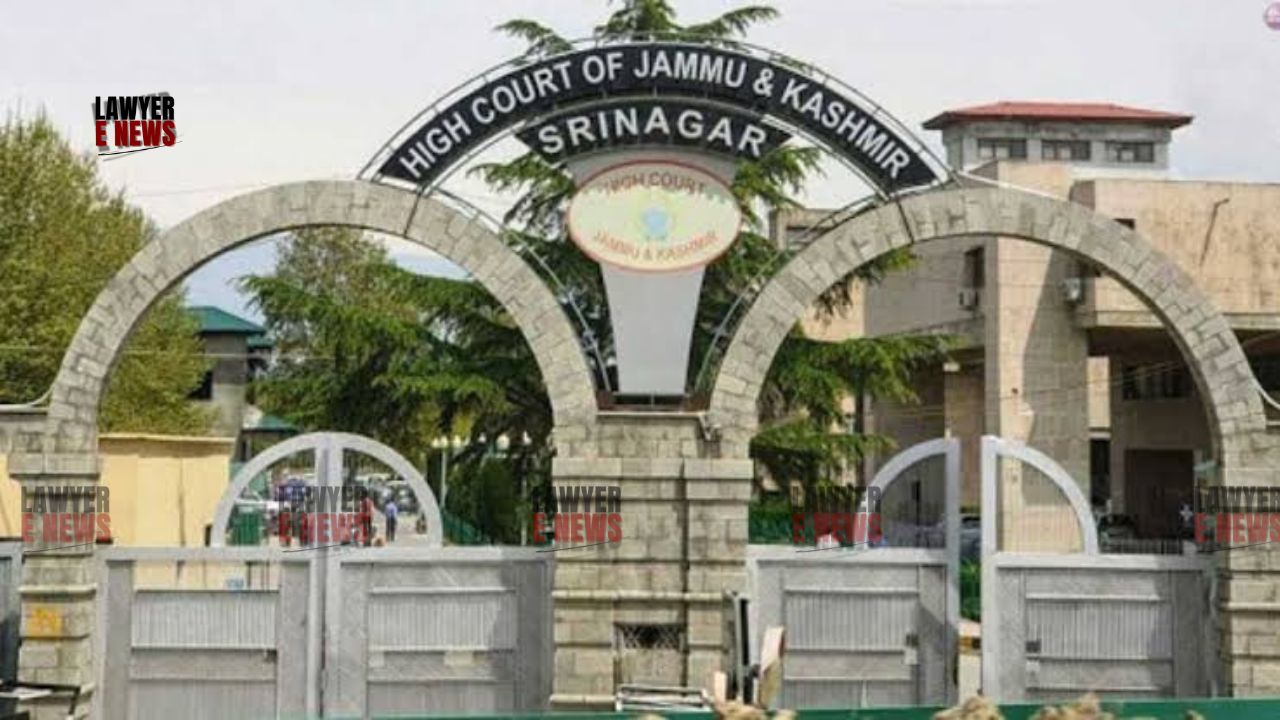
In a significant decision reinforcing the evidentiary threshold required for framing charges under corruption and conspiracy statutes, the High Court of Jammu & Kashmir and Ladakh at Srinagar dismissed a criminal revision petition filed by the Anti-Corruption Bureau (ACB), challenging the discharge of a former Executive Engineer and several others accused of misappropriation of public funds during road construction works under the NABARD scheme.
Justice Javed Iqbal Wani upheld the trial court's order discharging all accused (except one who had passed away), emphasizing that the prosecution had failed to present prima facie material suggesting criminal intent, conspiracy, or fraudulent misuse of official position.
The Court firmly observed: “Administrative deviations or procedural irregularities, absent a shared criminal intent or credible material of illegal gain, cannot sustain a prosecution under Section 120-B RPC or corruption laws.”
“Framing of Charge Requires Grave Suspicion, Not Speculation Based on Deteriorated Work Sites or Delayed FIRs” — Court Rebuffs ACB's Forensic Deficiencies
The case originated from FIR No. 21 of 2012, registered by the Vigilance Organization (now ACB) regarding works executed during 2007–08 and 2008–09 under two road projects: Vizer-Thindum-Kreeri-Tilgam Road and Saloosa-Shrakwara Road. It was alleged that 19 work components were allotted on approval basis without tenders, violating codal procedures, leading to a calculated loss of over ₹5.6 lakh to the public exchequer.
The ACB claimed that contracts were awarded to “blue-eyed” contractors and public funds were siphoned off through inflated rates and volume exaggeration. However, the High Court found that the charges were not borne out by any cogent or prosecutable material, especially in light of contradictory engineering reports and the natural degradation of physical works over 5+ years before FIR registration.
Justice Wani highlighted: “No explanation has been offered for the inordinate delay in registration of the FIR… natural wear and tear of the road works over time made several components non-verifiable, which fundamentally impaired the evidentiary basis of prosecution.”
“Lack of Tendering Alone Is Not a Criminal Offence When Works Are Sanctioned Within Financial Limits” — Court Recognizes Statutory Powers of Executive Engineers
The prosecution had specifically alleged that works were executed without tender and at inflated rates. However, the Court noted that under the Financial Code Entry 36, the Executive Engineer is authorized to approve works up to ₹5 lakh without tender, and all the impugned components fell within this monetary limit.
Thus, the absence of tendering was not per se unlawful. As the Court noted:
“The works in question did not fall beyond the financial powers of the respondent officers. Without material indicating mala fide intent or pecuniary advantage, exercise of statutory powers does not become an offence.”
This observation effectively nullified the foundation of ACB’s allegation that approval-based execution inherently implied misconduct.
“Conspiracy Cannot Be Presumed Without Specific Allegations of Agreement or Shared Criminal Intent” — Discharge Under Section 120-B RPC Justified
Rejecting the charge of criminal conspiracy under Section 120-B of the Ranbir Penal Code, the Court was categorical in holding that:
“Leveling of an allegation of conspiracy without mentioning how, where, and when the conspirators hatched conspiracy and for what purpose… is not enough to constitute an offence.”
Noting that no specific evidence established any prior agreement between officials and contractors to commit illegal acts, the Court found that prosecution allegations amounted to speculative inference and not factual accusation. This deficiency was fatal to the invocation of Section 120-B.
The Court relied on well-established precedent, including Ashoo Surendranath Tewari v. DSP, EOW, CBI, where the Supreme Court had ruled that criminal prosecution is not maintainable when departmental enquiries themselves exonerate the accused.
“Material Brought on Record Fails to Raise Even Grave Suspicion – Revisional Court Cannot Substitute Reasoned Discharge with Speculation”
Citing M.E. Shivalingamurthy v. CBI (2020) 2 SCC 768 and Kewal Krishan v. Suraj Bhan, the Court reaffirmed that discharge is proper where material fails to show even grave suspicion, and that:
“The trial judge is not a post office for prosecution. Mere suspicion, not rising to the level of grave suspicion, mandates discharge.”
It also reiterated that revisional jurisdiction is discretionary, meant for correcting jurisdictional errors or perversity in the trial court’s order. The Court held:
“An order of discharge should not be interfered with unless it is perverse, incorrect on the face of record, perfunctory or glaringly unreasonable. No such case is made out.”
Thus, the High Court declined to act as an appellate forum for reappreciating the ACB’s voluminous but ineffective factual assertions.
“Subsequent Departmental Enquiry Found Rates Justified, No Loss Established” — Clean Chit to Respondents Strengthened by Engineering Audit
In perhaps the most decisive aspect of the judgment, the Court relied on a subsequent departmental enquiry conducted by a Superintending Engineer, which had validated both the execution and the rates used for components 8 and 19—the only two components where loss was originally alleged.
The Court quoted the enquiry to hold that:
“Rate analysis of VOK is not based on general facts and real parameters… rates fixed by the Superintending Engineer were even on the lower side.”
Thus, the technical foundation of ACB’s allegations collapsed, and the Court concluded that criminal prosecution on such grounds would be an abuse of process, citing the principle that criminal charges demand a higher standard of proof than departmental inquiries.
No Prima Facie Case, No Grave Suspicion, No Prosecution
Summing up the legal rationale behind its dismissal of the ACB's revision, the Court stated:
“The impugned order of the trial court is not only well reasoned but also legally sustainable. It does not call for any interference.”
Accordingly, the criminal revision was dismissed, and the trial court's order of discharge dated 2 July 2022 was upheld.
Key Legal Takeaways
From a legal strategy standpoint, the judgment is a critical reminder of several principles vital in defending public officials or professionals against institutional prosecutions:
This decision may offer precedential protection to public servants facing stale and procedurally weak allegations, and stands as a strong reaffirmation of the law’s requirement of prosecutorial precision, not assumption.
Date of Decision: 10 November 2025