-
by sayum
25 August 2026 12:32 PM







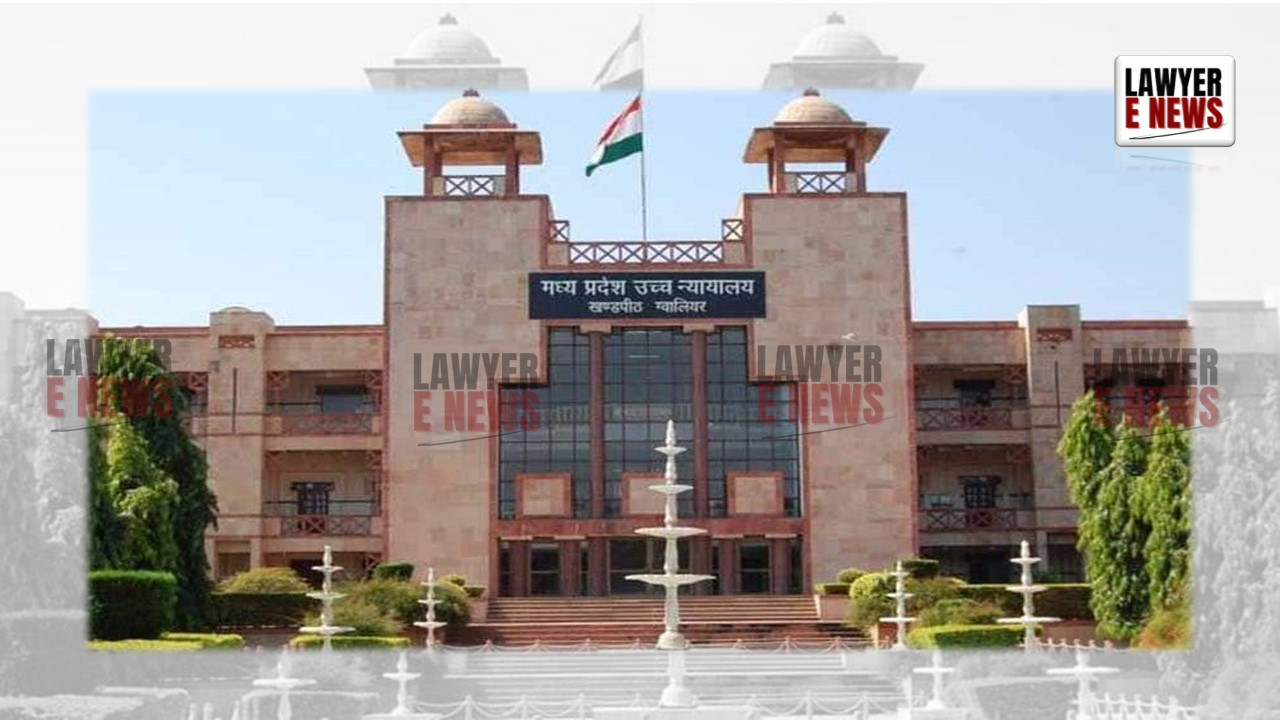
"Reservation Is a Constitutional Right, Not a Matter of Local Acceptance or Assumed Identity" – In a significant ruling reaffirming the strict compliance of caste-based reservations in elections, the Madhya Pradesh High Court at Jabalpur upheld the disqualification of Rajendra Singh, a Member of the Zila Panchayat, Ward No. 3, Raisen, for contesting and occupying a seat reserved for the OBC category without possessing a valid caste certificate.
A Division Bench comprising Justice Vivek Rusia and Justice Pradeep Mittal, while dismissing the writ appeal filed by the appellant, held that a self-declared affidavit claiming OBC status is no substitute for a valid caste certificate, and any person not legally recognised as belonging to a reserved category cannot occupy a reserved seat in a democratic institution.
“By giving a declaration on affidavit about gender, a man cannot contest for a seat reserved for women… Likewise, a candidate from the unreserved category cannot contest for a seat reserved for SC/ST/OBC,” the Court observed, emphasizing the mandatory requirement of proof of caste in cases of reservation.
Writ of Quo Warranto Maintains Democratic Purity Even After Dismissal of Election Petition
The case originated after the election of Rajendra Singh, who had won the Zila Panchayat election from a seat reserved for OBC candidates, was challenged by Respondent No. 6, a local voter, through a writ of quo warranto, despite an earlier election petition filed by the respondent’s wife (an opposing candidate) being dismissed on technical grounds.
The appellant argued that the prior dismissal barred any further challenge and that the High Court had exceeded its jurisdiction by entertaining a fresh petition on the same issue.
Rejecting this argument, the Court held: “The dismissal of an election petition will not come in the way of a voter seeking a writ of quo warranto. Both husband and wife are independent voters and citizens under the Constitution. No right can be conferred by individuals which the person cannot possess under law.”
Citing the Supreme Court’s decision in K. Venkatachalam v. Swamickan [(1994) 4 SCC 526], the High Court reaffirmed the power of constitutional courts to issue writs of quo warranto when a person usurps a public office contrary to law, even after the election process is over.
Possessing Caste Certificate Is Not Optional — It Is a Precondition for Eligibility
The central legal question revolved around whether submitting an affidavit stating caste identity is enough to meet the eligibility criterion for reserved seats under the M.P. Panchayati Raj Avam Gram Swaraj Adhiniyam, 1993 and the M.P. Panchayat Nirvachan Niyam, 1995.
The appellant admitted that:
He does not possess an OBC caste certificate, either at the time of filing nomination or even at the time of hearing.
He claims to belong to the “Pal Baghele” community, which is listed as an OBC in Madhya Pradesh, but the claim is pending verification before the High-Level Caste Scrutiny Committee.
The Court unequivocally held:
“It is an admitted fact that the appellant does not possess the caste certificate of OBC; therefore, there is no declaration by any law that he belongs to the OBC Category. The self-declaration of caste is not sufficient to contest the election.”
It also ruled that local acceptance or lack of objection during nomination scrutiny cannot legalise an otherwise ineligible candidature:
“Although no one raised any objection to the nomination of the appellant, it will not give any right to the appellant to hold the seat reserved for OBC Category, as this would frustrate the very purpose of reservation in the Panchayat elections.”
Constitutional Mandate Overrides Technical Omissions: High Court Affirms Purpose of Reservation
The Bench underscored that reservation in elections is not a mere procedural formality, but a constitutional safeguard to ensure representation of disadvantaged groups. The failure to verify and require a valid caste certificate at the nomination stage does not vest an unlawful right in the candidate who was ineligible from the outset.
“Seats reserved for SC/ST/OBC candidates are exclusively meant for candidates belonging to those respective categories, which is a mandate of the Constitution as well as the Election laws framed by the Central and State Governments.”
The Court further noted that the pending verification of caste status cannot be a reason to allow an ineligible candidate to hold office in the meantime:
“Till the time the appellant receives a valid caste certificate from the High-Level Scrutiny Committee, he cannot claim to belong to the OBC category for electoral purposes.”
Dismissal of Writ Appeal: Seat Declared Vacant
Affirming the impugned order passed by the Writ Court on 09.05.2024 in W.P. No. 17520/2022, the Division Bench dismissed the present writ appeal filed under Section 2(i) of the M.P. Uchcha Nyayalaya Khandpeeth Ko Appeal Adhiniyam, 2005, and upheld the declaration that the appellant is ineligible to hold the office of Zila Panchayat Member.
Accordingly, the seat was declared vacant, and the State Election Commission may proceed to fill the vacancy as per law.
“To Contest Is a Statutory Right, But to Represent Is a Constitutional Responsibility” — Court Guards the Integrity of Local Self-Government
The Madhya Pradesh High Court’s decision reinforces the principle that elected office cannot be usurped on technicalities or omissions, particularly where constitutional mandates like reservation are at stake. The judgment serves as a cautionary precedent for aspiring candidates to secure valid documentary proof of eligibility before contesting from reserved seats and emphasizes that electoral success cannot validate an illegal candidature.
Date of Decision: 09.12.2025