-
by sayum
04 August 2026 1:39 PM







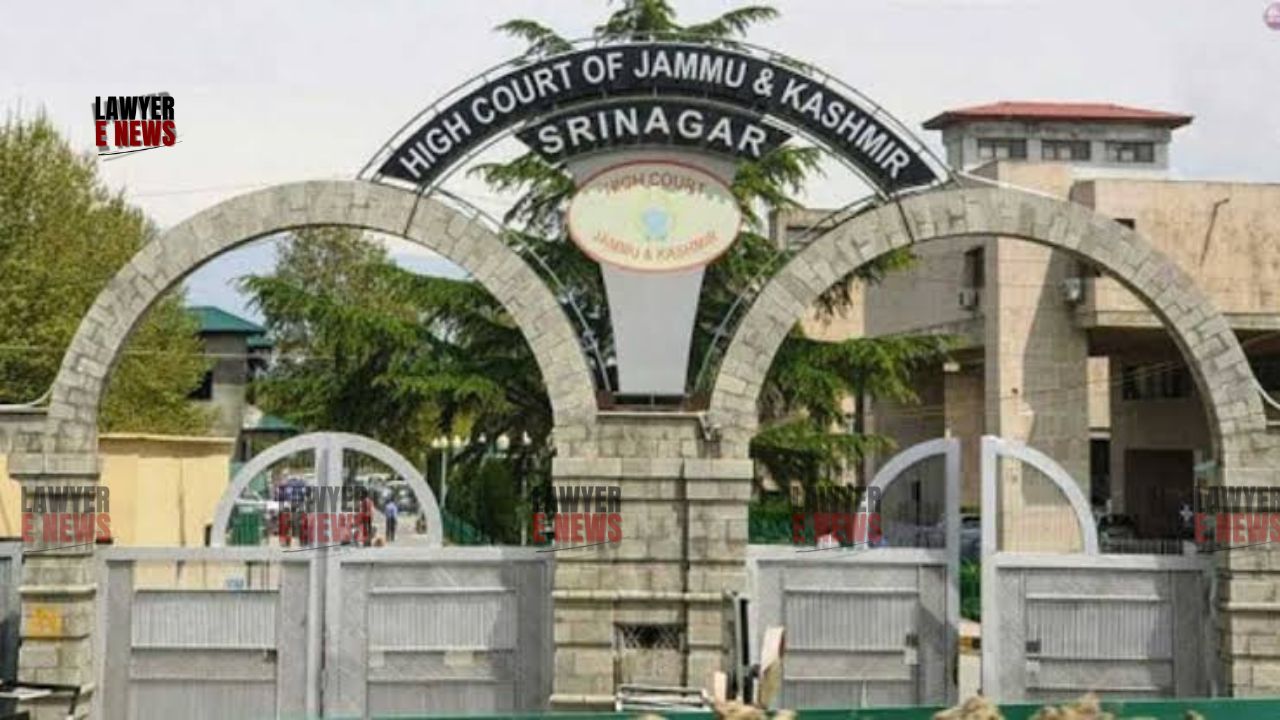
Petitioners Came With “Tainted Hands”: High Court of Jammu & Kashmir and Ladakh at Srinagar, in a sternly worded judgment, dismissed a writ petition at the threshold, holding that the petitioners suppressed the existence of a parallel civil suit on the same issue and attempted to mislead the Court, thereby abusing the writ jurisdiction under Article 226 of the Constitution of India.
The petitioners had challenged the laying of a 33KV transmission line through a residential locality in Baramulla district, citing safety concerns and violations of minimum clearance norms under the Indian Electricity Rules, 1956. However, the Court refused to enter into the merits, finding that the petitioners had failed to disclose material facts, including a pending civil suit on the same subject matter where interim relief had already been granted.
“Writ Jurisdiction Cannot Be Invoked With Unclean Hands”: High Court Slams Petitioners for Misleading the Court
The Court, presided over by Justice Wasim Sadiq Nargal, noted at the very outset that while the petitioners sought a writ of certiorari and mandamus to quash and reroute the transmission line, they withheld the crucial fact that they had already filed a civil suit before the Sub Judge, Pattan, involving identical reliefs—specifically, an injunction against the laying of the transmission line over their land.
The Court observed:
“The omission on part of the petitioners is not a mere oversight, but a deliberate attempt to withhold material information that could potentially influence the Court’s decision.” [Para 25]
This conduct, the Court held, amounted to fraudulent misrepresentation:
“The act of concealing such a significant fact from the Court amounts to an attempt to mislead the judicial process, thereby violating the principles of good faith and transparency.” [Para 26]
Citing several authoritative precedents, including Prestige Lights Ltd. v. SBI (2007) 8 SCC 449, K.D. Sharma v. SAIL (2008) 12 SCC 481, and Dnyandeo Sabaji Naik v. Mrs. Pradnya Prakash Khadekar (2017) 5 SCC 496, the Court reiterated that any person invoking writ jurisdiction must disclose all relevant facts candidly and failure to do so vitiates the entire proceeding.
Civil Suit and Interim Relief Withheld From Court – Parallel Litigation Constitutes Forum Shopping
The High Court recorded that the petitioners were also plaintiffs in a civil suit filed before the Trial Court at Pattan, in which an order of status quo had already been granted against certain respondents. Specifically, by order dated 08.12.2023, the civil court had directed defendant Nos. 4 and 5 to maintain status quo with respect to the suit property. When that order was misinterpreted by the plaintiffs to obstruct other officials, the defendants sought clarification—which was dismissed by the civil court on 29.02.2024, reaffirming the limited scope of the status quo.
Despite being parties to this suit, the petitioners chose to institute a fresh writ petition before the High Court without disclosing the ongoing litigation in their pleadings.
“The petitioners have engaged themselves in a conduct by representing a writ petition before this Court, without revealing the fact of earlier proceedings filed by them and also by relying on false and flimsy grounds...” [Para 26]
The Court made it clear that writ proceedings cannot be used as an alternative or parallel remedy when civil remedies are already being pursued, calling it a classic case of forum shopping.
Transmission Line Issue Falls Within Domain of Technical Evaluation — Court Refuses to Examine Merits
Although the petitioners had raised genuine safety concerns — including the non-observance of the minimum 3.7-meter clearance for high-voltage lines under the Indian Electricity Rules — the Court held that it would not enter into the merits, given the lack of clean hands and pending civil litigation.
“...this Court is not inclined to venture into the merits of the case. After analyzing all the material facts on record... this Court is of the considered view that the instant petition is misconceived, false, frivolous and liable to be dismissed.” [Para 30]
It was noted that the spot inspection revealed the line passing dangerously close — only about 2.5 feet from some houses, posing a safety risk. Even the local Naib Tehsildar and concerned Patwari acknowledged this fact in official reports. Nevertheless, the Court clarified that such issues should be resolved in the pending civil suit, especially where an interim order is already operational.
Petition Dismissed with Exemplary Costs of ₹20,000 for Misusing Judicial Process
In a bid to discourage unscrupulous litigation, the Court dismissed the petition in limine and imposed costs of ₹20,000 on the petitioners, directing the amount to be deposited in the Advocates' Welfare Fund within two weeks.
“The petitioners are burdened with costs of ₹20,000/-, to be deposited by the petitioners in the Advocate’s Welfare Fund... with the sole object to deter such unscrupulous persons... who try to mislead this Court.” [Para 35]
The Registry was directed to list the petition after two weeks solely for the purpose of verifying compliance with the cost order.
In its concluding remarks, the Court echoed a warning previously issued by the Supreme Court in Kusha Duruka v. State of Odisha (2024 SCC OnLine SC 56):
“A litigant, who attempts to pollute the stream of justice or who touches the pure fountain of justice with tainted hands, is not entitled to any relief, interim or final.” [Para 28]
The Jammu & Kashmir High Court has sent a clear message against suppression of facts and abuse of the constitutional writ remedy under Article 226. The judgment reaffirms the foundational rule that litigants must come to court with clean hands and that parallel proceedings will not be tolerated. While legitimate safety concerns were raised regarding the 33KV line, the petitioners’ unethical conduct in hiding the pending civil litigation completely undermined their case. The imposition of costs, though modest, is a symbolic deterrent against forum shopping and procedural deception.
Date of Decision: 12.11.2025