-
by sayum
27 August 2026 3:32 PM







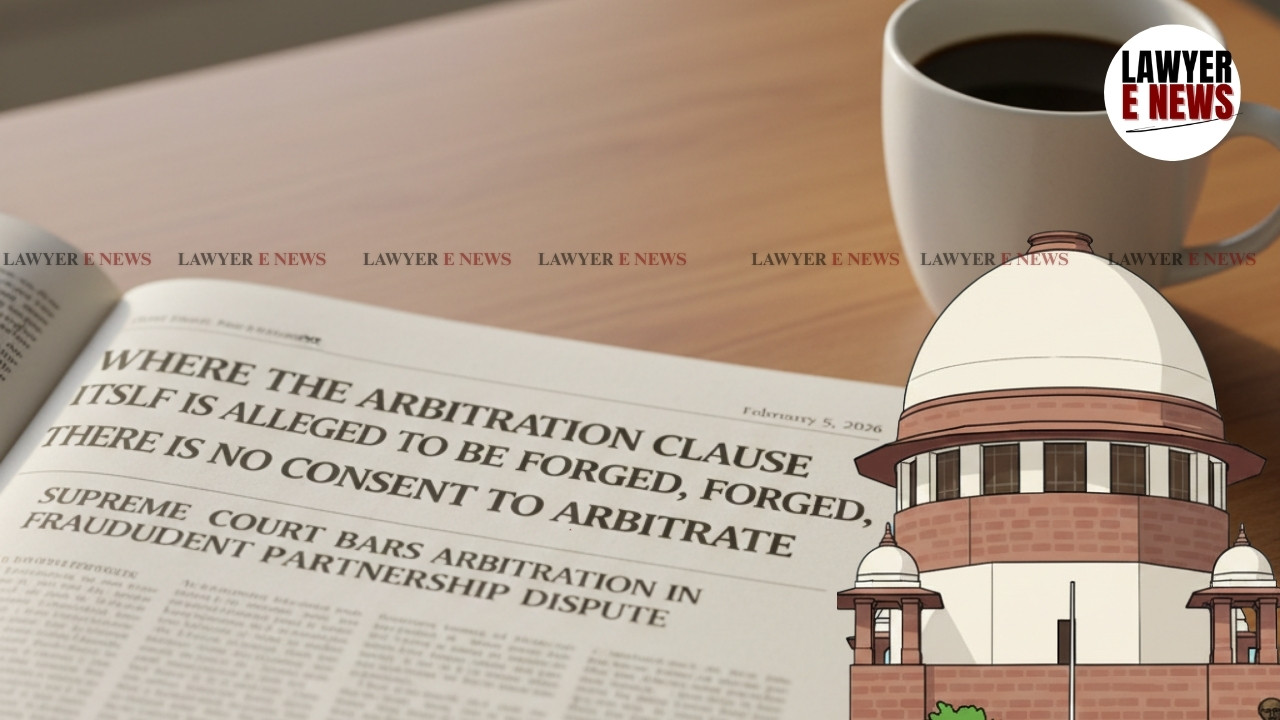
“Arbitration Is Founded on Consent – A Dispute That Strikes at the Root of the Arbitration Agreement Is Non-Arbitrable”, In a judgment that reiterates foundational principles of consent and jurisdiction in arbitration law, the Supreme Court held that serious allegations of fraud that question the very existence of an arbitration clause render the dispute non-arbitrable, even at the preliminary stage. The Court found that where the arbitration clause is embedded in a document alleged to be forged, such a dispute must first be decided by a civil court before the parties can be referred to arbitration.
Bench of Justice Pamidighantam Sri Narasimha and Justice Alok Aradhe delivered two interconnected rulings – dismissing an appeal seeking appointment of an arbitrator under Section 11 of the Arbitration and Conciliation Act, 1996, and setting aside a High Court order that had referred the parties to arbitration under Section 8.
The Court declared:
“Where the arbitration agreement itself is alleged to be forged or fabricated, the dispute ceases to be merely contractual and strikes at the very root of arbitral jurisdiction.”
“No Arbitrator Can Be Appointed Where the Very Existence of Arbitration Agreement Is in Doubt” – Supreme Court Upholds Judicial Gatekeeping on Arbitrability
The dispute arose from a contentious ‘Admission Deed’ dated 17.04.2007, purportedly inducting Rajia Begum as a partner in a firm. The appellant, Barnali Mukherjee, denied executing the deed and alleged it was forged, contending that no arbitration agreement ever existed. Despite the document forming the sole basis for Rajia Begum’s claim and the alleged arbitration clause, neither the original nor a certified copy of the deed was produced in court.
Refusing to refer the matter to arbitration, the Supreme Court observed:
“At the very least, the Admission Deed is under grave cloud of doubt, requiring a detailed and full-fledged inquiry.”
The Court further held that when the arbitration clause does not exist independently but is embedded within a document whose genuineness is itself contested, it would be legally impermissible to appoint an arbitrator.
“Supervisory Jurisdiction Under Article 227 Cannot Be Invoked to Re-Appreciate Evidence or Override Concurrent Findings”
The judgment also sets clear boundaries for the supervisory jurisdiction of High Courts under Article 227 of the Constitution. In this case, the Trial Court and Appellate Court had both rejected the request for arbitration under Section 8 of the Act, finding the allegations of fraud to be serious, and the document to be suspicious.
The High Court, however, reversed these findings in revision, and referred the matter to arbitration. The Supreme Court censured this approach:
“The High Court, while exercising jurisdiction under Article 227 of the Constitution, was not justified in dislodging the concurrent findings… particularly when the very existence of the arbitration agreement was under serious doubt.”
Prior Judicial Determination Under Section 9 Cannot Be Ignored – Findings On Non-Existence of Arbitration Agreement Had Attained Finality
Interestingly, the Supreme Court noted that this was not the first time the Admission Deed’s authenticity was questioned in court. Earlier, Rajia Begum had approached the court under Section 9 of the Arbitration Act seeking interim protection, which was denied by the High Court in 2018, citing the dubious nature of the Admission Deed. That order was affirmed by the Supreme Court, attaining finality.
The Court held:
“While findings in Section 9 proceedings are undoubtedly prima facie in nature, such findings, when they attain finality, cannot be ignored in subsequent proceedings founded on the very same issue.”
Test for Non-Arbitrability Reaffirmed: Does the Fraud Permeate the Arbitration Agreement?
Applying settled jurisprudence from Vidya Drolia, Rashid Raza, and Avitel Post Studioz, the Court reaffirmed that the key test is whether the allegations of fraud go to the root of the arbitration agreement itself.
The Bench cited Managing Director, Bihar State Food and Civil Supplies Corporation Ltd. v. Sanjay Kumar, in which Justice P.S. Narasimha (part of the present Bench) had recently reiterated:
“Serious allegations of fraud with respect to the arbitration agreement itself stand on a different footing... This is generally recognized as a dispute in the realm of non-arbitrability.”
In the present case, the Court concluded:
“The arbitration clause itself cannot be said to exist in a clear case where the party against whom breach is alleged cannot be said to have entered into the agreement at all.”
Circumstances Casting Grave Doubt on the Alleged Admission Deed
In reaching its decision, the Court pointed to several compelling circumstances that supported the appellant’s claim that the deed was concocted:
The Court remarked that such material casts a “serious cloud of doubt” over the deed and the arbitration clause embedded in it.
Arbitration Cannot Be Enforced Without Establishing Consent: Apex Court’s Final Word
Underscoring the foundational principle of arbitration law — consent — the Court drew a clear line:
“Arbitration is founded upon consent. A party may be bound by the arbitral process only if it is first shown, even at a prima facie level, that such a party had agreed to submit disputes to arbitration.”
Referring a dispute to arbitration without first resolving whether any agreement to arbitrate even exists, would not only violate statutory safeguards under Sections 8 and 11 but also undermine the jurisdictional integrity of the arbitral tribunal itself.
High Court's Reference to Arbitration Quashed — No Arbitrator to Be Appointed
Summarizing its findings, the Supreme Court held:
“The dispute relating to the Admission Deed dated 17.04.2007 involves serious allegations going to the root of the arbitration agreement itself and is not amenable to arbitration at this stage.”
Accordingly:
The ruling serves as a strong reaffirmation that courts must act as gatekeepers of arbitral jurisdiction and that fraud which goes to the root of consent cannot be swept aside under the guise of arbitration-friendly policy.
Date of Decision: February 2, 2026