-
by sayum
28 August 2026 6:47 AM







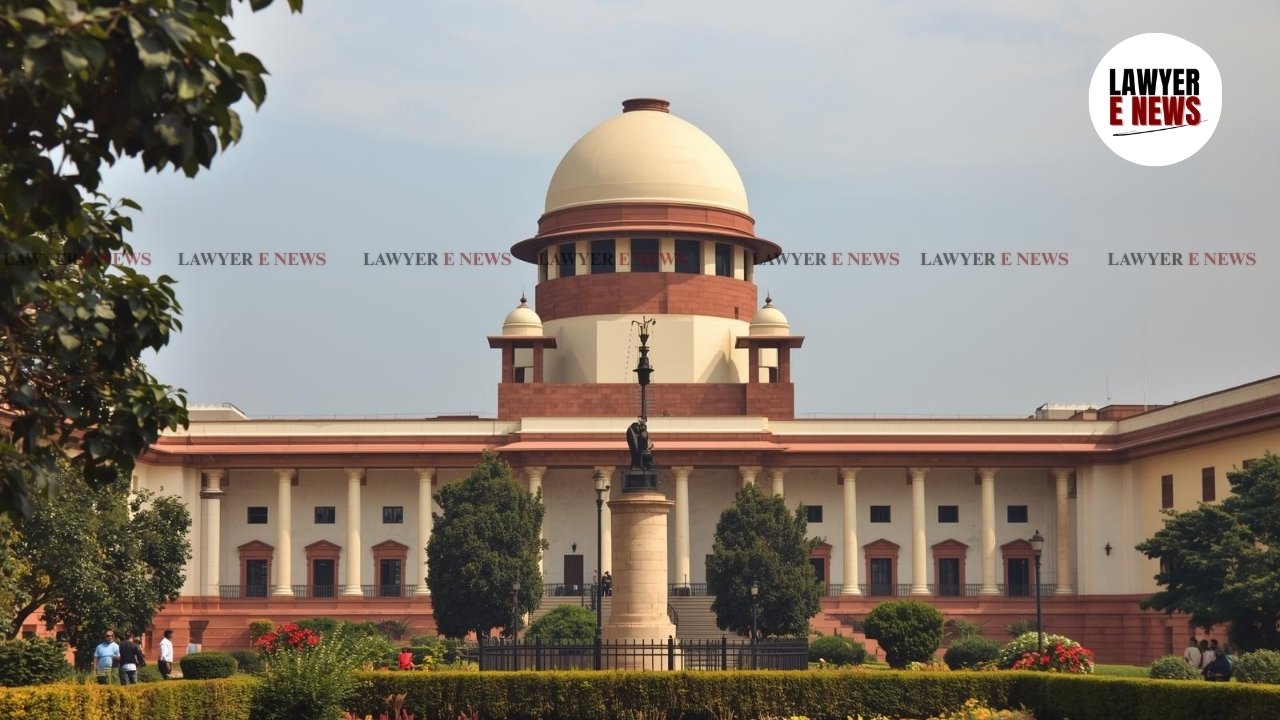
“On the date of the alleged offence, neither the Cement Control Order nor the State licensing regime operated so as to attract penal consequences”, In a powerful reaffirmation that criminal liability cannot survive without a statutory foundation, the Supreme Court of India on 13 February 2026 set aside the conviction of two accused prosecuted for alleged unauthorised possession and diversion of Government quota cement under the Essential Commodities Act, 1955.
Bench comprising Justice B.V. Nagarathna and Justice R. Mahadevan held that as on 24 March 1994 — the date of the alleged raid and seizure — there was no subsisting control order regulating cement under Section 3 of the Essential Commodities Act. In the absence of such an operative order, conviction under Section 7 of the Act was declared legally unsustainable.
The Court allowed the appeals, cancelled the bail bonds and directed refund of fine, observing that the prosecution was “wholly misconceived.”
Alleged Diversion of Government Cement Meant for Public Works
The prosecution case stemmed from a Public Works Department contract for construction of a cement concrete passage on the Kannad–Bahirgaon Road in Aurangabad. The contractor was allegedly supplied 850 bags of cement from Government quota. It was alleged that a portion of this cement was diverted and found stored near premises linked to the appellants.
On 24 March 1994, acting on secret information, police raided two trucks parked near shops allegedly connected with the appellants and claimed recovery of 365 bags of Government quota cement. Additional bags were recovered later.
The appellants were tried and convicted under Section 3 read with Section 7 of the Essential Commodities Act and sentenced to one year’s rigorous imprisonment. The High Court affirmed the conviction, leading to the present appeals.
Was There Any Law in Force to Violate?
Before the Supreme Court, the appellants raised a fundamental legal objection — that by virtue of the Cement Control (Amendment) Order, 1989, price and distribution control of cement had been withdrawn with effect from 01 March 1989.
The amendment notification categorically recorded:
“the Central Government has decided for the removal of price and distribution control of cement with effect from the first day of March, 1989…”
Further, by notification dated 07 August 1990, the Central Government rescinded the delegation of powers to State Governments to regulate retail cement distribution through licensing.
Thus, by 1994, neither the Cement Control Order, 1967 nor the Maharashtra Cement (Licensing and Control) Order, 1973 had operative force in relation to price, storage, or distribution controls.
Penal Provisions Cannot Float in Vacuum
The Bench undertook a detailed analysis of the statutory framework under Sections 3, 5 and 7 of the Essential Commodities Act.
It noted that Section 7 penalises only the contravention of an order made under Section 3. Therefore, the existence of a valid and operative control order is a sine qua non for sustaining a conviction.
The Court recorded:
“On that date, neither the Cement Control Order, 1967 nor the Maharashtra State licensing regime under the 1973 Order operated so as to attract penal consequences under Section 7 of the E.C. Act.”
It further held:
“Significantly, the prosecution has failed to place on record any subsisting control order, notification, or statutory restriction in force on the relevant date, violation of which could constitute an offence under Section 3 of the E.C. Act.”
The Court found that both the trial Court and the High Court committed a fundamental error by focusing solely on appreciation of evidence regarding possession and diversion, without first examining whether any statutory prohibition existed at all.
Reliance on Kolhapur Canesugar: Effect of Omission Without Saving
The Supreme Court relied on the Constitution Bench judgment in Kolhapur Canesugar Works Ltd. v. Union of India (2000) 2 SCC 536, which held that when a statutory provision is unconditionally omitted without a saving clause, it is treated as if it never existed for future purposes.
Quoting the principle, the Court reiterated:
“If a provision of a statute is unconditionally omitted without a saving clause in favour of pending proceedings, all actions must stop where the omission finds them…”
Applying this doctrine, the Bench held that once price and distribution control over cement stood withdrawn in 1989 and State-level licensing powers were rescinded in 1990, prosecution under the Essential Commodities Act in 1994 was legally untenable.
It concluded in unequivocal terms:
“In the absence of any subsisting statutory order under Section 3 of the E.C. Act on the date of the alleged occurrence, a conviction under Section 7 thereof is legally impermissible.”
A Word of Caution: IPC Prosecution Still Possible
While allowing the appeals, the Court made an important clarification. It observed that although prosecution under the Essential Commodities Act could not survive due to decontrol, diversion or dishonest retention of Government-supplied cement could still attract offences under the Indian Penal Code if ingredients were made out.
The Bench noted:
“Acts such as diversion of Government-supplied cement meant for public works, dishonest retention thereof, or unauthorised dealing in such Government property may still attract penal consequences under the Indian Penal Code…”
However, it pointed out that the investigating agency failed to invoke appropriate IPC provisions, and the High Court could not substitute conviction under a distinct offence for the first time in appeal.
The lapse, the Court remarked, lay squarely at the door of the investigating agency.
Holding that the prosecution under the Essential Commodities Act lacked statutory foundation, the Supreme Court allowed the criminal appeals, set aside the conviction and sentence, cancelled bail bonds, and directed refund of fine.
The ruling serves as a reminder that criminal liability cannot be sustained merely on suspicion or factual findings unless supported by an operative statutory prohibition.
Date of Decision: 13 February 2026