
-
by sayum
28 August 2026 8:01 AM







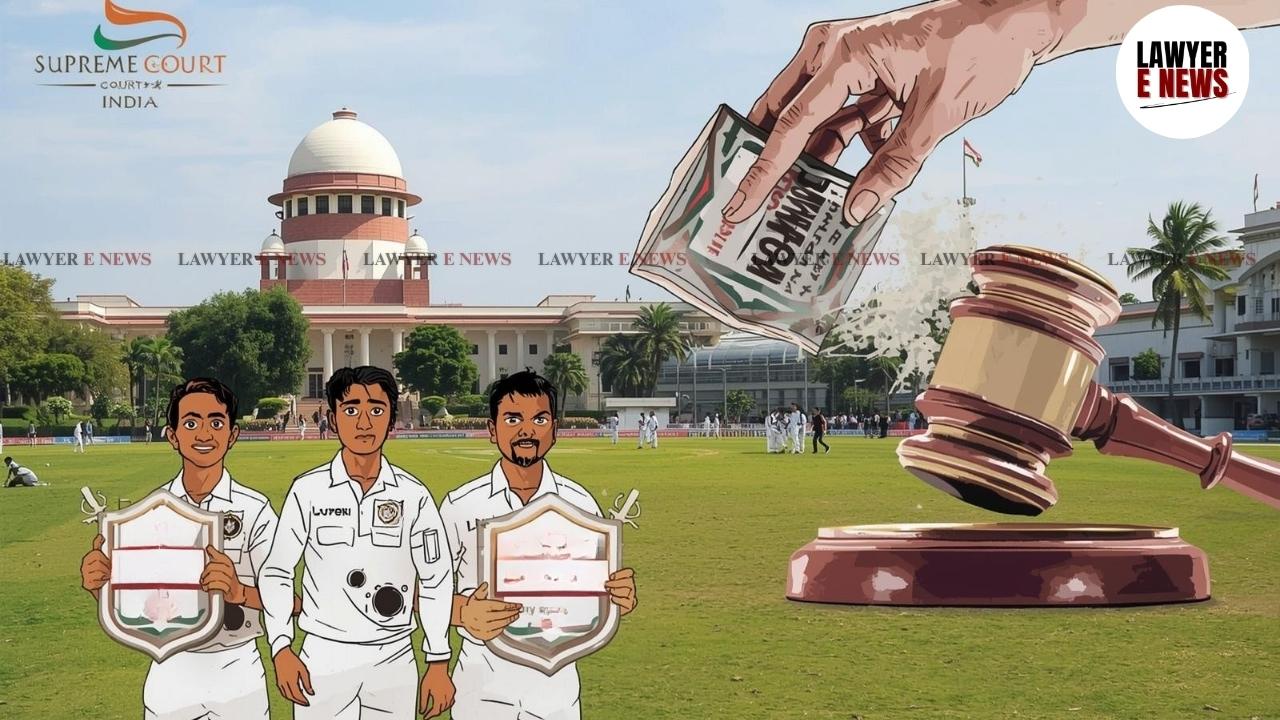
“BCCI Judgment Does Not Warrant District Associations To Model Their Bye-Laws On Exact Lines Of The BCCI Constitution”, On 13 February 2026, the Supreme Court of India delivered a significant ruling on the limits of judicial intervention in sports governance. A Bench comprising Justice Pamidighantam Sri Narasimha and Justice Alok Aradhe held that the sweeping reform directions issued in S. Nithya v. Union of India—including the mandate that 75% of sports association members must be eminent sportspersons and that key office bearers must be sportspersons—cannot automatically be extended to district-level cricket associations governed within the BCCI framework.
Setting aside the Madras High Court’s judgment to the extent it imposed the S. Nithya framework on a district cricket body, the Court reaffirmed that while reform is desirable, judicial review cannot compel structural restructuring in the absence of a binding legal mandate. The appeal was partly allowed, and pending membership disputes were left to be resolved by statutory authorities and the High Court expeditiously.
The appellant, Tiruchirappalli District Cricket Association, established in 1958 and registered under the Tamil Nadu Societies Registration Act, 1975, is affiliated to the Tamil Nadu Cricket Association (TNCA). The litigation arose from two writ appeals before the Madurai Bench of the Madras High Court.
In the first matter, Anna Nagar Cricket Club sought membership and voting rights in the appellant association. While participation in tournaments had already been granted, the High Court held that the club was entitled to voting and membership rights. Before the Supreme Court, the appellant fairly conceded that it had no objection to the club’s voting rights.
The second matter involved a former office bearer who sought directions for conducting fresh elections and for constitutional amendments in line with S. Nithya v. Union of India, a decision of the Madras High Court concerning athletics governance and mandating structural reforms in sports bodies.
The High Court relied upon S. Nithya to direct compliance by the district cricket association, including requirements such as 75% eminent sportsperson membership and sports-person-only office bearers. This reliance became the central issue before the Supreme Court.
The case traversed constitutional principles under Articles 19(1)(c) and 19(1)(g), alongside Directive Principles under Articles 38 and 39(b), and statutory considerations under Section 36 of the Tamil Nadu Societies Registration Act, 1975. The National Sports Development Code, 2011, also featured prominently in arguments.
The key legal questions were:
“Whether the directions in S. Nithya, issued in the context of athletics governance and the National Sports Code, apply to cricket associations governed by the BCCI regime?”
“Whether district cricket associations are bound to restructure their constitutions strictly in conformity with the BCCI Constitution?”
“Can courts, through judicial review, compel district associations to adopt structural reforms not mandated by statute or binding precedent?”
Supreme Court on Applicability of S. Nithya to Cricket
The Court undertook a careful examination of the factual and legal context of S. Nithya, noting that it arose from grievances concerning athletics governance and the implementation of the National Sports Development Code.
The Bench observed that the directions in S. Nithya—including the mandate that “a minimum of 75% of the members of any sports body/organisation/association/NSF shall be composed of eminent sports persons and they shall have voting rights”—were rooted in the peculiar circumstances of athletics administration.
Crucially, the Court held that the sport of cricket stands on a different regulatory footing in light of the Supreme Court’s earlier judgment in BCCI v. Cricket Association of Bihar (2016) 8 SCC 535, where the BCCI Constitution had received judicial approval.
The Court categorically declared:
“There being no prescription or direction in the BCCI judgments on 75% membership in an association to be filled by eminent sports persons… the directions in S. Nithya (supra) would not be applicable to the fact of the present case concerning sport of cricket.”
Thus, the High Court’s application of S. Nithya to a district cricket association was held to be legally unsustainable.
Article 19(1)(c) and Limits of Regulatory Control
Relying on extracts from BCCI v. Cricket Association of Bihar, the Court revisited the contours of the right to form associations under Article 19(1)(c).
Quoting extensively, the Bench reiterated:
“The right guaranteed under Article 19(1)(c) does not extend to guaranteeing to the citizens the concomitant right to pursue their goals and objects uninhibited by any regulatory or other control.”
However, the Court clarified that in BCCI, the restructuring directions did not alter the “initial voluntary composition” of associations. Extending that logic, it held that absent a specific judicial direction or statutory prescription, district associations cannot be compelled to replicate the BCCI Constitution.
The Court noted:
“The judgment in BCCI does not warrant District Associations to model their regulations and bye-laws on exact lines of the BCCI Constitution.”
No material was placed before the Court to demonstrate a binding consensus or judicial mandate requiring district associations to align identically with BCCI’s constitutional structure. Hence, the High Court erred in effectively imposing such restructuring.
Judicial Review in Sports Governance: Reform Through Persuasion, Not Compulsion
While rejecting compulsory judicially enforced restructuring, the Bench adopted a reform-oriented tone.
The Court emphasized that it is “open, rather necessary” for State Associations to initiate reforms ensuring professionalism, transparency, and conflict-free administration at the district level. It underscored the importance of transparency in player selection, contracts, and governance mechanisms.
In a philosophically rich observation, the Court reflected:
“National, international, regional or even mohalla sports in India serve as the Karmabhumi where cohesion and collective purpose take tangible form… embodying the Constitutional value of fraternity.”
The Court further observed:
“It is high time we recognize that sporting ‘facilities and opportunities’ are ‘material resources of the community’, and their organizers are ‘the institutions of the national life’.”
By invoking Articles 38 and 39(b), the Court subtly connected sports governance with distributive justice and equitable access, stressing that sporting revenues and opportunities must not remain concentrated in the “urban economic elite.”
Thus, while declining coercive intervention, the Court left no doubt that reform is a constitutional expectation.
Pending Membership Disputes and Section 36 Inquiry
The Court was informed of pending proceedings under Section 36 of the Tamil Nadu Societies Registration Act, 1975, including a statutory inquiry and related writ petitions concerning life membership and voter lists.
The appellant proposed amendments such as freezing life membership at 179, imposing a three-year voting embargo for new life members, deleting the “family member” category, and ensuring broader representation to clubs.
However, the Bench declined to comment substantively on these proposals in view of pending proceedings.
It directed that the High Court dispose of the writ appeals expeditiously to enable the statutory authorities to complete their inquiry and facilitate elections at the earliest.
The appeal was accordingly partly allowed, and the High Court’s judgment was set aside to the extent it applied S. Nithya to the appellant association.
In this nuanced judgment, the Supreme Court has drawn a careful constitutional line. While reaffirming that sports bodies are not immune from reform, it has cautioned against overextension of judicial directions across distinct regulatory frameworks.
The ruling clarifies that S. Nithya—born in the context of athletics and the National Sports Code—cannot be mechanically applied to cricket associations governed by the BCCI regime. At the same time, district cricket bodies have been reminded that transparency, professionalism, and equitable access are not optional ideals but constitutional imperatives.
The judgment stands as a measured affirmation of associational autonomy under Article 19(1)(c), tempered by constitutional values of fraternity, distributive justice, and good governance.
Date of Decision: 13 February 2026





